

Master the Future of Search: AI-Driven SEO & Generative Engine Optimization (GEO)
Read MoreYour customers are now asking ChatGPT instead of Googling. As an AI SEO Specialist, I can tell you that local businesses like dental practices in Manhattan need to optimize for this new era of AI-powered search. The future of local SEO is Generative Engine Optimization (GEO), and I’m here to show you how to get ahead.
What is GEO and Why Does It Matter?
Generative Engine Optimization (GEO) is the process of optimizing your online presence to rank highly in AI-powered search tools like ChatGPT. These conversational AI assistants are quickly becoming the go-to for consumers seeking local services and information. Unlike traditional Google SEO, which focuses on keyword-rich content and technical site optimizations, GEO requires a more holistic approach that considers how AI systems process and interpret data.
For Manhattan dentists, this means going beyond just ranking for “dentist in Manhattan” and instead focusing on providing AI assistants with the most relevant, trustworthy, and engaging information about your practice. This could include details about your specialties, patient testimonials, service offerings, and even answers to common dental health questions. By optimizing for GEO, you can ensure your practice is the first to appear when a potential patient in Manhattan asks ChatGPT, “Who is the best dentist near me?”
How GEO Differs from Local Business SEO
While traditional local SEO and GEO share some common goals, such as improving visibility in local search results, the underlying strategies are quite different. Local business SEO typically revolves around tactics like Google Business Profile optimization, citation building, and keyword-focused content.
In contrast, GEO is more about understanding how AI systems gather, process, and interpret information. Rather than just stuffing your website with keywords, you need to focus on creating content that is genuinely helpful, authoritative, and engaging. This could include in-depth blog posts, FAQ sections, and even collaborating with the AI SEO Content Bot from AI SEO Offer Hunters to generate high-quality, optimized content at scale.
Additionally, GEO requires a deeper understanding of how AI assistants like ChatGPT function. This includes factors like natural language processing, sentiment analysis, and knowledge graph integration. By aligning your online presence with these AI-centric parameters, you can position your Manhattan dental practice as the go-to choice for local consumers.
How to Optimize for AI Search
Optimizing for AI search goes beyond just creating great content. You also need to ensure your website and online listings are structured in a way that makes it easy for AI systems to understand and surface your information. This includes:
– Implementing schema markup to provide clear, machine-readable data about your services, location, and expertise
– Maintaining an up-to-date and accurate Google Business Profile, as this is a key data source for AI assistants
– Generating a wide range of content, from blog posts and FAQs to video testimonials and virtual tours, to give AI systems a comprehensive understanding of your practice
– Monitoring and responding to online reviews, as AI assistants use sentiment analysis to gauge the trustworthiness of local businesses
By taking a strategic, AI-first approach to your local SEO efforts, you can ensure your Manhattan dental practice is poised to thrive in the era of conversational search.
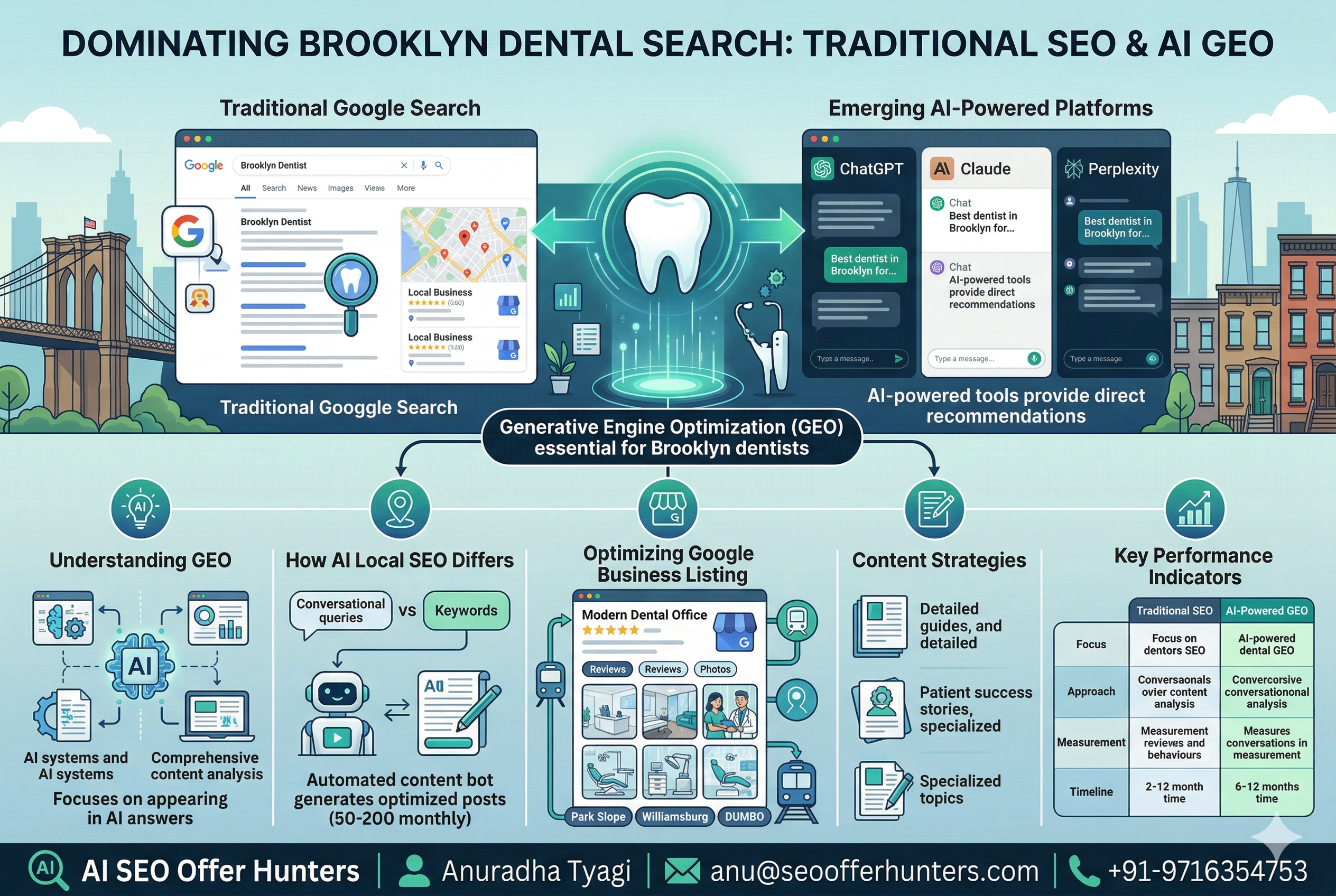
The Future of Local Search: Traditional SEO vs. GEO
Based on the strategic shift for Manhattan dental practices and the data provided, here is the comparative breakdown of how search is evolving.
As you can see, the shift from Google SEO to GEO represents a fundamental change in how local businesses need to approach their online marketing efforts. By partnering with an AI SEO Specialist like those at AI SEO Offer Hunters, Manhattan dentists can stay ahead of the curve and ensure their practice is poised for success in the age of AI-powered search.
| Feature | Traditional Local SEO | Generative Engine Optimization (GEO) |
| Primary Goal | Ranking in Google’s “Blue Links” & Maps | Appearing in AI-generated answers (ChatGPT, Claude) |
| Content Strategy | Keyword-focused: Optimization for specific terms like “Brooklyn dentist.” | Helpful & Authoritative: Conversational content that answers complex patient queries. |
| On-Page Focus | Technical Factors: Meta tags, H1-H3 hierarchy, and site speed. | NLP & Entities: Optimization for Natural Language Processing and entity extraction. |
| Off-Page Signals | Backlinks & Citations: Quantity and authority of external links. | Sentiment & Trust: Analysis of review sentiment and brand trust signals. |
| Measurement | Traffic & Rank: Tracking keyword positions and click-through rates. | Relevance & Quality: Measuring answer quality and conversational mentions. |
| Timeframe | 6–12 Months: Slow build-up of domain authority. | 3–6 Months: Faster recognition as AI models ingest fresh, high-value data. |
FAQ:
What is GEO?
Generative Engine Optimization (GEO) is the process of optimizing your online presence to rank highly in AI-powered search tools like ChatGPT. This involves creating helpful, authoritative content that AI assistants can easily understand and surface to users, rather than just focusing on traditional SEO tactics like keyword optimization.
How do I rank in ChatGPT?
To rank well in ChatGPT and other AI search engines, you need to focus on providing relevant, trustworthy information about your local business. This includes creating in-depth content, maintaining an accurate Google Business Profile, and implementing structured data markup on your website. An AI SEO Specialist can help you develop a comprehensive GEO strategy.
Is Google SEO still important?
While the rise of AI-powered search is transforming the local SEO landscape, traditional Google SEO is still an important part of the equation. Dentists in Manhattan should continue to optimize their websites and online listings for Google, while also adapting their strategies to excel in AI-driven search.
How long does GEO take?
Compared to traditional SEO, which can take 6-12 months to see meaningful results, Generative Engine Optimization (GEO) typically delivers results in 3-6 months. This is because GEO focuses on providing AI assistants with the most relevant and helpful information, rather than just optimizing for keyword rankings.
Can small businesses do GEO?
Absolutely! GEO is particularly well-suited for small and local businesses, as it allows them to directly showcase their expertise, customer service, and unique value proposition to AI-powered searchers. By partnering with an AI SEO Specialist, even a small dental practice in Manhattan can implement a successful GEO strategy.
If you’re a Manhattan dentist looking to get ahead of the AI search revolution, I encourage you to reach out to the team at AI SEO Offer Hunters. Their AI SEO Specialist approach, combined with the power of the SEO AI Content Bot, can help you dominate local search and attract new patients in the age of ChatGPT.