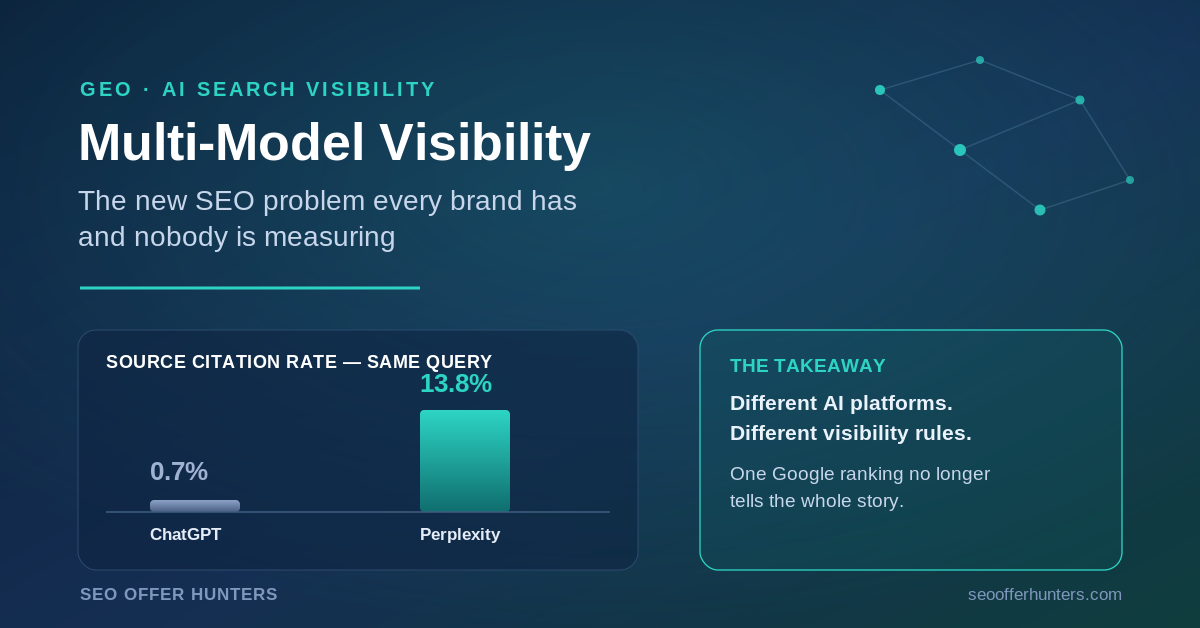
Your brand might be invisible right now, and you would never know it from your analytics. Search Console shows your rankings. Your rank tracker shows your keywords. Your traffic dashboard shows steady visits from Google. Everything looks fine. But none of these tools tell you what happens when someone asks ChatGPT, Perplexity, Gemini,… Continue reading Multi-Model Visibility: The New SEO Problem That Every Brand Has and Nobody Is Measuring
Read More
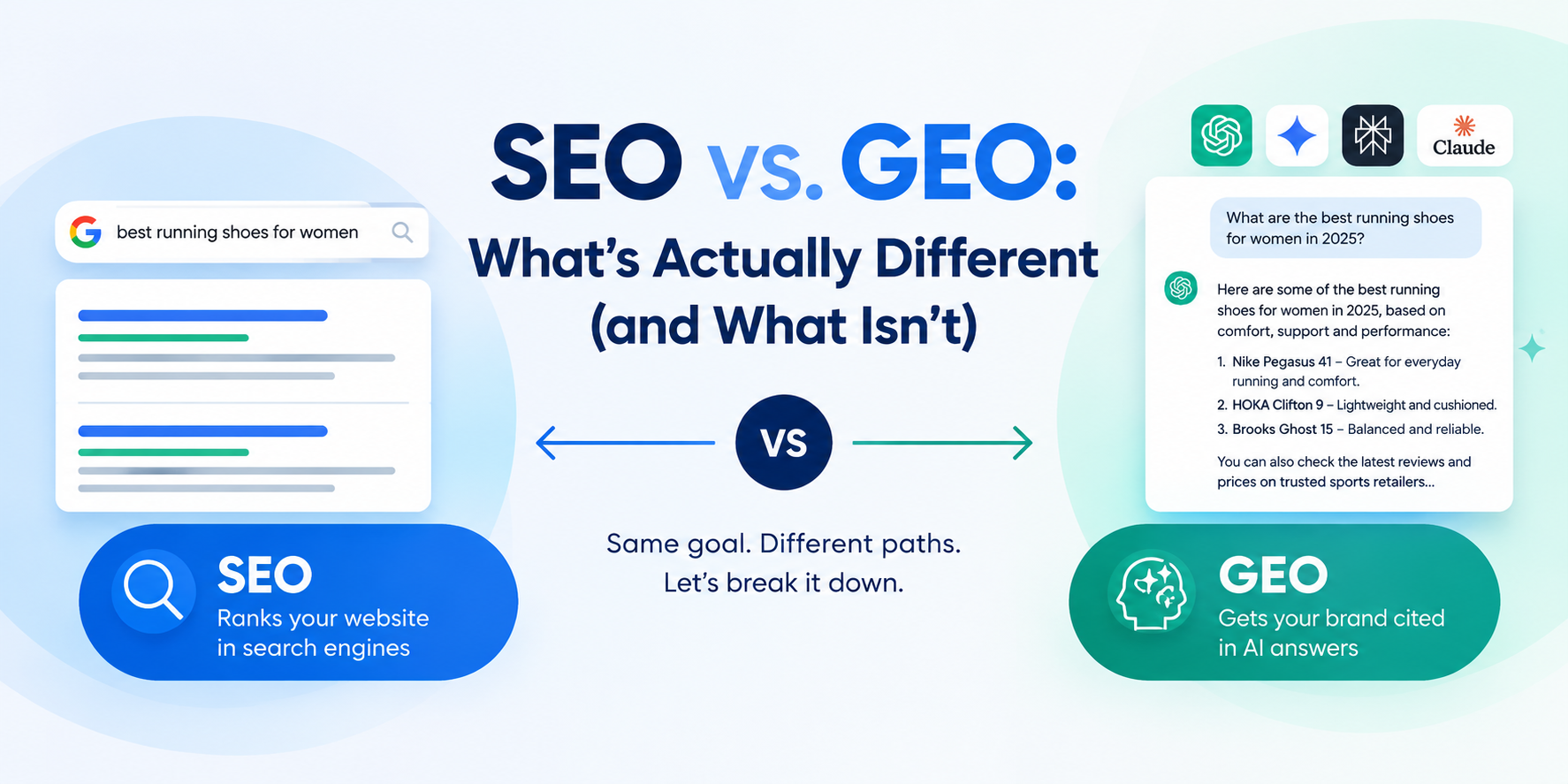
Ask ChatGPT to explain the difference between SEO and GEO, and it will actually attempt an answer. That alone tells you something: this confusion isn’t just marketing noise. It’s common enough that people are asking AI models directly, because the terms get thrown around interchangeably in posts, pitches, and agency decks, often by people who haven’t thought through what’s actually different.
We get some version of this question from almost every client we talk to.
So here’s a straight answer : what’s genuinely difference between SEO and GEO, what actually overlaps more than people assume, and how to think about budget and effort without falling for either extreme — “GEO replaces SEO” or “GEO is just SEO with a new name.”
Where the Confusion Comes From
Both disciplines are, at the surface level, about the same thing: being visible when someone is looking for what you offer. That surface similarity is exactly why the terms get blurred together. But visibility in a list of ten blue links and visibility inside a single AI-generated paragraph are genuinely different problems, solved with overlapping but distinct tools.
Part of the confusion also comes from timing. GEO emerged directly out of SEO practice, built by the same people, often published on the same blogs, using a lot of the same vocabulary — keywords, authority, technical accessibility. That shared language makes it easy to assume GEO is simply SEO’s new coat of paint. It isn’t, and the differences matter for where you actually spend your time.
What SEO Actually Optimizes For
Traditional SEO is built around a specific goal: getting your page to rank high enough in a list of search results that someone clicks through to your site. The entire discipline — keyword targeting, page speed, internal linking, backlink building — exists in service of that click.
That means SEO is fundamentally about your website. Your pages, your technical structure, your on-site content are the primary surface being evaluated. External factors like backlinks matter, but they’re largely functioning as a vote of confidence in your specific pages, feeding into where those pages land in a ranked list.
The output of good SEO is a click. Someone searches, sees your result, chooses it over the others, and lands on your site. Everything downstream of that — conversion, engagement, retention — is a separate discipline. SEO’s job ends at getting them to click.
What GEO Actually Optimizes For
GEO is built around a different goal entirely: getting an AI model to mention your business, by name, inside the answer it generates — without necessarily sending anyone to your website at all. The person asking ChatGPT or Perplexity a question often gets a complete answer without ever clicking through anywhere.
That single difference reshapes everything downstream. Because there’s often no click to compete for, GEO isn’t primarily about ranking your page above someone else’s. It’s about being confident enough, well-documented enough, and consistently described enough that a model is willing to say your name out loud as part of its answer.
This is also why GEO pulls in sources SEO mostly ignores. An AI model deciding whether to recommend you draws on reviews, forum discussion, third-party mentions, and directory consistency — signals that live off your website entirely. SEO cares what’s on your pages. GEO cares what’s said about you everywhere, including places you don’t control.
The Real Differences, Side by Side
Goal: SEO aims for a click. GEO aims for a citation, often with no click involved at all.
Primary surface: SEO is mostly about your own website. GEO weighs your website alongside reviews, third-party mentions, and off-site consistency just as heavily, sometimes more.
What “ranking” means: SEO has a visible, ordered list — position one through ten. GEO usually has no visible ranking at all; a model either names you or it doesn’t, often alongside just two or three competitors.
Update cycle : Google’s index updates constantly and can reflect a change within days. AI models are shaped by training data and periodic retraining, so shifts in what a model “knows” and recommends can lag well behind reality, sometimes by months.
Measurement: SEO has mature, standardized tools — rankings, impressions, click-through rate, all trackable in Search Console. GEO measurement is still young; tracking whether and how often you’re mentioned across AI platforms is possible but far less standardized.
Content format that wins: SEO tends to reward comprehensive, well-structured pages built around a target keyword. GEO tends to reward direct, extractable answers — content that states a clear fact or conclusion early, in a form a model can quote or paraphrase cleanly.
What’s Actually the Same
This is the part that gets lost in most “SEO vs GEO” content, and it’s arguably more useful than the differences: a large share of what makes content work for SEO also makes it work for GEO.
Genuinely useful, original content — not rehashed, not templated — performs better in both. Clear writing and logical structure help both a human skimming a page and a model parsing it for an answer. E-E-A-T signals — real authorship, demonstrated expertise, accurate information — matter to Google’s ranking systems and to whether an AI model trusts a source enough to cite it.
Structured data is another genuine overlap. Schema markup that helps Google understand a page’s content also helps AI systems parse it more reliably. Topical authority — being the site that consistently, credibly covers a specific subject — helps you rank in Google and helps a model treat you as a trustworthy source on that topic.
The honest takeaway: you are not choosing between two unrelated skill sets. You’re taking a shared foundation of quality, clarity, and credibility, and then layering two different sets of additional work on top — one aimed at ranking pages, one aimed at earning citations.
Why This Keeps Coming Up Inside ChatGPT Itself
It’s worth pausing on the detail we opened with: people are genuinely asking AI models to explain the difference between SEO and GEO. That’s a useful signal in itself. It means the confusion isn’t isolated to a few marketing blogs — it’s common enough, and current enough, that it’s become one of the questions people expect an AI assistant to be able to answer cleanly.
It also says something about where we are in this shift. Categories that are fully settled don’t generate this many “what’s the difference” questions. SEO versus GEO is still being worked out in real time, by practitioners and by the platforms themselves, which is exactly why a clear, honest answer is worth more right now than another vague comparison piece.
Do You Need a Separate GEO Strategy?
For most businesses, the honest answer is: not a separate strategy from scratch, but a real, deliberate addition to what you’re already doing. If your SEO foundation is solid — genuinely useful content, clean technical structure, real expertise behind what you publish — you’re not starting GEO from zero. You’re extending that same foundation into off-site trust signals and answer-ready content formatting.
Where a dedicated GEO effort becomes necessary is the off-site half: actively earning reviews, seeking genuine third-party mentions, fixing directory and NAP consistency, adding structured data specifically aimed at making your content extractable. None of that happens as a side effect of good on-page SEO. It requires its own attention.
The businesses that get this wrong tend to make one of two mistakes: assuming great SEO automatically produces AI visibility, or assuming GEO is a totally separate discipline requiring a total content rebuild. Neither is accurate. It’s shared foundation, plus a distinct layer of additional work.
A Practical Way to Think About Budget and Effort
If you’re deciding where to put time and budget, a simple framing helps: SEO work protects and grows the traffic you already get from search. GEO work builds visibility in a channel that’s growing but where you’re likely starting from near zero, competing against businesses that haven’t yet fully invested there either.
That second point matters more than it sounds. Because AI search visibility is still relatively new territory for most industries, the gap between “invested” and “not invested” is currently wider than it is in mature Google SEO, where most competitors are already doing the basics. There’s more room to move quickly in GEO right now than there typically is in a fully mature SEO landscape.
A reasonable starting split for most small and mid-sized businesses: keep maintaining the SEO fundamentals that are already working, and direct new effort specifically toward the off-site, citation-focused work GEO requires — since that’s the part least likely to already be happening on its own.
Frequently Asked Questions
Is GEO just a rebrand of SEO?
No. They share a foundation of quality content and technical accessibility, but they optimize for different outcomes — a click versus a citation — and GEO leans much more heavily on off-site signals like reviews and third-party mentions.
Will good SEO automatically improve my GEO visibility?
It helps, since the two share real overlap, but it isn’t automatic. The off-site trust signals AI models weigh heavily — reviews, mentions, directory consistency — don’t improve just because your on-page SEO is strong.
Do I need to rewrite all my content for GEO?
Usually not entirely. Existing high-quality, well-structured content is a solid foundation. What often needs adjusting is making key facts and conclusions more direct and extractable, rather than buried several paragraphs in.
How is GEO actually measured, since there’s no ranking position?
It’s measured by testing real queries across AI platforms and tracking whether, how often, and how favorably your business gets mentioned. It’s less standardized than SEO tracking, but it is measurable.
Which one should a small business prioritize first?
If your basic SEO foundation is already weak — unclear content, poor technical structure — fix that first, since it underpins both. If that foundation is solid, GEO-specific work is often where the more available opportunity currently sits.
Does paid advertising fit into either of these?
No, both SEO and GEO are organic disciplines. Paid search and paid placement are separate strategies that can run alongside either one, but they don’t substitute for the underlying visibility work described here.
Why does ChatGPT get asked to explain its own category confusion?
Because the SEO/GEO distinction is still actively being worked out across the industry, including by the AI platforms themselves. It hasn’t fully settled into shared, standard terminology yet, which is exactly why direct explanations are still in high demand.
Published by AI SEO Offer Hunters | seoofferhunters.com | GEO & AI Search Visibility Specialists