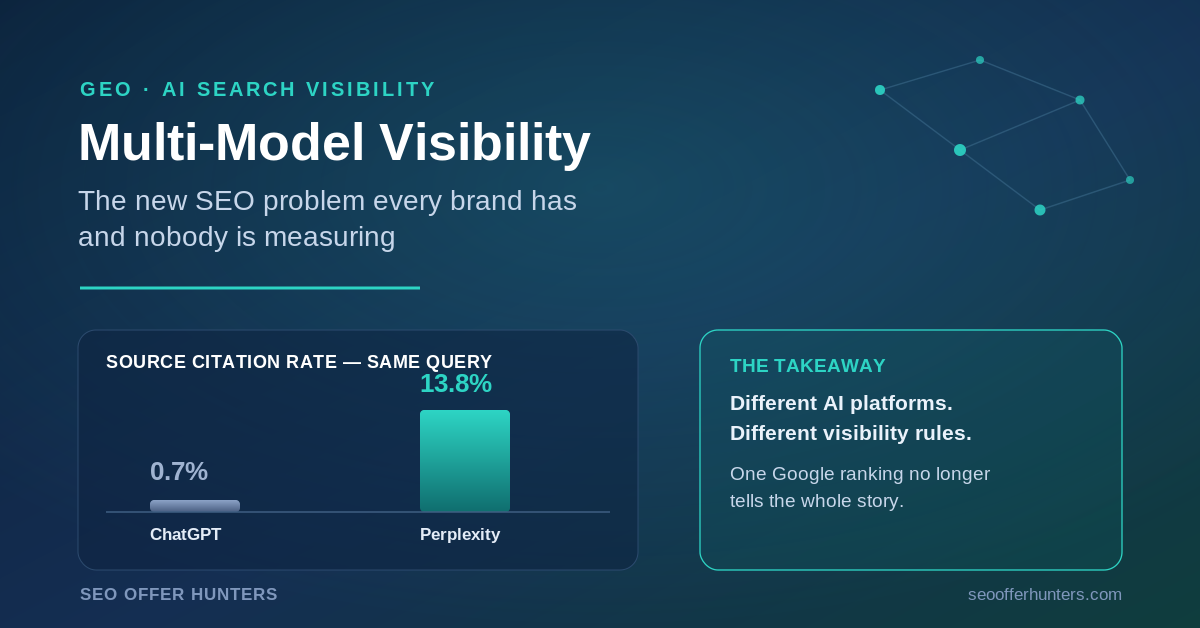
Your brand might be invisible right now, and you would never know it from your analytics. Search Console shows your rankings. Your rank tracker shows your keywords. Your traffic dashboard shows steady visits from Google. Everything looks fine. But none of these tools tell you what happens when someone asks ChatGPT, Perplexity, Gemini,… Continue reading Multi-Model Visibility: The New SEO Problem That Every Brand Has and Nobody Is Measuring
Read MoreHere’s something that actually happened last week.
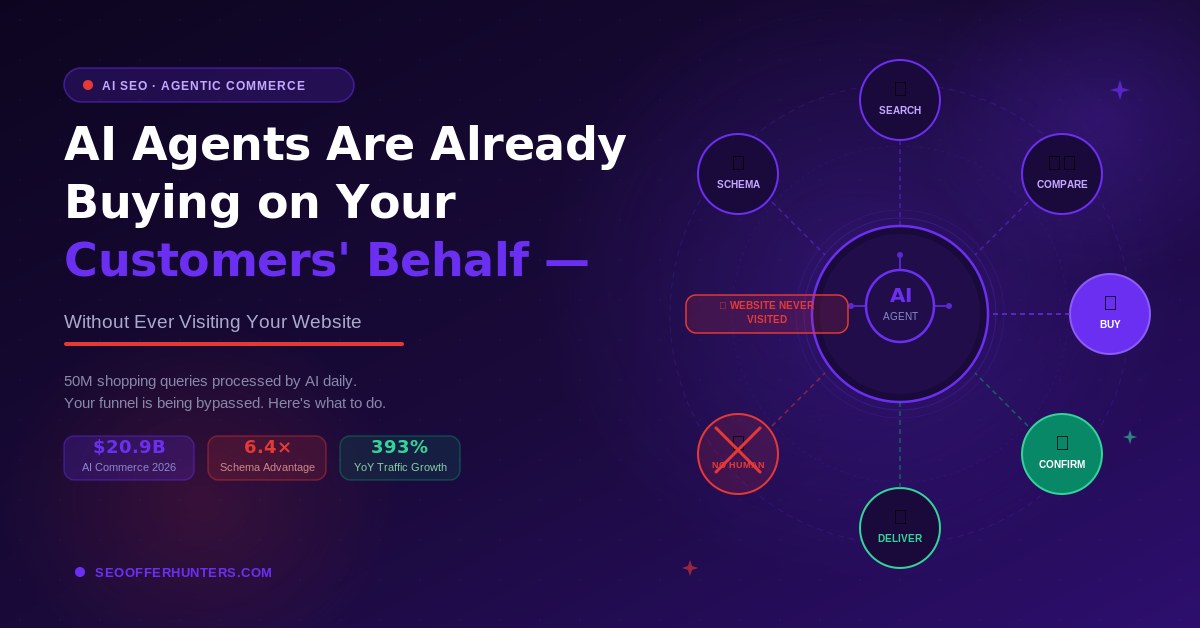
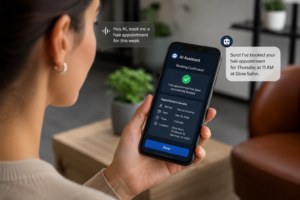
A business owner in Manchester told her phone: “Book me a same-day plumber — reliable, under £120, available after 2pm.” She didn’t search Google, scroll through Checkatrade, or visit a single website.
Her AI assistant found three plumbers. It compared their pricing and availability, checked online reviews, and booked the most trusted one — all in 40 seconds.
That winning plumber never knew a customer had entered his funnel. The AI skipped his landing page entirely. Nobody read his about page. All those carefully written testimonials? The AI ignored them completely.
The losing plumber got the same experience — just from the other side.
Welcome to agentic commerce. It isn’t something coming in the future. Today, it already processes 50 million shopping and service queries every single day.
The losing plumber got the same experience — just from the other side.
Welcome to agentic commerce. It isn’t something coming in the future. Today, it already processes 50 million shopping and service queries every single day.
The Numbers That Should Make Every Business Owner Pay Attention
Let’s start with the data, because this is moving faster than most people realize.
| Stat | What it means |
|---|---|
| $20.9B | AI platforms will drive this much retail spending in 2026 alone — nearly 4× the 2025 figure (eMarketer, 2026) |
| $3–5T | McKinsey’s estimate for global spend flowing through agentic commerce by 2030, with $1 trillion from the US alone |
| 393% | Year-on-year growth in AI-referred retail traffic in Q1 2026 — the fastest-growing traffic source in digital commerce history |
| 73% | Share of consumers already using AI somewhere in their shopping journey — for ideas, comparisons, or review summaries |
| 6.4× | How much more likely AI agents are to select a business with complete Schema.org markup (LLMRecommend.com, Q1 2026) |
| 42% | Better conversion rate for AI-referred visitors versus traditional search — they arrive already decided |
Sit with that last number for a moment. Customers who arrive at your business after an AI recommended you convert 42% better than those who found you through Google. They come pre-sold. They’ve already had the AI do the research, ask the questions, and weigh the options. By the time they reach you, the decision is nearly made.
Now think about how many of those customers you’re missing because the AI didn’t know your business existed, or couldn’t read the data it needed to make a recommendation.
Who’s Actually Building This — And Why It Matters for Your Business
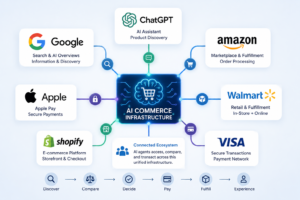
This isn’t a single company’s experiment. Every major technology player on earth is building AI-agent commerce systems simultaneously. Here’s what’s already live:
| Platform | What it does | Who it affects |
|---|---|---|
| 🤖 ChatGPT / OpenAI | Shopping discovery, comparison, product recommendations — users complete purchases via redirect to merchant | E-commerce, SaaS, service bookings |
| 🛒 Amazon Rufus | Autonomous product research and purchase recommendation within Amazon’s ecosystem | Product sellers, Amazon marketplace brands |
| 🔍 Google Buy for Me | Autonomous comparison and purchase across Google Shopping — direct checkout being developed | Any business indexed in Google Shopping |
| ⚡ Perplexity Buy with Pro | Research + buy in one interface — Perplexity finds, evaluates, and initiates purchase for Pro subscribers | E-commerce, subscriptions, service providers |
| 🍎 Apple Intelligence | Siri now uses AI to find and recommend local services, products, and bookings for iOS users | All local businesses, service providers |
The Shared Foundation Underneath It All
Beyond individual apps, the entire industry is also building shared standards so all these agents can work together seamlessly:
Agentic Commerce Protocol (ACP) — Created by Stripe and OpenAI, this powers ChatGPT Shopping. It allows AI agents to check prices and complete purchases directly with merchants.
Universal Commerce Protocol (UCP) — Launched at NRF 2026 by Google, with Walmart, Visa, Mastercard, Shopify, Target, Etsy, and Wayfair as founding members. It establishes an open standard for AI agents to communicate with any merchant, across the entire purchase journey.
When those companies align on the same infrastructure simultaneously, you’re no longer watching a technology trend. Instead, you’re watching commerce itself restructure from the ground up.
Your Website Is Not Part of This Decision
Here’s the uncomfortable truth most business owners haven’t fully accepted yet.
AI agents don’t behave like human shoppers. There’s no browsing your homepage, no clicking through your about page, and no watching your founder video. An agent won’t notice your brand new website redesign or care about your colour scheme.
Instead, an AI agent reads structured data. That’s the only thing it examines.
Structured data is the machine-readable layer beneath your website. It tells AI exactly what you sell, what it costs, where you are, and what customers think of you. Humans never see it. However, every major AI engine reads it before it looks at anything else.
What Structured Data Actually Looks Like
Research from LLMRecommend.com (Q1 2026) found a clear pattern: businesses with all six Schema.org data types active are 6.4 times more likely to get selected by an AI agent. Here are the six types:
- Product / Service — What you sell, described in terms a machine can read
- Offer — Your price, availability, and purchase conditions
- AggregateRating — Your average review score from verified sources
- Review — Individual customer reviews in structured form
- FAQPage — Common questions with direct, clear answers
- ReturnPolicy / ServiceGuarantee — Your refund terms or service guarantees
Most businesses only have Product and Offer set up. Sometimes they also add AggregateRating. The remaining three are absent from nearly every website — and those missing types are exactly what separates businesses AI recommends from businesses it ignores.
Four More Signals That Influence Every AI Recommendation
Schema is the most measurable factor, but agents also evaluate four additional signals:
Consistent business information — Does your name, address, and phone number appear identically across Google, Yelp, LinkedIn, and your website? Inconsistency makes AI agents uncertain about your business.
Third-party mentions — Has a trusted publication, directory, or review platform referenced your business? External sources carry far more weight than anything published on your own site.
An llms.txt file — A page you publish at yourdomain.com/llms.txt that tells AI crawlers exactly who you are and what you offer. Think of it as a cover letter written directly for the AI.
Online booking or purchase access — Can an AI agent check your availability and complete a booking without human help? Without this, agents move to competitors who allow it.
The Old Marketing Funnel Is Being Cut Short
This is the business consequence that most people aren’t discussing loudly enough yet.
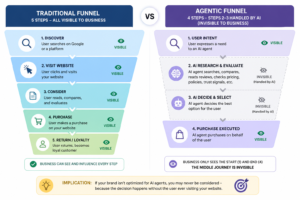
The traditional sales funnel has five clear stages: a customer spots a need → searches Google → finds your listing → lands on your website → browses and eventually buys.
For 20 years, digital marketing focused on optimising every stage of that process. Better rankings, stronger ads, smarter landing pages, sharper offers — all of it designed to move people through step by step.
What the Agentic Buying Journey Looks Like Instead
The agentic process skips most of those stages entirely:
- A customer identifies a need
- They ask their AI assistant
- The AI selects a business and initiates contact or purchase
- The customer confirms
Your Google ranking plays no role here. The landing page gets bypassed. Retargeting campaigns never activate. Your welcome email sequence never fires, and the brand identity you’ve spent years building? The AI never looks at it.
By the time the customer appears, an AI has already made the choice for them. None of your conversion tools ever had a chance to work.
Here’s the twist: this is actually a better experience for the customer. They receive a fast, relevant recommendation from a business the AI has already screened for quality. However, for businesses not set up to appear in this process, it’s completely invisible.
An Honest Picture of Where We Are Right Now
Let’s be clear about the nuance here, because this is genuinely new territory.
73% of shoppers already use AI somewhere in their buying journey. Nevertheless, only 14% trust AI to complete a full purchase on their behalf. As a result, the pattern most buyers follow today looks like this:
- “ChatGPT, which of these three accountants should I call first?” → AI researches; the buyer then makes the call
- “Perplexity, find me project management software under $50/month for 10 people” → AI finds options; the buyer visits the winner
- “Alexa, book a cleaner for Saturday morning” → AI completes the whole task; the buyer simply confirms
The first two examples are fully mainstream right now. The third grows every month. Crucially, in all three cases, any business that didn’t appear in the AI’s shortlist lost the customer — whether the AI completed the purchase or simply filtered the options.
Even when a human makes the final call, the shortlist is already set. And that shortlist turns entirely on schema data, entity signals, and citation authority.
5 Steps to Make Your Business Agent-Ready
Good news: none of this requires rebuilding your website. Here’s where to focus your energy instead.
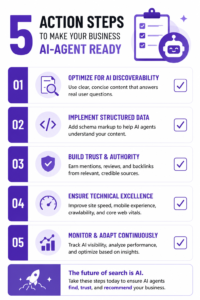
1. Complete your Schema markup. Most businesses only have Product and Offer. Add the missing four types — Review, AggregateRating, FAQPage, and ReturnPolicy or ServiceGuarantee. Completing all six makes your business 6.4 times more likely to appear when an agent is choosing between options in your category.
2. Publish an llms.txt file. Place it at yourdomain.com/llms.txt and describe your business in plain language — who you are, what you sell, and what makes you different. Most competitors haven’t done this yet, so even a basic version gives you an immediate advantage.
3. Make your information consistent everywhere. Check your business name, address, phone, and hours across Google Business Profile, Yelp, Facebook, LinkedIn, and your website. Every version should match exactly. Consistency signals to AI agents that your business is real and trustworthy.
4. Earn mentions from sources AI trusts. AI agents don’t rely on your word — they look to third parties. Get listed in relevant directories, earn coverage in industry publications, and build your presence on trusted review platforms. Each external mention strengthens the AI’s confidence in recommending you.
5. Let AI access your business directly. For service businesses, ensure your booking system works through a structured link or API. For product businesses, keep pricing and availability data current and publicly accessible. Businesses that allow direct machine access get prioritised over those that don’t.
The Window Is Open — But It Won’t Stay That Way
Here is the honest reality in 2026.
Most businesses haven’t taken any of these steps. The majority of websites still carry incomplete schema. Plenty haven’t heard of llms.txt. Many don’t know that Amazon Rufus already recommends products to millions of people each day — based entirely on structured data, not website design.
That gap is your opportunity. Getting agent-ready right now puts you ahead of roughly 90% of businesses in your category. Acting today costs a few days of technical work and some focused content updates.
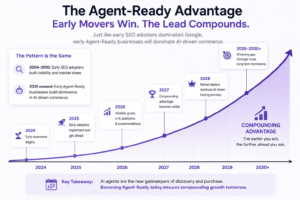
Waiting, however, carries a different cost. As more businesses implement these signals, the first-mover advantage narrows. Furthermore, the businesses that establish strong agent-readable content in a category early become the default recommendation over time — AI systems reinforce them, making them progressively harder to displace.
This mirrors what happened with search engine optimisation in 2004. Early movers built compounding advantages that lasted years. Late arrivals paid more for smaller results.
| Businesses NOT ready for agents | Businesses THAT ARE agent-ready |
|---|---|
| Invisible to AI-mediated purchase decisions | Selected by AI before competitors are considered |
| Bypassed before the human even decides | Receive 4x higher-converting referral traffic |
| Marketing budget reaches a shrinking audience | Gain compounding citation authority over time |
| Losing high-intent customers to agent-ready competitors | Revenue grows from a channel most competitors ignore |
The Bottom Line
Agentic commerce is not a future concern you can put on next year’s strategy roadmap. It’s live, it’s growing at 393% year-over-year, and it processes tens of millions of shopping and service queries every single day.
The businesses getting chosen in those queries are not necessarily the best businesses. Rather, they’re the businesses that published the right structured data, built their entity signals, and made themselves readable to machines.
That’s the new competitive reality. Your customer isn’t just a human anymore. Their AI assistant is the new gatekeeper — and it decides whether to recommend you or your competitor based on signals most businesses haven’t even thought about yet.
| The good news: most of your competitors haven’t done this yet either. The window is open. The question is whether you’re going to be the business that claims this ground — or the one that watches a competitor do it instead. |
Want to Know If Your Business Is Agent-Ready?
We audit AI agent readiness across schema, entity authority, llms.txt, citation signals, and agentic commerce platform integration — then build the strategy to fix every gap we find.
Published by AI SEO Offer Hunters | seoofferhunters.com | GEO & AI Search Visibility Specialists