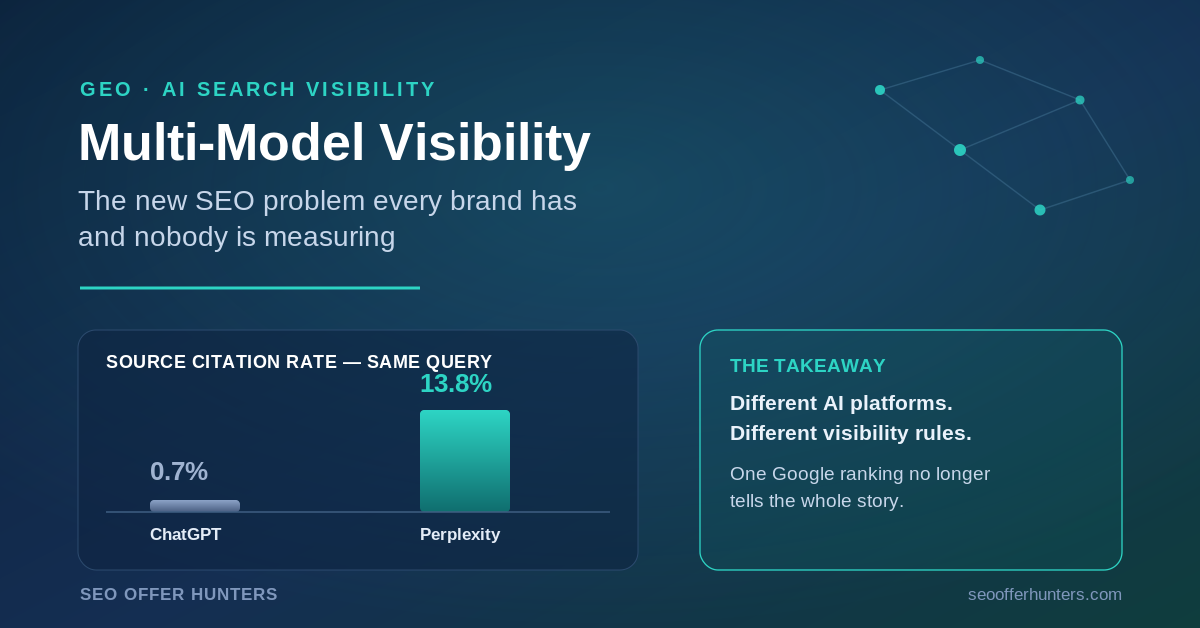
Your brand might be invisible right now, and you would never know it from your analytics. Search Console shows your rankings. Your rank tracker shows your keywords. Your traffic dashboard shows steady visits from Google. Everything looks fine. But none of these tools tell you what happens when someone asks ChatGPT, Perplexity, Gemini,… Continue reading Multi-Model Visibility: The New SEO Problem That Every Brand Has and Nobody Is Measuring
Read More
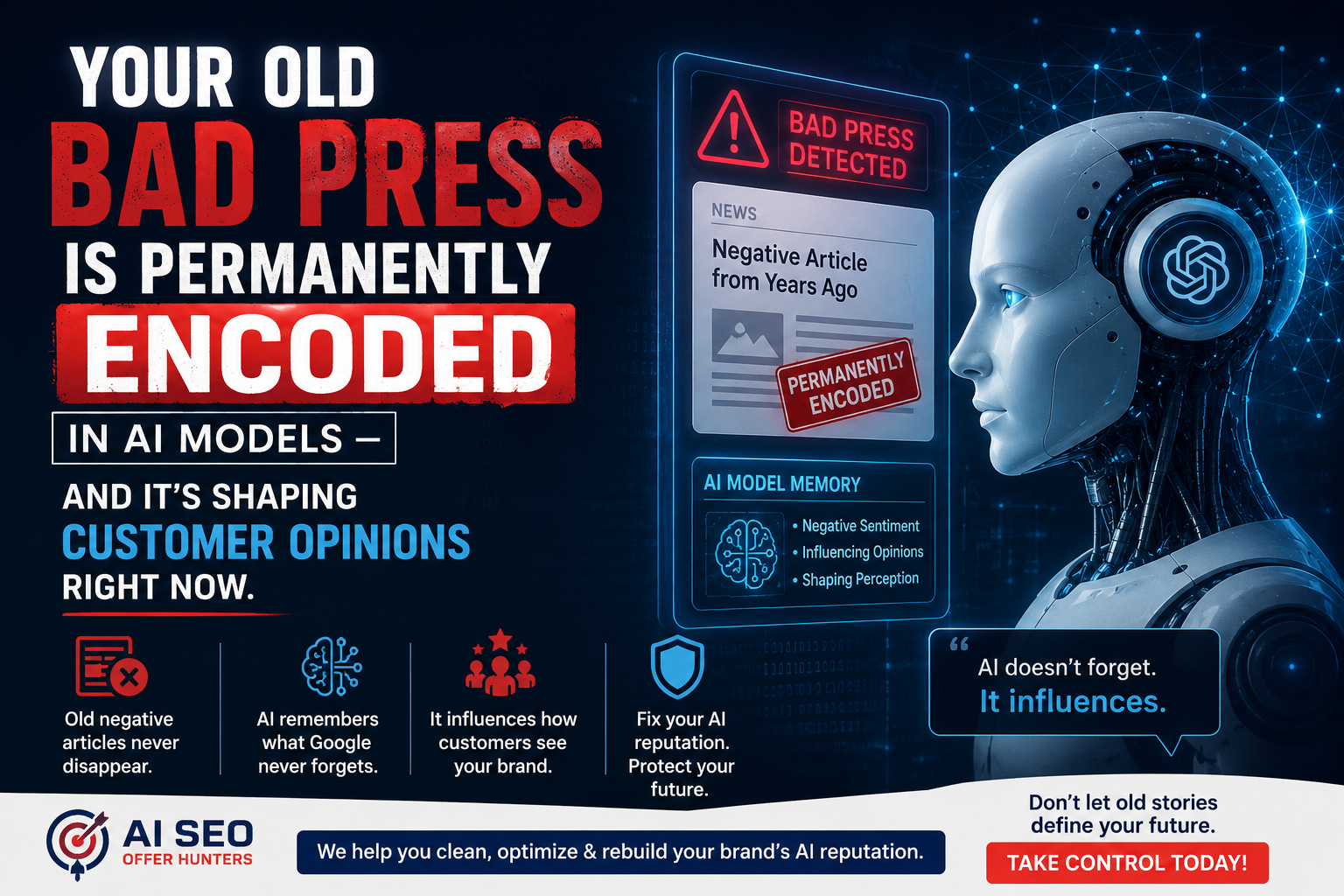
Quick Answer: AI language models like ChatGPT, Gemini, Claude, and Perplexity trained on web content from across the internet — including old negative reviews, critical articles, forum complaints, and bad press about your brand. Unlike Google, which can de-index or demote outdated content, AI models do not forget. That negative narrative may now be permanently embedded in how AI describes your business to prospective customers.
Imagine a customer who has never visited your website. They open ChatGPT and type: ‘Is [Your Company] a good choice for [your service]?’
ChatGPT does not visit your website in real time. Instead, it draws from what it learned during training — billions of web pages, reviews, articles, forum threads, and news stories absorbed before its knowledge cutoff. If those sources include a 2020 news story about a lawsuit your company settled, a 2019 BBB complaint thread, or a Reddit post from a dissatisfied customer, those narratives now form part of how AI understands your brand.
Furthermore, this is one of the most underestimated threats in modern brand management. And most business owners have no idea it is happening.
How AI Models Learn About Your Brand
To understand why old bad press creates such a serious problem, you need to understand how large language models (LLMs) like ChatGPT actually work.
During training, these models absorb enormous quantities of text from the public internet — news articles, blog posts, review platforms, Reddit, Quora, Twitter/X, LinkedIn, industry forums, and more. They do not simply read this content. Instead, they encode patterns from it into billions of parameters that shape every future response.
When a user asks about your brand, the model does not search the web (unless it has a live browsing tool enabled). It draws from those encoded patterns — essentially retrieving a compressed, probabilistic summary of everything it read about you during training.
⚠ Reality Check: AI models have knowledge cutoffs, but the content they learned from does not expire. As a result, a Trustpilot review from 2018 that mentioned your company in a negative context may still be influencing AI outputs in 2026.
The 4 Types of Old Bad Press Most Likely to Harm Your Brand in AI
1. Negative Review Threads on High-Authority Platforms
Google Reviews, Trustpilot, Yelp, G2, and Capterra all carry enormous domain authority. When AI models crawled the web during training, these sites received heavy representation. Consequently, a cluster of negative reviews from even three to five years ago — if they appeared on a platform with high crawlability — may be disproportionately present in what AI ‘knows’ about your brand.
2. Critical News Articles and Press Coverage
A local news story about a complaint, a trade publication that covered a dispute, or an investigative piece that mentioned your company — these editorial sources carry significant weight in AI training. AI models typically treat journalistic sources as high-credibility inputs. Therefore, if that credibility encoded negative associations with your brand, those associations now shape AI outputs.
3. Forum and Community Discussions
Reddit, Quora, industry-specific forums, and Facebook Groups all contributed heavily to AI training data. A Reddit thread where users warned others about your company does not disappear when it falls off the front page. In fact, crawlers may have captured and encoded it into model weights that still influence responses years later.
4. Competitor-Authored Content
Competitor comparison pages, ‘alternative to [your brand]’ articles, and affiliate content that subtly positioned your company unfavorably — this type of strategically written negative content formed part of AI training data. Moreover, because competitors wrote it to rank on Google, it received wide indexing and was highly likely to appear in training crawls.
What AI Says About Your Brand — Tested
The fastest way to understand your AI reputation is to test it directly. Open ChatGPT, Claude, Gemini, and Perplexity. Then ask:
- ‘What do you know about [Your Company Name]?’
- ‘Is [Your Company] reliable / trustworthy / recommended?’
- ‘What are the common complaints about [Your Company]?’
- ‘Should I use [Your Company] for [your service]?’
Note every negative association, concern, or hesitation the model expresses. These are your encoded reputation signals — the summarised picture AI has built from everything it read about you. This is precisely what your customers see when they research you via AI.
AI Insight: AI models often phrase negative reputation signals as ‘some users have reported…’ or ‘there have been concerns about…’ — which sounds objective but directly derives from negative content in training data. Customers interpret these as credible warnings.
Why You Cannot Simply Delete the Problem
Traditional SEO Has Pathways — AI Does Not
With traditional SEO, a damaging piece of content ranking on Google gives you several pathways to address it. You can create counter-content, build links to positive material, request removal under certain conditions, or suppress negative results with new rankings.
With AI models, however, none of those mechanisms work directly. You cannot submit a ‘disavow’ file to ChatGPT. You cannot request that Gemini forget a specific source. The training has already happened. The model has already encoded those patterns.
What You Can Do Instead
What you can do — and what the most forward-thinking companies are doing right now — is build a body of new, authoritative, positive content that achieves the following:
- Gets incorporated into future AI model training updates
- Gets cited by AI systems with live browsing capabilities (Perplexity, Bing AI, some ChatGPT modes)
- Displaces negative associations through volume and authority of counter-narrative
- Establishes your brand in AI-readable formats — structured content, FAQs, entity-consistent information
The Compounding Problem: AI Teaches Itself
How Negative Narratives Multiply Over Time
Here is the part that most people miss entirely. AI models do not only learn from the original web. They increasingly learn from AI-generated content, AI summaries, and AI outputs that themselves get indexed on the web.
If early model versions described your brand negatively — and those descriptions appeared anywhere online — later model versions may have trained on those AI outputs as source material. In other words, a negative narrative that entered AI models three years ago can compound over time.
The Reinforcement Loop
The process works like this: a model produces a negative output, that output gets published somewhere online, a crawler captures that publication, and the next training run reinforces the same negative pattern. This is not theoretical. It is the documented ‘model collapse’ risk that AI researchers have actively warned about.
As a result, the businesses that act now to establish positive, authoritative, entity-consistent content about their brand are building defences against this compounding effect. The businesses that do not act are watching the problem grow larger with each training cycle.
What Proactive AI Reputation Management Looks Like
Building Your AI Brand Architecture
The strategic response to encoded bad press is not reactive PR — it is proactive AI brand architecture. In practice, this means taking several concrete steps:
- Publishing clear, factual, authoritative brand descriptions that AI can reference as canonical definitions
- Building consistent entity signals across all platforms — NAP consistency, social profiles, review platforms, schema markup
- Creating high-quality FAQ content that directly addresses the concerns AI may have encoded about your brand
- Generating positive third-party content — case studies, media coverage, expert mentions — that provides counter-evidence to negative training signals
- Monitoring AI outputs regularly to track how your brand reputation evolves across models and updates
How AI SEO Offer Hunters Helps
This is precisely what AI SEO Offer Hunters builds for clients — a comprehensive AI brand presence strategy that addresses both historical reputation damage and ongoing reputation architecture.
Is your brand carrying negative signals in AI models right now? AI SEO Offer Hunters offers a Free AI Visibility Check — we test what ChatGPT, Claude, Gemini, and Perplexity actually say about your business and give you an actionable plan to correct negative narratives. Visit seoofferhunters.com to get started.
Frequently Asked Questions
Can AI models be wrong about my brand’s reputation?
Yes — and this is part of why the problem is so serious. AI models generate probabilistic outputs based on patterns in training data. If the negative content about your brand was more prominent, more recent at training time, or came from high-authority sources, it receives heavier weighting in outputs — even if the situation has since changed. Importantly, the model has no mechanism to verify that a problem is resolved. It simply reflects what it learned.
How long ago did ChatGPT train on content about my brand?
GPT-4’s training data has a knowledge cutoff in early 2024 for most versions. Earlier GPT versions used data from 2021 to 2022. Therefore, content about your brand published before those dates — positive or negative — is already encoded. However, many AI tools now have browsing capabilities, which means current content can influence responses even after training cutoffs. Building strong current content is consequently valuable for both training-time and real-time AI interactions.
What if the negative press about my brand was inaccurate or resolved?
Unfortunately, AI models do not automatically know when situations have changed or when coverage was inaccurate. If a false claim appeared and got indexed before the training cutoff, the model may encode it as part of its knowledge. The solution is not to argue with the AI — it is to build a strong counter-narrative through authoritative new content that provides context, resolution, or correction. Over time and across model updates, this new content competes with the old negative signals.
Which AI platforms are most affected by old negative content?
All major AI models — ChatGPT, Claude, Gemini, Perplexity, and Microsoft Copilot — are affected because they all trained on public web content. The specific impact varies by platform based on what data sources each model prioritised during training. Additionally, Perplexity is particularly worth monitoring because it combines live web search with AI synthesis — meaning it can pull current negative content in real time, not just from training data.
What is AI SEO Offer Hunters’ approach to fixing encoded bad press?
AI SEO Offer Hunters takes a three-phase approach. First, we audit what AI models currently say about your brand across all major platforms. Second, we identify the sources and patterns driving negative outputs. Third, we build a content and entity strategy that creates authoritative counter-signals — structured brand content, third-party mentions, FAQ libraries, schema markup, and review strategy — designed to appear in future AI outputs and real-time AI browsing responses. It is not a quick fix, but it is a systematic solution.
Published by AI SEO Offer Hunters | seoofferhunters.com