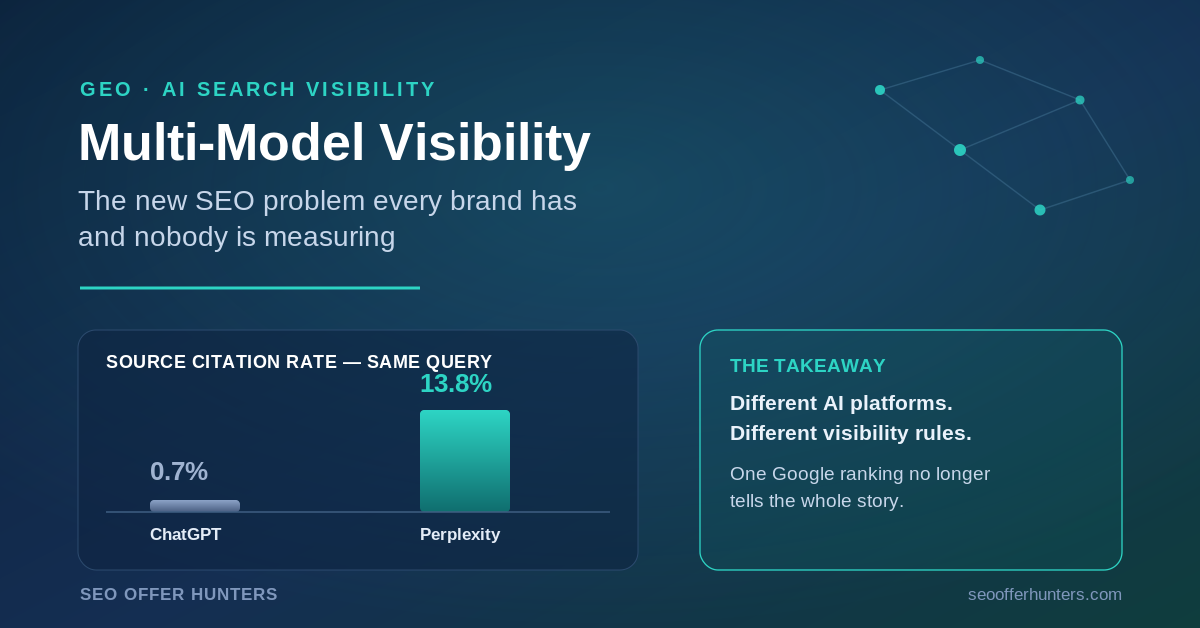
Your brand might be invisible right now, and you would never know it from your analytics. Search Console shows your rankings. Your rank tracker shows your keywords. Your traffic dashboard shows steady visits from Google. Everything looks fine. But none of these tools tell you what happens when someone asks ChatGPT, Perplexity, Gemini,… Continue reading Multi-Model Visibility: The New SEO Problem That Every Brand Has and Nobody Is Measuring
Read More
Picture a customer in Calgary typing a question into ChatGPT instead of Google. She asks for the best accounting firm nearby. Within seconds, she gets one confident answer.
There is no scrolling and no comparing ten blue links. She simply gets a name. Often, only one or two business names make the cut.
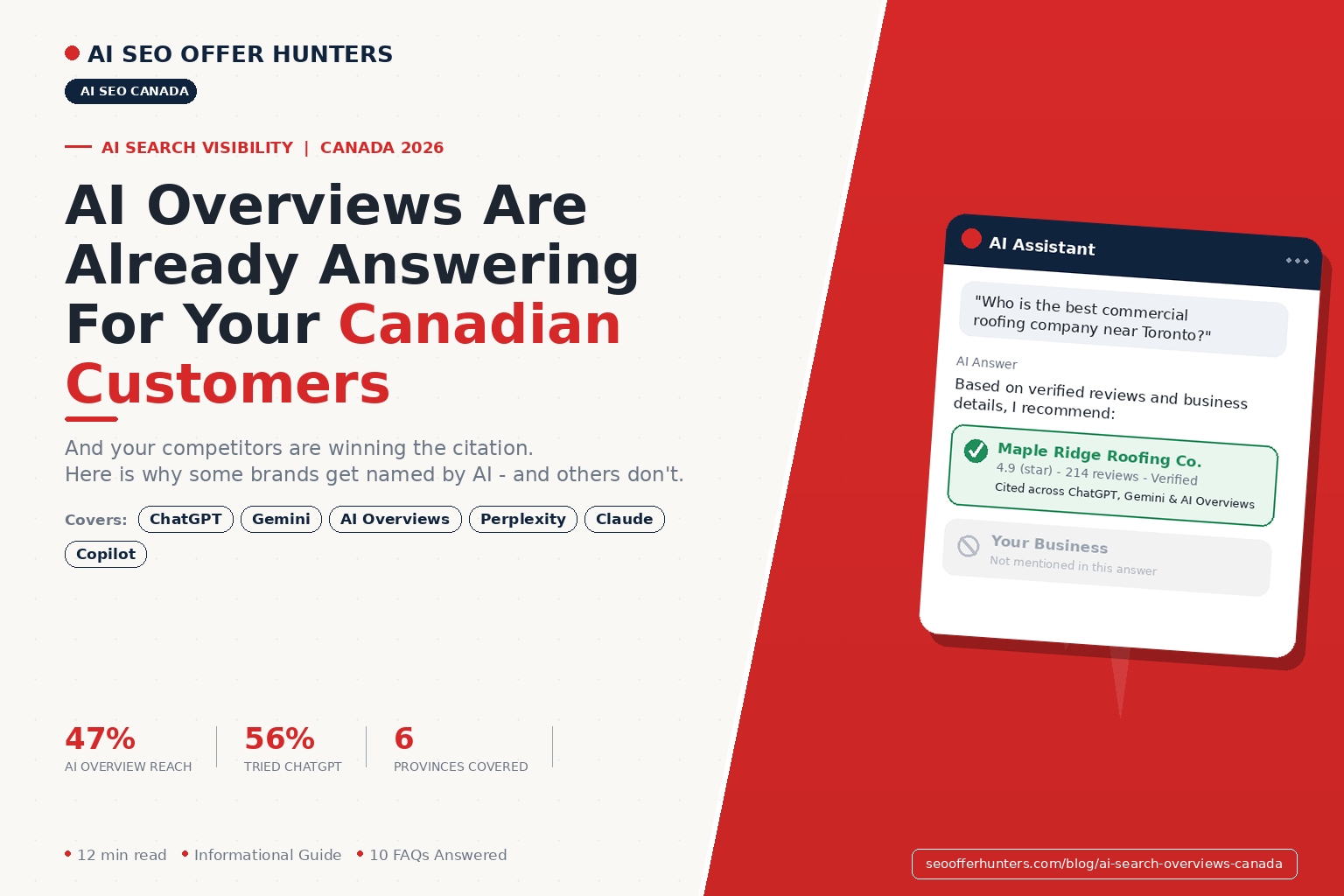
This is already happening across Canada. Google AI Overviews now appear on roughly 47 percent of commercial-intent searches. That is nearly double the share recorded a year earlier.
Meanwhile, 56 percent of Canadians have tried ChatGPT, a higher adoption rate than reported in the United States. Customers are asking AI tools directly, and those tools are answering with specific business names.
The catch is simple. Most Canadian businesses have no idea this shift is already affecting them. While they wait for familiar rankings to matter the way they always have, their competitors are quietly becoming the answer.
This article explains why that happens. It also covers how AI tools decide who to mention, and what a business can do about it, step by step.
The Shift from Search Engines to Answer Engines
For twenty years, search worked the same way. A person typed a query, Google returned ten links, and the business with the strongest SEO usually won the click. That system rewarded pages, not businesses, because ranking was really a contest between web documents.
AI search works differently. Instead of a list of links, tools like ChatGPT, Gemini, Claude, and Perplexity generate one direct answer. They pull that answer from multiple sources at once.
These tools behave less like a librarian pointing at a shelf. Instead, they act more like a knowledgeable friend giving a personal recommendation.
From Clicks to Citations
The new currency in search is not the click. It is the citation. When an AI engine names a business inside its answer, that mention carries the weight of a trusted referral.
Consequently, businesses that earn these citations gain credibility before a customer ever visits their website. For Canadian businesses, this shift is not a future concern. It is already measurable, since AI Overviews cut clicks to the top-ranking Google result by more than half.
In other words, ranking first no longer guarantees visibility. Businesses now lose ground to whichever competitor the AI decides to mention instead.
Why Canadian Businesses Are Missing From AI Search Results
Many well-established Canadian businesses are surprisingly absent from AI-generated answers. This rarely happens because their products or services fall short.
Instead, their digital presence was built for a search era that is fading quickly. A few specific gaps are usually to blame.
Weak Entity Signals
AI models rely on entity recognition to understand exactly who a business is. This matters especially when other companies share a similar name.
When a business name, address, or phone number varies across its website and directories, the AI struggles to confirm the business is real. As a result, it often skips that listing and cites a competitor with cleaner details instead.
A Winnipeg plumbing company listed under three slightly different names across directories, for example, sends mixed signals. Small inconsistencies like this quietly erode AI trust.
Poor Structured Data
Structured data, also called schema markup, is behind-the-scenes code. It tells search engines and AI crawlers exactly what a page contains, whether that is a service, a product, or an address.
Without it, AI tools have to guess. Many Canadian business websites, especially older ones, still carry no schema markup at all, which makes them slower to interpret.
Even a basic Organization schema block often closes this gap quickly. Most sites can add it within a single afternoon of development work.
Thin Content Without Real Answers
Pages that simply list a service without explaining it rarely earn a citation. AI engines look for content that genuinely answers a question.
Thin content might satisfy a human skimming quickly, but it gives an AI model nothing substantial worth quoting. A one-line description under “Services” is not enough. The page needs to explain what the service involves and who it helps.
Lack of Topical Authority
A business with only a homepage and a contact page looks thin to an AI model. This is true even when the company has decades of real-world expertise behind it.
Topical authority comes from covering a subject in real depth, across several pages, over time. Businesses without that depth simply leave less material for an AI system to draw from.
Publishing a small cluster of related pages tends to work far better than one page trying to cover everything.
Outdated SEO Strategy
Finally, many Canadian businesses still optimize purely for keyword rankings. That approach is not wrong, but it is incomplete on its own.
AI search rewards clarity, structure, and verified expertise rather than keyword density alone. Businesses relying only on older tactics are, therefore, optimizing for a search era that is already changing underneath them.
How AI Search Overviews Decide Which Businesses to Mention
AI Overviews and chatbot answers do not choose businesses at random. They rely on a fairly consistent set of signals to decide who deserves a mention.
Understanding these signals is the first step toward earning one.
Entity Recognition
AI systems build an internal profile of a business, treating it as a distinct entity rather than just a web page. Consistent naming, an accurate address, and a clear description all strengthen that profile.
When those details are scattered or contradictory, the AI struggles to trust the business enough to cite it. Think of it as a background check the AI runs in seconds, using whatever public information it can find.
| QUICK DEFINITION
Entity SEO means helping search engines and AI models clearly identify your business as a distinct, verified “who” — not just a website with matching keywords. |
E-E-A-T in Practice
E-E-A-T stands for Experience, Expertise, Authoritativeness, and Trustworthiness. Originally a Google guideline, it now shapes how AI models judge content too.
A page written by a named expert, backed by real credentials, consistently outperforms anonymous, generic content. Simply adding an author byline with a short bio can noticeably strengthen this signal.
Structured Data Markup
Schema markup remains one of the clearest signals available to any business today. It labels page content in a format machines can read instantly.
This speeds up how quickly an AI tool can confirm what a business offers and exactly where it operates. Because this markup is invisible to human visitors, many businesses simply forget it exists.
Brand Authority
Brand mentions across other reputable websites, directories, and press coverage tell an AI model that a business is recognized beyond its own website. This is sometimes called off-site authority.
It matters just as much as anything published on-site. A short feature in a local Canadian business publication, for instance, can carry real weight here.
Helpful Content
Content written to genuinely help a reader, rather than to game a ranking, tends to answer questions more directly. AI models are trained to identify and favour this kind of content.
This is largely because it mirrors what a helpful human expert would actually say. Generic, recycled copy rarely survives this filter.
Multi-Source Verification
Perhaps most importantly, AI tools rarely trust a single source. Instead, they look for the same facts about a business repeated across its website, reviews, and directories.
Agreement across sources builds confidence, while contradictions quietly reduce it. Even a mismatched business hour listing can introduce doubt.
Traditional SEO vs AI SEO
Traditional SEO and AI SEO share some DNA, yet they are not quite the same discipline. Understanding the difference explains why a business can rank well on Google and still stay invisible inside an AI answer.
At a Glance
The table below breaks down the core distinctions between the two approaches, side by side.
| Focus Area | Traditional SEO | AI SEO (GEO) |
| Primary Goal | Rank on a results page | Get named inside an AI-generated answer |
| Core Unit Evaluated | Individual web pages | The business as a recognized entity |
| Content Format | Long-form, keyword-targeted pages | Clear answers, FAQs, structured definitions |
| Key Signal | Backlinks and keyword density | Entity consistency, schema, E-E-A-T |
| Trust Builder | Domain authority | Facts verified across multiple sources |
| Update Frequency | Periodic content refreshes | Continuous accuracy across every platform |
| Local Relevance | Google Business Profile and map pack | Same, plus consistent details across the web |
| Typical Timeline | Roughly four to six months for movement | Varies; strong entities can be cited sooner |
| Success Metric | Keyword rankings and organic clicks | Citation frequency and AI-referred visits |
What This Means for Your Business
Neither approach replaces the other. A business still needs solid technical SEO to be found and crawled in the first place.
However, ranking alone no longer guarantees a mention inside an AI answer. Both disciplines now need to work together, not in isolation.
Real Business Scenario
The Question
Consider a homeowner in Toronto who opens ChatGPT and types a simple question: “Who is the best commercial roofing company near me?”
Within seconds, the assistant names one company, describes its specialties, and mentions its rating. A second, larger, and longer-established roofing company is never mentioned at all.
What ChatGPT Actually Considered
The larger company ranks reasonably well on Google and has served the Toronto area for over fifteen years. Yet its website has no schema markup, and its service pages are short and generic.
Its business details also differ slightly across directories, sometimes listing a different phone number entirely. The smaller company, by comparison, tells a very different story.
It publishes detailed project case studies and uses schema markup across its service pages. Its name, address, and phone number stay identical everywhere online, alongside an aggregated review score pulled from several platforms.
None of this required a massive budget. It required consistency and clearer structure. Side by side, the difference looks like this:
- Larger company: strong Google ranking, no schema markup, inconsistent directory listings, no visible review score.
- Smaller company: modest Google ranking, full schema markup, identical business details everywhere, aggregated review score displayed clearly.
Faced with these two profiles, the AI model has an easy choice. It picks the business it can verify quickly, not necessarily the one with the longer history.
The Business Lesson
Google ranking and AI visibility are no longer the same contest. A business can dominate page one and still lose the citation to a smaller, better-structured competitor.
That is precisely why AI SEO now deserves its own strategy. It works alongside traditional SEO, not as a replacement for it.
Industries in Canada Most Affected by AI Search
Some sectors feel this shift faster than others. This usually happens because their customers already turn to AI tools for research before making a decision.
Healthcare and Legal Services
Both fall into what search engines call “your money or your life” categories, where accuracy and trust matter enormously. Patients ask AI tools about symptoms and treatment options.
Prospective clients, meanwhile, ask about legal rights and next steps. Clinics and law firms that publish credentialed, clearly authored content earn far more AI citations than those relying on generic service pages.
A named physician bio or a lawyer’s call-to-bar year can meaningfully shift which practice gets mentioned.
Finance and Manufacturing
Finance sits in the same high-trust category, so verified credentials and transparent information matter just as much here. Manufacturing, meanwhile, is largely B2B.
Buyers increasingly use AI tools to research suppliers before ever contacting one. Detailed technical specifications and clear documentation help these businesses get found during that research stage.
Construction and Home Services
Both categories depend heavily on local, near-me style searches. AI tools are already answering these queries directly, as shown in the roofing example above.
Reviews, consistent business listings, and schema markup make an outsized difference for contractors and electricians. These are exactly the businesses customers ask AI to shortlist under real time pressure.
SaaS and E-commerce
Software buyers frequently ask AI tools to compare products, such as “best CRM for a small business in Canada.” Comparison-friendly content performs especially well here.
E-commerce brands, in turn, benefit from product schema and aggregated reviews. Both help AI shopping assistants describe and recommend specific products accurately, alongside clear pricing and shipping details.
How Canadian Businesses Can Improve AI Visibility
Improving AI visibility is not about chasing a single trick. It is about steadily strengthening the signals covered earlier in this article, one at a time.
Strengthen Entity SEO
Start by making sure the business name, address, and phone number match exactly everywhere online. Add a clear About page that explains who the business is and what makes it credible.
This single audit often uncovers small inconsistencies that have quietly existed for years.
Add Schema Markup
Implement Organization, LocalBusiness, Service, FAQ, and Review schema where relevant. This single technical step often delivers the fastest improvement in how AI tools interpret a website.
Most Canadian Shopify and WordPress sites can add this within a single development sprint.
Create AI-Ready Content
Write clear, upfront definitions and direct answers near the top of each page, followed by supporting detail. Use bullet points, numbered steps, and FAQ sections generously.
AI tools tend to extract this kind of structured content more easily than dense paragraphs. A good test is simple: could someone quote a single sentence and have it make complete sense alone?
Build Internal Linking and Brand Consistency
Link related pages together so search engines and AI crawlers can see how topics connect across the site. At the same time, keep the brand name and description worded identically everywhere.
This includes social bios, supplier directories, and every listing in between.
Earn Reviews and Digital PR
Actively collect reviews on Google and any relevant industry platforms. Review volume and rating consistency both feed directly into AI trust signals.
Digital PR, such as being quoted in local news or industry publications, adds another layer of validation. AI models notice this kind of coverage, and over time, they remember it.
Prioritize Genuinely Helpful Content
Above all, write for the reader first. Specific, example-driven content that solves a real problem will always outperform generic filler.
This single habit, more than any technical fix alone, tends to compound the fastest over time.
Explore Our AI SEO Services Across Canada
AI SEO Support in Every Province
AI SEO Offer Hunters works with businesses across the country through a dedicated AI SEO Canada service and a focused GEO services program. Both are built around the entity, schema, and content signals covered throughout this article.
In Ontario, businesses face some of the country’s heaviest AI search competition, particularly around Toronto’s dense professional services market. British Columbia brings its own mix of tourism, tech, and trades businesses competing for visibility along the Vancouver corridor.
Alberta‘s energy, construction, and home services sectors are increasingly answered by AI tools before a phone ever rings. Quebec adds a bilingual layer entirely, where genuine French-language content determines whether a business gets cited at all.
Manitoba and Nova Scotia round out the picture. Smaller markets here often mean an even bigger opportunity for a well-structured business to become the one name AI consistently recommends.
Every province follows the same underlying principles explained in this article. They simply apply to local competition, local language needs, and local search behaviour.
Frequently Asked Questions
What is AI SEO and how is it different from traditional SEO?
AI SEO, sometimes called GEO or generative engine optimization, focuses on getting a business named inside AI-generated answers rather than simply ranked on a page. It relies on entity clarity, schema markup, and verified expertise alongside traditional ranking factors.
Why do AI Overviews show different businesses than Google’s normal search results?
AI Overviews pull from multiple verified sources at once, not just page ranking. A business can rank well in traditional search yet still be skipped if its entity signals or content depth are weaker than a competitor’s.
Can a small Canadian business really compete with larger AI-visible competitors?
Yes, and often more easily than in traditional SEO. AI models reward clarity and consistency over sheer size. A smaller business with clean schema markup and strong reviews can outperform a larger, less organized competitor.
How long does it take to see AI search visibility improve?
Timelines vary by industry and starting point. Many businesses see measurable movement within a few months of fixing entity consistency and adding schema markup, since these are often the fastest signals for AI systems to pick up.
Does schema markup really affect whether ChatGPT mentions a business?
Schema markup does not guarantee a citation on its own. However, it significantly speeds up how accurately AI tools can interpret a page, which meaningfully improves the odds of being cited correctly.
Is AI SEO only relevant for e-commerce businesses?
No. Healthcare providers, law firms, contractors, and manufacturers are already being named or skipped by AI tools today, regardless of whether they sell products online.
How do reviews affect AI search citations?
Reviews act as a trust and verification signal. AI models look for consistent ratings and volume across platforms as evidence that real customers back up a business’s claims about itself.
What is entity SEO in simple terms?
Entity SEO means helping search engines and AI models clearly recognize a business as a specific, verified organization, rather than just a collection of keyword-matched pages.
Will AI search replace Google entirely in Canada?
Not entirely, at least not yet. Traditional search still handles a large share of queries, but AI Overviews and standalone AI tools are steadily capturing more commercial and informational searches across Canada.
How can I check if my business is already appearing in AI search results?
Try asking ChatGPT, Gemini, or Perplexity questions a customer might ask, such as “best [service] in [city].” If a business is never mentioned, that is a strong signal it is currently missing from AI search.
Final Thoughts
Start Winning the Citation
AI Overviews, ChatGPT, Gemini, Claude, and Perplexity are already answering questions on behalf of Canadian customers today, not at some point in the future.
Businesses that strengthen their entity signals, add proper schema markup, and publish genuinely helpful content are the ones earning those citations right now.
The businesses that wait usually are not failing at SEO. They are simply optimizing for a version of search that customers are gradually leaving behind.
AI SEO Offer Hunters helps Canadian businesses close that gap through practical, entity-first strategies built for how AI search actually works today.
If your business has never checked whether it shows up inside an AI-generated answer, now is a reasonable time to find out. Explore our AI SEO services across Canada and start building the visibility that rankings alone can no longer guarantee.
Published by AI SEO Offer Hunters | seoofferhunters.com | GEO & AI Search Visibility Specialists