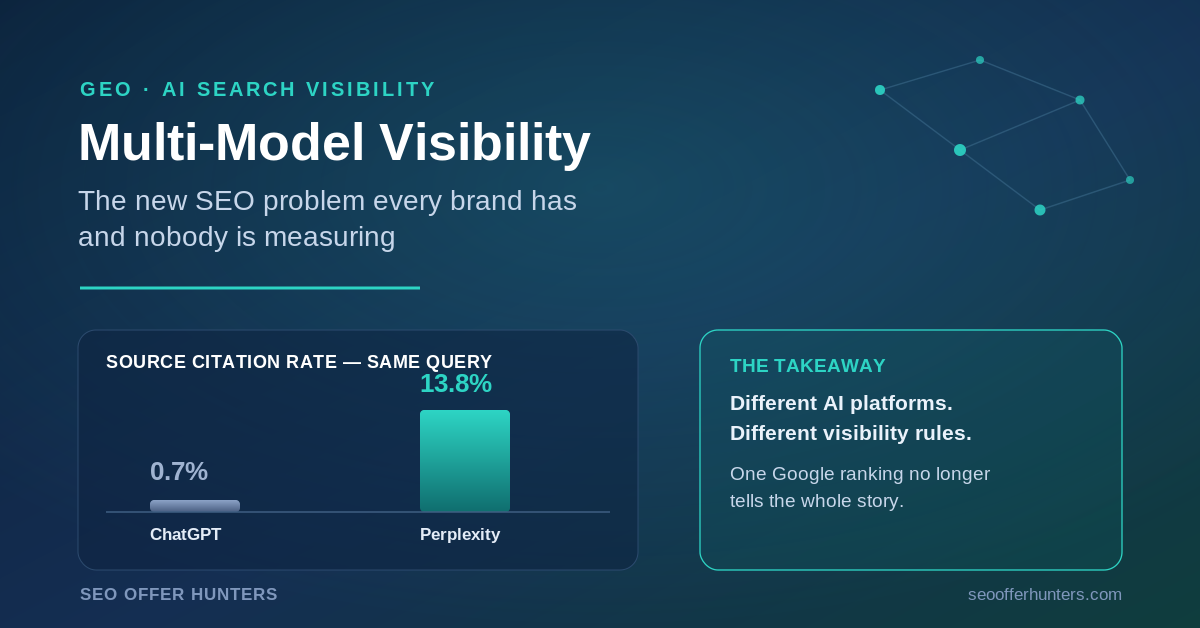
Your brand might be invisible right now, and you would never know it from your analytics. Search Console shows your rankings. Your rank tracker shows your keywords. Your traffic dashboard shows steady visits from Google. Everything looks fine. But none of these tools tell you what happens when someone asks ChatGPT, Perplexity, Gemini,… Continue reading Multi-Model Visibility: The New SEO Problem That Every Brand Has and Nobody Is Measuring
Read More
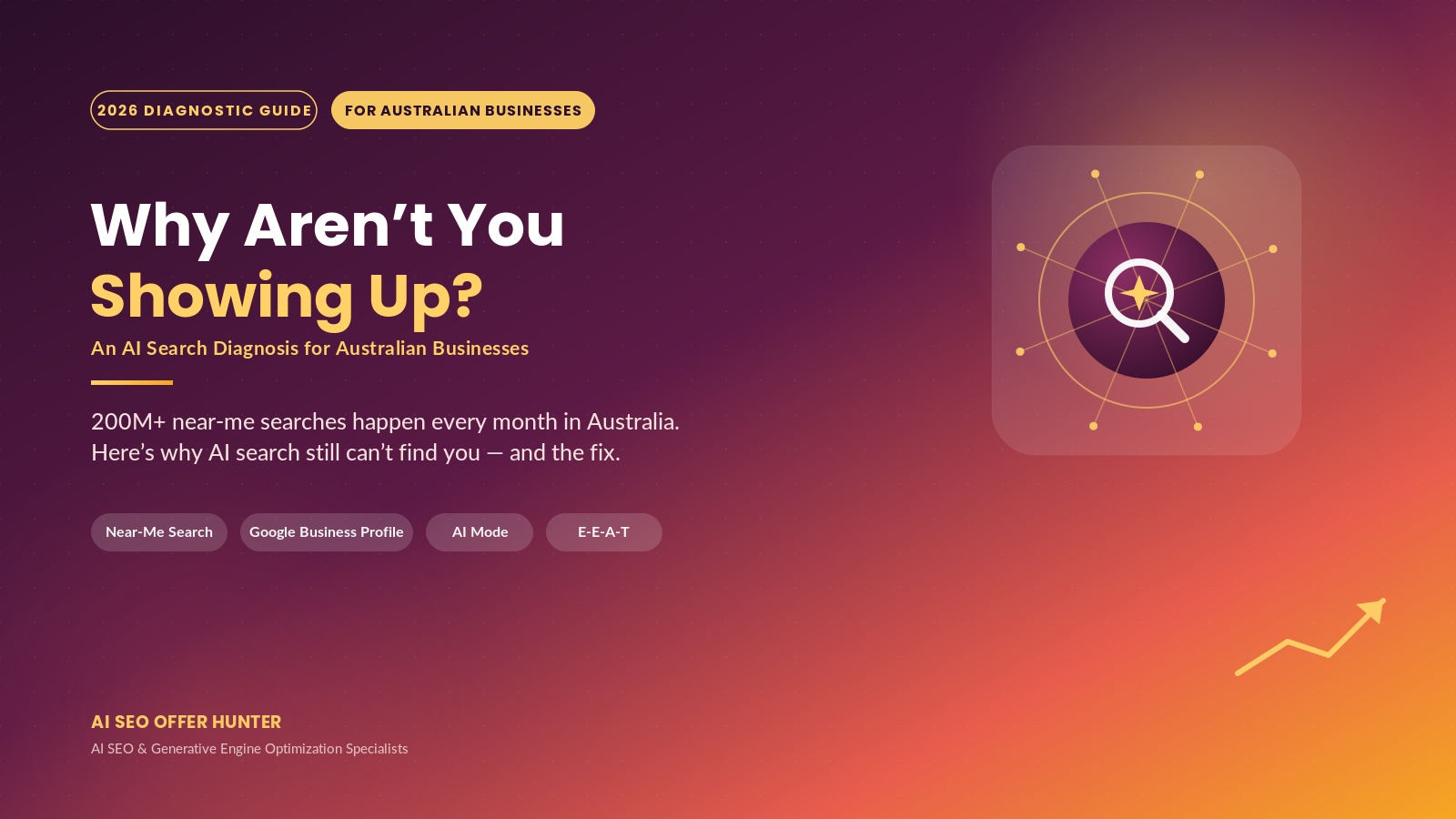
Somewhere between 11pm and midnight, a lot of Australian business owners type the same question into Google: “why isn’t my business showing up.” If that has been you recently, you are not imagining things, and you are not alone. Search itself changed under your feet, and most of the advice still circulating was written for the version of Google that existed two years ago.

Here’s what actually shifted. Google AI Mode launched in Australia in October 2025, turning search into a conversational interface that reads more like ChatGPT than a results page. AI Overviews now appear in roughly 39% of Australian searches, and businesses that haven’t adapted are seeing visibility declines of up to 37%. Meanwhile, more than 200 million “near me” searches happen every month across the country, and that volume has grown 900% in two years. Your customers didn’t slow down. Google just stopped showing them a list of blue links and started giving them an answer.
This guide is built like a diagnosis, not a lecture. You’ll work through why your business might currently be invisible, what Australians are actually typing into search right now, and a practical five-step plan to fix it — with a realistic timeline for when you should expect to see movement.
What Actually Changed in Australian Search This Year
Before diagnosing anything, it helps to understand the two shifts driving almost everything below: AI-generated answers replacing click-through results, and the sheer scale of hyper-local, intent-driven search.
AI Overviews and AI Mode Are Now the Default, Not the Exception
AI Overviews are no longer a test — they sit at the top of a large share of Australian search results, and AI Mode pushes that further by letting people ask follow-up questions the way they would in a conversation. The practical effect is a measured 34.5% drop in click-through rate for businesses that used to hold the top organic position, with some websites reporting traffic declines between 20% and 60%. The flip side: when someone does click through from an AI-influenced result, they arrive more informed and more likely to enquire, because the AI has already done some of the filtering for them. Fewer clicks, but better ones — provided your business is one AI actually mentions.
Near-Me and “Right Now” Searches Have Overtaken Generic Keywords
Local intent now dominates. 46% of all Google searches carry local intent, 82% of near-me searches happen on a phone, and 76% of people who run a near-me search visit a business within 24 hours. “Open now near me” is one of the fastest-growing search phrases in the country. Despite this, 58% of Australian businesses still aren’t optimised for local search, and only 30% have any real plan to capture it. That gap is exactly where AI search visibility is won or lost.
Why Your Business Might Be Invisible Right Now
If you rank on page one for your own business name but not for the searches that actually bring in customers, one or more of the following is almost certainly the cause. Work through these before touching anything else — they’re the foundation everything else in this guide depends on.
Your Google Business Profile Is Incomplete, Unclaimed, or Unmanaged
This is the single most common reason. If your profile isn’t claimed and verified, Google may show fragments of information it has found elsewhere rather than what you’d choose to show. An unmanaged profile — no recent photos, no responses to reviews, no Q&A activity — reads to Google as a business that might not be operating, which quietly suppresses your local visibility.
Your Business Details Don’t Match Across the Web
Your name, address, and phone number need to be identical on your website, your Google Business Profile, directories, and social platforms. Even small inconsistencies — “St” versus “Street”, an old suburb, a disconnected phone number — make it harder for Google and AI systems to trust that the listing they’re citing is actually correct and current.
You’re Ranking for the Wrong Keywords Entirely
Many business owners write their website copy using the words they would use, not the words their customers actually search. Someone looking for a plumber rarely searches “emergency plumbing solutions” — they search “plumber near me open now” or “burst pipe fix Blacktown.” If your content targets industry language instead of customer language, AI systems have nothing customer-shaped to cite.
Your Site Has Technical Gaps AI Can’t Read Around
Most Australian small business websites fail at least one Core Web Vitals signal, and a one-second delay in mobile load time can reduce conversions by up to 20%. AI systems and search crawlers both need to read your site quickly and cleanly. If your site is slow, poorly structured, or missing basic schema markup, you are making both Google and AI models work harder to trust you — and they usually won’t bother.
You’re Winning the Branded Search, Not the Commercial One
There’s a difference between showing up when someone searches your exact business name and showing up when someone searches “dentist Parramatta” or “accountant near me.” Most small businesses have the first covered and are completely invisible for the second — which is where nearly all new customer enquiries actually originate.
What Australians Are Actually Typing Into Google (and ChatGPT)
Different search phrasing signals different intent, and AI systems respond to each type differently. Understanding the pattern helps you see exactly which of your pages should be doing the work — and which currently aren’t
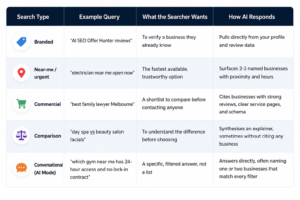
That last row is the one most businesses aren’t prepared for. Conversational queries reward businesses with clean, specific, structured information — exact hours, exact inclusions, exact service areas — because that’s what lets an AI model filter confidently. Vague copy gets skipped, not shortlisted.
Industry Snapshot: Where AI Search Risk Is Highest Right Now
AI Overview frequency isn’t even across industries. Some sectors are seeing AI-generated answers on the majority of relevant searches already; others are catching up. Here’s how nine key Australian industries currently stack up.
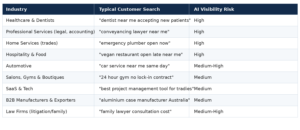
Healthcare, Trades, and Hospitality Are Moving Fastest
These three sectors share a pattern: the searches behind them are urgent, local, and comparison-heavy — exactly the conditions AI Overviews and AI Mode are built to answer directly. A patient searching for a same-day dentist, a homeowner with a burst pipe, or someone looking for a table that’s open right now all want a fast, filtered answer, not a list of ten websites to click through. Businesses in these categories should treat Google Business Profile accuracy and schema markup as urgent, not optional.
Professional Services Are Catching Up Quickly
Legal and accounting searches used to reward long-form authority content almost exclusively. That still matters, but AI Mode is increasingly answering practical questions — “how much does conveyancing cost in NSW,” “do I need a lawyer for a small business dispute” — directly, and citing the firms that have published clear, specific, well-structured answers to those exact questions.
Home Services and Trades Live or Die on “Right Now”
Plumbers, electricians, and locksmiths are almost entirely dependent on urgent, time-sensitive searches, which is exactly the query type AI Mode is optimised to answer with a shortlist rather than a full results page. A tradie with accurate hours, a clearly defined service area, and consistent reviews will be surfaced ahead of a larger competitor whose profile hasn’t been touched in a year, regardless of how established that competitor is offline.
B2B Manufacturers and Exporters Are the Quiet Exception
B2B searches tend to be more technical and specification-driven — “aluminium case manufacturer Australia,” “custom flight case supplier” — and AI systems handle these by pulling from product pages, spec sheets, and case studies rather than reviews or proximity. For manufacturers and exporters, the highest-leverage move is making technical content genuinely easy for AI models to parse: clear specifications, structured product data, and named use cases.
The Fix: A 5-Step AI Visibility Action Plan
None of this requires starting over. It requires fixing the same five things, in this order, because each step makes the next one more effective.
Step 1 — Run a Full Name, Address, and Phone Audit
List every place your business appears online — website, Google Business Profile, directories, social platforms, industry associations — and make the details identical everywhere. This is unglamorous work, but it’s the foundation every AI trust signal is built on.
Step 2 — Treat Your Google Business Profile Like a Second Homepage
Add real photos regularly, respond to every review, keep hours accurate down to public holidays, fill in every attribute Google offers, and post updates. An active, complete profile is one of the strongest trust signals available to a local business, and it costs nothing but consistency. Many owners set this up once at launch and never touch it again — and Google notices the silence.
Step 3 — Add Schema Markup AI Systems Can Actually Read
LocalBusiness, Service, FAQ, and Review schema give search engines and AI models clean, structured facts instead of forcing them to infer information from paragraphs. This is one of the highest-leverage technical changes available, and most Australian small business sites still don’t have it.
Step 4 — Rewrite Key Pages Around Real Customer Language
Pull your actual search queries from Google Business Profile insights and Search Console, and rewrite your top service pages using that exact phrasing — not the industry terms you’d use internally. Specific, plain-language answers to specific questions are what AI systems pull from. If you offer twelve services on one crowded page, consider splitting the highest-demand ones into their own focused pages so each has a clear job to do in search.
Step 5 — Build Reviews and Third-Party Mentions Deliberately
AI models cross-check claims across multiple sources before citing a business confidently. Consistent, recent reviews and mentions on industry directories, local news, and partner sites all reinforce the same story about who you are — and that consistency is what earns the citation.
How Long Until You See Results
This is the question every business owner asks next, and the honest answer depends on which layer of the fix you’re measuring.
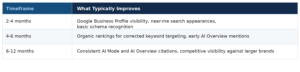
The businesses that see the fastest movement are the ones that fix all five steps together rather than one at a time. A perfect Google Business Profile with no schema markup, or great content with inconsistent NAP data, both slow the whole system down.
Common Mistakes That Slow This Down
These are the patterns that most often stall an otherwise solid AI visibility effort — worth ruling out before you assume the strategy itself isn’t working.
- Treating this as a one-off project. Two months of effort followed by a long pause is the most common way Australian small business SEO quietly dies.
- Fixing content before fixing consistency. Beautiful new service pages won’t help if your NAP data still conflicts across ten directories.
- Targeting the wrong page for the wrong search. A homepage trying to rank for twelve different services usually loses to a competitor with twelve focused, specific pages.
- Ignoring reviews until there’s a problem. Reviews are a trust signal AI models actively check — sporadic, defensive review management is easy for both customers and AI to notice.
- Assuming AI Mode and AI Overviews behave identically. They draw on similar signals but respond differently to conversational, multi-filter queries versus single-answer summaries.
AI Search Support Across Australia
AI visibility work looks slightly different depending on your local competition and market. We support businesses across every state and territory:
AI SEO Services in New South Wales GEO Services in Western Australia
GEO Services in Victoria AI SEO Services in Queensland
AI SEO Services in South Australia GEO Services in the ACT & Canberra
Frequently Asked Questions
The questions we hear most often from Australian business owners working through this exact problem.
Why isn’t my business showing up in ChatGPT even though I rank #1 on Google?
Google rankings and AI citations are related but not the same system. ChatGPT and similar tools rely on structured, consistent, cross-verified information about your business — not just your Google position. A page one ranking with weak schema markup and inconsistent listings can still be invisible to AI models.
Is Google AI Mode the same as AI Overviews?
No. AI Overviews are AI-generated summaries that appear above traditional results for many searches. AI Mode is a separate, fully conversational search experience launched in Australia in October 2025, where users can ask follow-up questions the way they would in a chat.
Do I still need a website if I have a strong Google Business Profile?
Yes. Your Google Business Profile is often the first thing customers see, but AI systems and search engines still rely on your website for the detailed, structured content that confirms and expands on what your profile says.
How do I know if AI Overviews are costing me clicks?
Compare your Search Console click-through rate for queries where an AI Overview appears against queries where it doesn’t. A significant gap between the two is a clear signal.
Should I stop investing in traditional SEO?
No. Traditional SEO fundamentals — site speed, quality content, backlinks — still feed directly into AI visibility. AI SEO builds on traditional SEO; it doesn’t replace it.
What’s the fastest single fix if I only have time for one thing?
Claim, verify, and fully complete your Google Business Profile. It’s the highest-leverage, lowest-cost fix available, it directly feeds near-me and AI Mode visibility, and most of it can be done in a single afternoon rather than requiring a developer or an agency.
Do near-me searches matter if my business doesn’t have a physical shopfront?
Yes, if you serve a local area. Service-area businesses can still rank in near-me results by setting an accurate service area in Google Business Profile and using location-specific content.
How often should I update my Google Business Profile?
At minimum monthly — new photos, responses to any new reviews, and a check that hours and attributes are still accurate, especially around public holidays.
Final Thoughts
Start With the Diagnosis, Not the Rebuild
Most Australian businesses don’t need a new website or a new strategy from scratch. They need the five foundational issues above fixed, in order, and given time to compound. AI search rewards consistency and clarity more than volume — which means a smaller business that gets the fundamentals right can absolutely out-cite a larger competitor who hasn’t.
If you’ve worked through the diagnostic above and recognised more than one issue, that’s normal, and it’s fixable. Get in touch to see exactly where your business currently stands in AI search and what the fastest path to visibility looks like for your industry and location.
Published by AI SEO Offer Hunters | seoofferhunters.com | GEO & AI Search Visibility Specialists