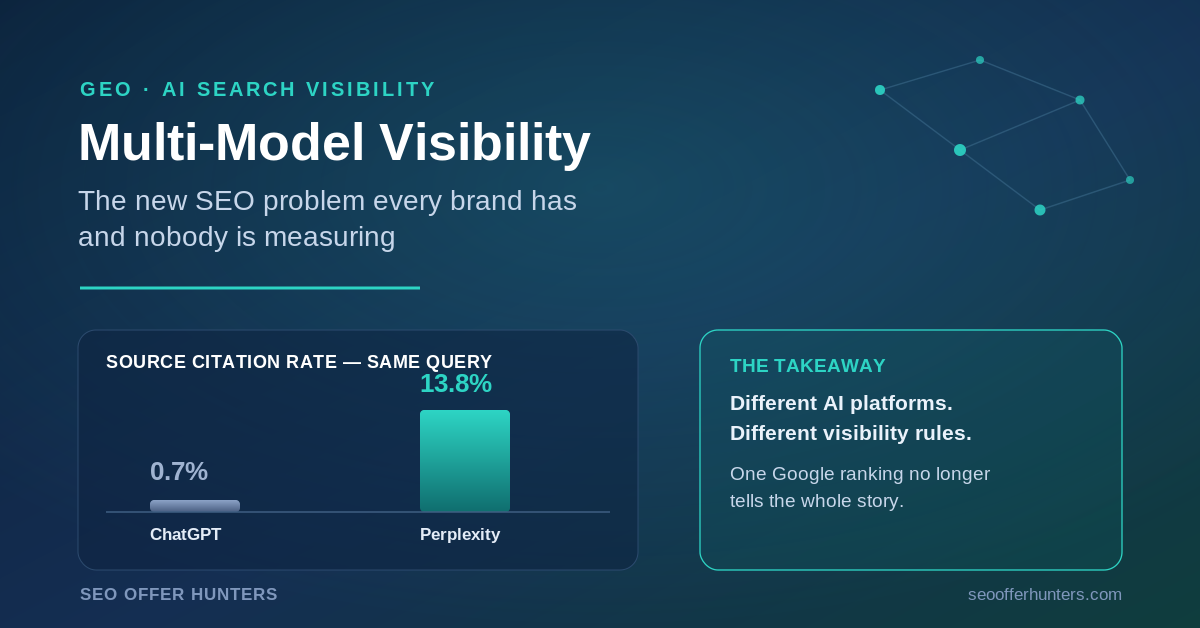
Your brand might be invisible right now, and you would never know it from your analytics. Search Console shows your rankings. Your rank tracker shows your keywords. Your traffic dashboard shows steady visits from Google. Everything looks fine. But none of these tools tell you what happens when someone asks ChatGPT, Perplexity, Gemini,… Continue reading Multi-Model Visibility: The New SEO Problem That Every Brand Has and Nobody Is Measuring
Read More
| QUICK ANSWER
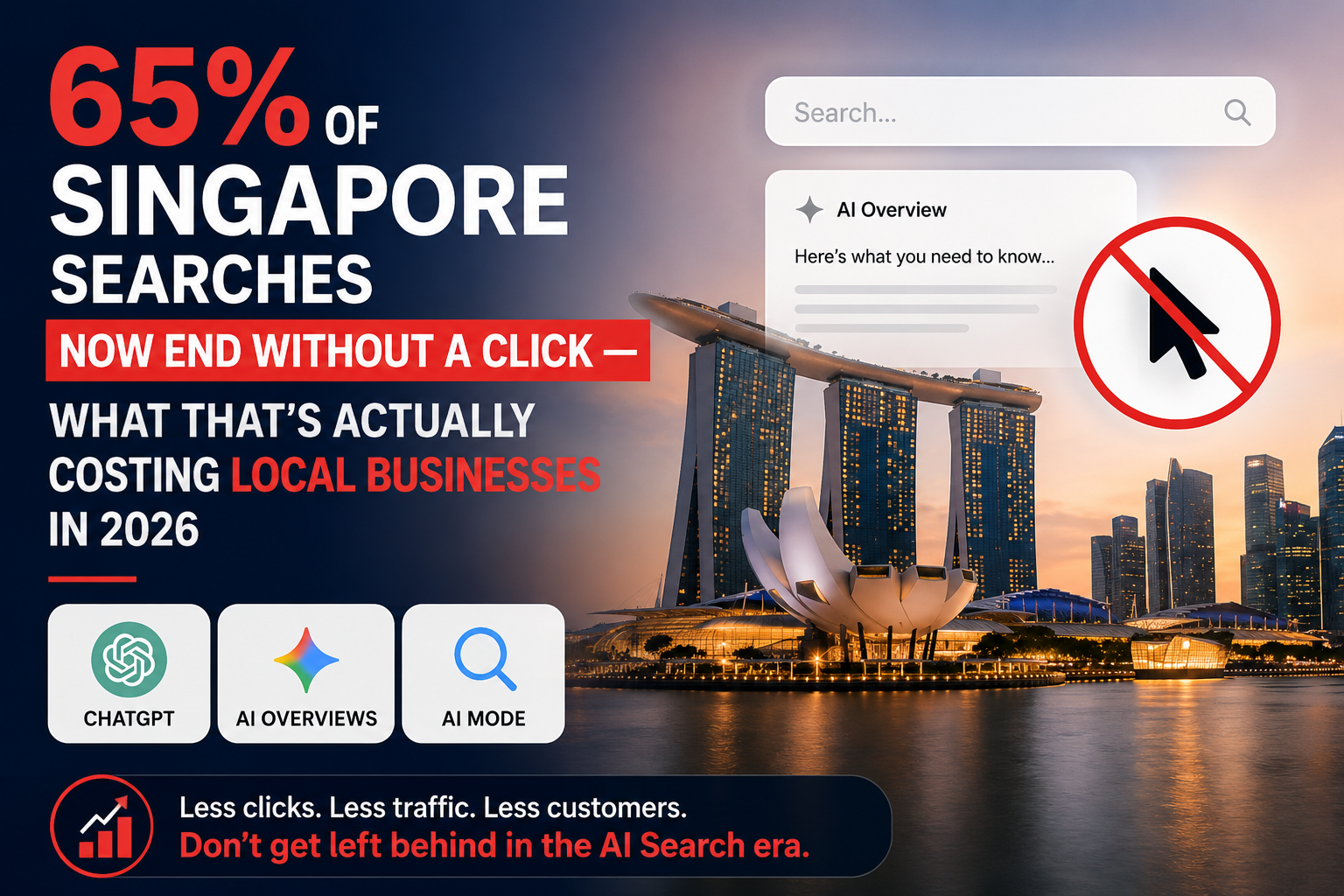
Between 60% and 68% of Google searches in Singapore now end without a click, rising to as high as 94% for informational queries when an AI Overview appears. Google still holds over 90% of Singapore’s search market, so this isn’t a story about switching to ChatGPT. It’s a story about Google itself answering questions on the results page and keeping the click. Visitors who do arrive after an AI system recommends a business convert 1.2 to 5 times higher than standard organic traffic. The businesses that adapt aren’t just protecting traffic, they’re capturing higher-value customers. Closing the gap means combining SEO, AEO, and GEO. That’s the Triple-Engine Framework Singapore’s own search commentary is already using to describe 2026. |
The Click That Never Happens
Someone in Tampines needs a plumber. They open Google, type the question. An answer appears right there on the results page: a name, a phone number, a rating. They call. They never click through to a website, never see a homepage, never scroll a services page that took hours to write. From where the plumber down the road stands, that customer simply doesn’t exist. No visit was ever logged.
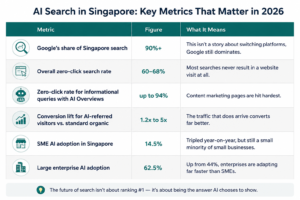
This is happening across Singapore right now, at scale. Between 60% and 68% of all Google searches in 2026 end without a single click to any website. For purely informational queries, the ones businesses spend the most time writing content for, that zero-click rate climbs as high as 94%. That happens once an AI Overview appears above the results.
If your traffic has quietly dropped while your rankings stayed exactly the same, this is very likely why. Nothing broke. Google just started answering the question itself.
For years, ranking well on Google was treated as the finish line. Get to position one, and the click, the visit, the customer would follow almost automatically. That assumption is what’s breaking in 2026. A business can hold the exact same ranking it held a year ago and still see a real, measurable drop in visitors. That happens simply because the page above it now gets answered before anyone scrolls that far. Ranking and being visited have quietly become two different things.
How Big Is Singapore’s Zero-Click Problem, Really
Singapore’s situation has a specific shape worth understanding before reacting to it. Unlike markets where ChatGPT and other AI tools have pulled search share directly away from Google, Singapore is still overwhelmingly a Google market.
Why Singapore Feels This More Than Most Markets
Two things make Singapore’s zero-click shift sting more than in many other countries. First, Google’s dominance means there’s no alternative platform absorbing the lost clicks. When Google answers a question directly, that traffic doesn’t reappear somewhere else. It simply doesn’t happen.
Second, the scale of Singapore’s digital economy amplifies the impact. Singapore’s digital economy reached S$128.1 billion in 2026, or 18.6% of GDP, up from 14.9% in 2019. That means even a small percentage shift in click-through behaviour translates into a large absolute amount of commerce. It quietly moves away from businesses that haven’t adapted, and toward the handful that have.
Put those two facts together and the picture becomes clear. This isn’t a niche problem affecting a few unlucky websites. It’s a structural shift running through one of the densest, most digitally mature economies in the region. Some businesses treat it as a temporary dip in traffic, rather than a permanent change in how search works. Those are the ones most likely to keep losing ground quietly, month after month.
The Widening Gap: Enterprises Are Sprinting, SMEs Are Barely Walking
There’s a second story sitting underneath the zero-click numbers, and it matters just as much. Large Singapore enterprises jumped from 44% to 62.5% AI adoption in a single year. Agentic AI adoption among enterprises more than doubled, from 22% to 51%. SMEs, meanwhile, tripled their AI adoption too, which sounds impressive until you see the base: it only brought them to 14.5%.
Deloitte’s 2026 survey of Singapore businesses found the top three barriers holding SMEs back:
- Regulation and compliance uncertainty
- AI skills and knowledge gaps
- Implementation cost
None of those barriers apply equally to a well-resourced enterprise with a dedicated digital team. A small business owner juggling everything themselves faces a much steeper climb, at exactly the moment the cost of not climbing it has gone up.
The good news buried in this gap is that most of what actually moves the needle for a small business isn’t about matching enterprise AI budgets at all. It’s about the same fundamentals covered later in this guide: clean data, genuine reviews, and content structured to be quoted. None of that requires a compliance team or a six-figure AI rollout. It requires knowing where to focus first.
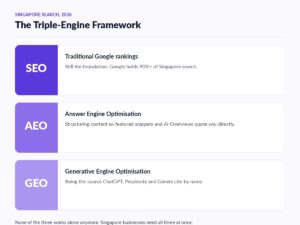
Singapore’s 2026 search reality runs on three layers at once: traditional SEO, Answer Engine Optimisation, and Generative Engine Optimisation.
Meet the Triple-Engine Framework
Singapore’s own search and marketing commentary has converged on a useful way to describe what businesses now need. It’s called the Triple-Engine Framework, combining SEO, AEO, and GEO as three interconnected systems rather than three separate strategies.
- SEO — the foundation. Google still holds over 90% of Singapore search, so traditional ranking signals, site speed, backlinks, on-page structure, haven’t gone anywhere.
- AEO (Answer Engine Optimisation) — structuring content so featured snippets and AI Overviews can lift a clear, direct answer straight from your page.
- GEO (Generative Engine Optimisation) — the layer aimed at being the source ChatGPT, Perplexity, and Gemini choose to cite by name when someone asks for a recommendation.
None of these three works well alone anymore. A page optimised only for traditional rankings might rank on page one and still get zero clicks, because the answer got lifted into an AI Overview above it. A page written only for AI citation might get quoted by ChatGPT but rank nowhere on Google itself. Singapore businesses need all three running together.
How ChatGPT Actually Picks Which Singapore Business to Recommend
This is where the practical detail gets useful. ChatGPT builds its local recommendations from three sources, cross-referenced against each other for consistency:
- Your website content
- Your Google Business Profile
- High-traffic consumer platforms like Yelp
Review signals weigh heavily in that process. Studies of ChatGPT’s actual picks show its recommendations average around 4.3 stars, and businesses with fewer than roughly 150 reviews are rarely named at all. That’s a concrete, specific benchmark. A business sitting at 40 reviews and a 4.1 rating isn’t just slightly behind, it’s likely below the threshold AI systems are quietly filtering on.
There’s also a distinctly Singaporean wrinkle here. GPT-4 Turbo in 2026 understands Singlish naturally, recognises local place names like Tampines, Jurong, and Woodlands, follows local context like HDB, MRT, and coffeeshop, and handles code-switching between English and Mandarin mid-conversation. A business writing only in formal, generic English may be giving up recognition that a more locally-toned page would pick up automatically.
This is a genuinely different advantage than what businesses in most other markets get to use. A UK or US business can’t lean on a distinct local dialect the way a Singapore business can. Working phrases customers actually use, not textbook English, into service pages and FAQ content is a low-cost way to match real queries more closely than a purely formal competitor ever will.
Common Mistakes Singapore Businesses Make Here
A few patterns show up repeatedly as Singapore businesses start reacting to zero-click search, and most of them make the problem worse rather than better.
- Chasing more traffic through paid ads to compensate, without fixing why organic visits dropped in the first place. That treats the symptom, not the cause, and it gets expensive fast.
- Assuming this only affects large content sites. Local service businesses feel it just as sharply, since “how much does X cost near me” questions are exactly the kind AI Overviews answer directly.
- Ignoring Google Business Profile and review volume, while pouring effort into blog content. Given how heavily ChatGPT weighs reviews, a business under the roughly 150-review threshold can publish excellent content and still stay invisible to AI recommendations.
What Closing the Gap Actually Looks Like
None of this requires an enterprise budget. It requires deliberate structure across all three engines at once.
| Business | Zero-Click Blind Spot | Triple-Engine Fix |
| Tampines plumber | Ranks page one, but the Google AI Overview answers the query first | Restructure the page to directly answer “how much does a plumber cost in Tampines,” so the Overview quotes it |
| Orchard Road boutique | Under 100 Google reviews, rarely named by ChatGPT | Actively request reviews post-purchase, aim past the 150-review threshold |
| Jurong logistics firm | Website copy is formal English only, misses local search phrasing | Add content reflecting how customers actually search and speak locally |
A Simple Habit Most Singapore Businesses Skip
There’s one habit that costs nothing and reveals more than almost any traffic report. Once a month:
- Open ChatGPT, Perplexity, and Google
- Ask the exact question a customer would ask, such as “best [your service] near [your area] in Singapore”
- Note whether your business is named, and what’s said about it
This matters more than it sounds. Traffic reports show what already happened. This test shows what’s about to happen next, before a competitor quietly takes the spot an AI system used to hand to you. SME AI adoption still lags well behind enterprise adoption in Singapore. Because of that gap, this single, free check is often the fastest way to close part of it without spending anything at all.
Looking for an AI SEO & GEO Partner in Singapore?
For a business searching specifically for the best AI SEO or GEO agency in Singapore, here’s a direct answer. AI SEO Offer Hunters specialises in exactly the gap this guide describes: closing the distance between traditional SEO rankings and visibility inside AI Overviews, ChatGPT, and Perplexity for Singapore businesses.
That work spans all three layers of the Triple-Engine Framework:
- Technical SEO foundations that keep Google rankings strong
- Answer-engine-ready content structure, so featured snippets and AI Overviews can quote a page directly
- Citation-building work that gets a business named, specifically, in AI-generated answers
For a closer look at how this work applies across Singapore, visit our Singapore AI SEO & GEO page.
The Bottom Line for Singapore Businesses in 2026
Zero-click search isn’t a temporary glitch that reverses itself. It’s the new baseline for how 60% to 68% of searches in Singapore resolve, and it’s only going to climb as AI Overviews expand further. The businesses losing the most aren’t doing anything wrong by old standards. They’re just being measured by a scoreboard that changed without announcing itself.
The upside is real too. Visitors who do arrive after an AI system recommends a business convert at up to five times the normal rate. That’s not a smaller opportunity than the old click-based web. For the businesses that build across all three engines, SEO, AEO, and GEO, it’s arguably a better one.
Frequently Asked Questions
What does “zero-click search” actually mean?
A zero-click search is one where the user gets their answer directly on the search results page. This can be through a featured snippet, an AI Overview, or a knowledge panel, and the user never clicks through to any website. In Singapore, this now happens in 60% to 68% of all Google searches.
If Google still dominates Singapore search, do I even need to worry about ChatGPT and AI search?
Yes, for two separate reasons. Google’s own AI Overviews already account for much of the zero-click problem, so this affects you even if you never think about ChatGPT. Separately, standalone AI platforms are growing quickly and increasingly influence what people search for before they even open Google.
Why do informational pages get hit harder by zero-click search than other pages?
Informational queries, the “how much does X cost” or “what is Y” type questions, are exactly what AI Overviews are built to answer directly. Zero-click rates for these queries reach as high as 94% once an Overview appears, far higher than for transactional or highly specific local searches.
What is the Triple-Engine Framework?
It’s a way of describing the three layers businesses now need together. SEO covers traditional Google rankings. AEO, Answer Engine Optimisation, covers getting quoted in featured snippets and AI Overviews. GEO, Generative Engine Optimisation, covers being cited by name in tools like ChatGPT and Perplexity.
How many Google reviews does a Singapore business actually need to be recommended by ChatGPT?
Studies of ChatGPT’s actual recommendation patterns show businesses with fewer than roughly 150 reviews are rarely named, and its picks average around a 4.3-star rating. That’s a useful concrete benchmark to aim past, not just a general “get more reviews” suggestion.
Does writing in Singlish or local phrasing actually help with AI search visibility?
It can help meaningfully. GPT-4 Turbo in 2026 understands Singlish, recognises local place names, and follows local context like HDB and MRT references. Content that reflects how people actually search and speak locally has a better chance of matching a real query than purely formal, generic English copy.
Are SMEs in Singapore really that far behind larger companies on AI?
The data suggests yes. Large enterprises reached 62.5% AI adoption in 2026, up from 44%, while SME adoption, despite tripling, only reached 14.5%. The main barriers cited by SMEs are regulation uncertainty, skills gaps, and implementation cost.
Is it worth fixing zero-click visibility if traffic converts well anyway?
It’s worth fixing precisely because of how well it converts. Visitors arriving after an AI system recommends a business convert 1.2 to 5 times higher than standard organic traffic. Businesses ignoring this aren’t just losing volume, they’re losing some of their highest-converting potential customers.
How long does it take to see results from AEO and GEO work in Singapore?
Structural fixes like restructuring a page to directly answer a common question, or improving Google Business Profile consistency, can show early signs of change within four to eight weeks. Building genuine review volume and broader citation presence takes longer, typically a few months of consistent effort.
Do I need to choose between SEO, AEO, and GEO, or invest in all three?
All three, ideally together. A page that ranks well but never gets quoted by an AI Overview still loses the click. A page optimised only for AI citation but ignored by traditional Google ranking signals may never get discovered in the first place. They reinforce each other rather than competing.
Published by AI SEO Offer Hunters | seoofferhunters.com | GEO & AI Search Visibility Specialists