If you’ve searched for help getting your business to show up in ChatGPT, Perplexity, or Google’s AI Overviews, you’ve probably run into a wall of agencies all saying the same thing: “we’ll make AI recommend you.” Almost none of them explain how. That’s usually not because it’s a secret — it’s because most of… Continue reading The GEO Audit Checklist: 20 Things to Check Before You Pay Anyone for AI Visibility
Read More
Most businesses that ask us why ChatGPT or AI Overviews won’t recommend them have already done the obvious things. Their website loads fast. Their pages have clear headings. They’ve even added some schema markup. And they’re still invisible.
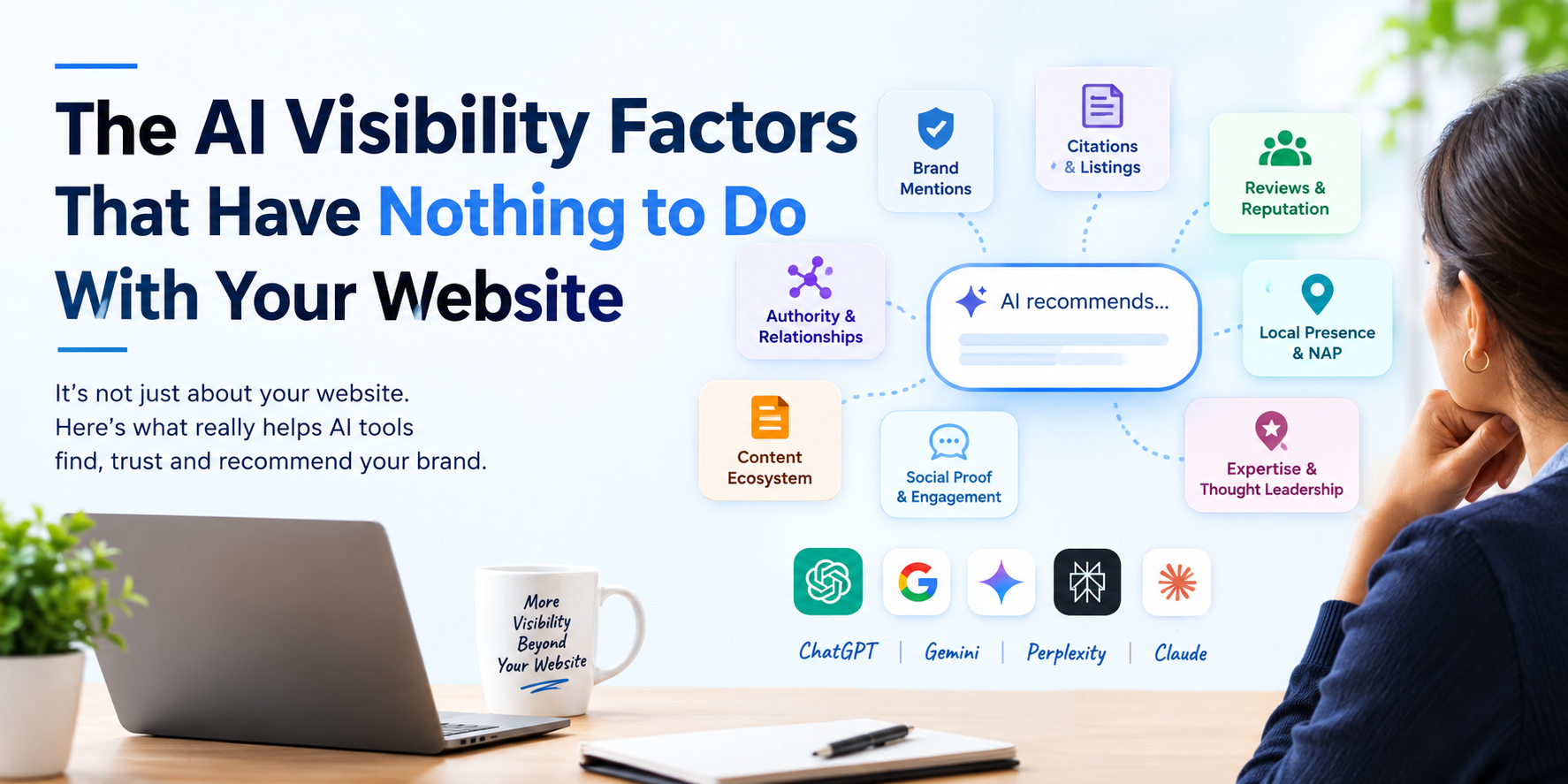
Here’s the part that surprises people: a large share of what decides whether AI recommends you has nothing to do with your website at all. It’s what other people and other platforms say about you, spread across the web, in places you don’t control and often don’t even check.
This article covers those off-site factors specifically — what they are, why they carry so much weight with AI tools, and what you can actually do about the ones you don’t directly control.
Why On-Page SEO Alone Isn’t Enough Anymore
Traditional SEO trained everyone to think about their own website first. Fix the title tags. Improve the content. Speed up the page. That work still matters, but it answers a different question than the one AI models are actually asking.
A search engine mostly needs to know if your page matches a query. An AI model needs to decide if it’s confident enough to say your name out loud bonus anymore. For AI visibility specifically, they’re often the deciding factor.
Reviews: The Signal AI Models Check First
Reviews carry more weight in AI search than most businesses realize. Industry tracking suggests AI tools reference review content in a large share of their responses, and Perplexity in particular leans on review signals heavily when forming an answer. When a model is deciding whether to name your business, it’s often quietly checking: does the review pattern actually back this up?
Volume matters, but recency and platform spread matter just as much. A business with hundreds of reviews from three years ago can look less trustworthy to an AI system than one with a steady, recent trickle of reviews across two or three platforms. That’s because a stale review pattern reads as a business that may not still operate the way it used to. A recent, consistent one reads as current and real.
It’s also worth being present on more than just Google Reviews. Industry-specific platforms — G2 and Capterra for software, Trustpilot for consumer brands, Yelp for local service businesses — get referenced independently by AI tools building a fuller picture of a business’s reputation.
Third-Party Mentions and the Consensus Effect
There’s a specific pattern AI researchers describe as a consensus effect. When several unrelated, credible sources all say roughly the same thing about a business — a trade publication, an independent comparison site, a niche reviewer — AI models start treating that repeated claim as more likely to be true, and cite it with more confidence.
This is different from backlinks in the traditional SEO sense. It’s less about link equity and more about independent corroboration. One glowing mention on your own blog proves nothing to a model. The same claim showing up, worded differently, across three or four sources you don’t control is a much stronger signal.
Practically, this means earning genuine mentions matters more than producing more content about yourself. A guest post on a relevant industry site, a mention in a roundup article, an interview on a niche podcast — these all contribute to the same underlying pattern AI models are trying to detect: is this a real, established business that other people independently recognize?
Forums and Communities: Powerful, But Not Permanent
Discussion platforms like Reddit have played an outsized role in AI search because they contain exactly the kind of unfiltered, first-person opinion that polished marketing copy doesn’t. For a while, Reddit threads were among the most frequently cited sources across AI search tools.
That picture has shifted recently. In August 2026, ChatGPT’s citations of Reddit dropped sharply — by more than 70% according to multiple trackers — while Google’s AI Overviews saw a much smaller decline over the same period. Reporting suggests ChatGPT began querying specific, named sources directly for answers rather than relying as heavily on broad forum search, and reference sites and official pages filled the gap Reddit left behind. Despite the drop, Reddit content still gets cited constantly across AI search overall, and Perplexity in particular continues to lean on it heavily.
The lesson here isn’t “ignore forums.” It’s that no single off-site channel is a safe place to concentrate all your visibility. A platform’s role in AI citations can shift within weeks, for reasons entirely outside your control. The businesses least affected by a shift like the Reddit citation drop were the ones whose visibility was already spread across reviews, directories, and third-party press — not resting on one channel alone.
Directory and NAP Consistency
NAP stands for name, address, and phone number, and it’s one of the oldest local SEO concepts still directly relevant to AI visibility. If your business name is written three different ways, your address has an outdated suite number on one directory, or your phone number is a discontinued tracking line on another, that inconsistency makes it harder for any system — search engine or AI model — to confirm you’re a real, stable business at a real location.
This matters more for AI tools than it used to for search engines, because AI models are often trying to give one confident, specific answer rather than a list of ten links. Voice assistants in particular need a single answer, not a set of options, which makes clean, consistent business data even more important than it was a few years ago.
Fixing this is unglamorous but high-leverage work: pulling up every directory and listing your business appears on, and making sure the name, address, and phone number match exactly, down to abbreviations and suite numbers.
Backlinks: Quality Over Quantity, More Than Ever
Backlinks still matter for AI visibility, but the bar has shifted. A large number of low-quality, unrelated links does little to help and can actively look suspicious. A smaller number of links from genuinely relevant, respected sites in your industry does far more, because those links function as another form of the same consensus signal reviews and mentions provide: real, independent sources vouching for you.
If you’re evaluating your current backlink profile, the useful question isn’t “how many links do I have.” It’s “how many of these come from a site a real person in my industry would recognize and trust.”
Entity Consistency: Being the Same “Thing” Everywhere
AI models increasingly think in terms of entities — a specific business, treated as one consistent concept, rather than a pile of disconnected web pages. The more consistently your business is described across the platforms that exist for it — Google Business Profile, industry directories, your own site, any Wikidata entry if you have one — the easier it is for a model to confidently treat you as a single, well-defined thing worth recommending.
This doesn’t mean every small business needs a Wikidata entry. For most, it means auditing what’s already out there and fixing the places where your category, description, or details drift from listing to listing.
How These Signals Work Together
None of these factors work in isolation, and that’s really the point. A great set of reviews with no third-party mentions looks incomplete. Strong backlinks with inconsistent NAP data undercuts trust. A business mentioned constantly on Reddit but nowhere else is now more exposed than it would have been eight months ago, given how quickly that channel’s weight shifted.
AI models are, in effect, triangulating. They’re looking for multiple, independent confirmations that agree with each other before they’ll stake a recommendation on your name. The businesses that show up in AI answers consistently are usually the ones with a reasonably strong presence across several of these channels at once, not just one done perfectly.
A Practical Off-Site Checklist
A short, honest audit of where you actually stand: are your reviews recent, not just numerous, and spread across more than one platform? Can you find genuine, independent mentions of your business beyond your own site and social channels? Does your name, address, and phone number match exactly across every directory you appear on? Do your backlinks come from sites that are actually relevant to what you do? And if you rely heavily on any single off-site channel for visibility, do you have a plan for what happens if that channel’s weight in AI search shifts, the way Reddit’s did in August 2026?
None of this replaces good on-page SEO. But it explains why good on-page SEO alone so often isn’t enough to earn an AI recommendation. The website is where you make your case. The rest of the internet is where that case gets checked.
Frequently Asked Questions
Why do off-site signals matter more for AI search than they did for traditional SEO?
Traditional search mostly needed to match a query to a relevant page. AI search needs enough confidence to make a specific recommendation, which pushes models toward independent, external confirmation rather than relying only on what a business says about itself.
How many reviews does a business actually need?
There’s no fixed number that applies to every business or category. What matters more consistently is recency and spread across more than one platform, rather than chasing a specific volume target.
Is Reddit still worth focusing on after the August 2026 citation drop?
Reddit’s role in ChatGPT specifically dropped sharply, but it remains a heavily cited source overall, especially on Perplexity. The bigger lesson is not relying on any single channel exclusively.
What’s the fastest off-site fix for most businesses?
NAP consistency across directories is usually the quickest, most mechanical fix available, since it just requires auditing existing listings rather than earning new mentions.
Do backlinks still matter if I’m focused on AI visibility rather than Google rankings?
Yes, but the emphasis shifts toward relevance and credibility of the linking site over sheer link volume, since AI models appear to weigh backlinks partly as another form of independent corroboration.
Can I control what third parties say about my business?
Not directly, but you can influence it by making it easy for credible sources to cover you accurately — through outreach, genuine expertise-sharing, and making sure your own public information is accurate and consistent for anyone writing about you.
Does a Wikidata or Wikipedia entry matter for a small local business?
Generally not as a priority. It matters more for larger or more established brands. Small and local businesses typically get more value from consistent directory listings and genuine reviews first.
How often should I check my off-site presence?
A periodic check every few months is reasonable for most businesses, since review patterns, directory data, and platform weighting in AI search can all shift without any action on your part.