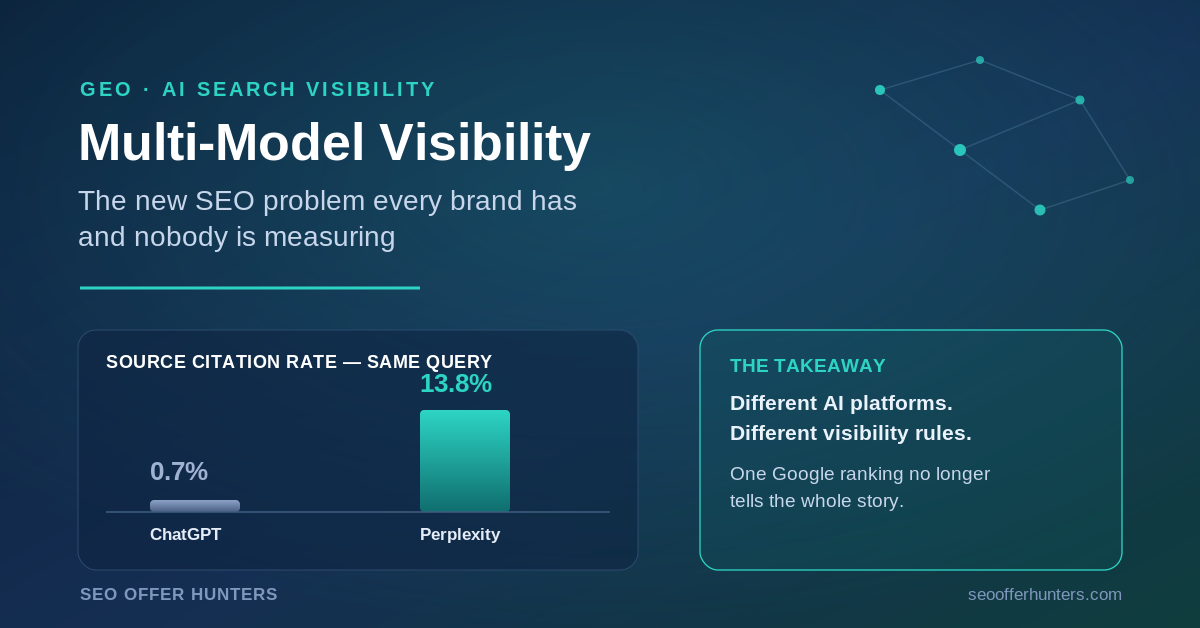
Your brand might be invisible right now, and you would never know it from your analytics. Search Console shows your rankings. Your rank tracker shows your keywords. Your traffic dashboard shows steady visits from Google. Everything looks fine. But none of these tools tell you what happens when someone asks ChatGPT, Perplexity, Gemini,… Continue reading Multi-Model Visibility: The New SEO Problem That Every Brand Has and Nobody Is Measuring
Read More
A client told us something last month that stuck with us. “ChatGPT used to mention us all the time,” he said. “Now it barely does. We didn’t change anything.” That last part was the real problem. Nothing on his site had changed, and in AI search, standing still counts as falling behind.
This is the part of GEO that almost nobody talks about. Everyone wants to know how to earn an AI citation. Few people ask what happens after they earn one. The honest answer is that the citation rarely lasts. It fades, it loses ground, and AI tools quietly replace it while you’re still celebrating that it showed up at all.
We call this pattern AI citation decay, and if your GEO strategy ignores it, you’re building on sand.
What AI Citation Decay Actually Means
AI citation decay describes the gradual loss of visibility a page experiences inside AI-generated answers, even after earning a citation once. It works differently from a Google ranking drop. A page can hold position three on Google for years with barely any changes. That same page can lose its spot inside a ChatGPT or Perplexity answer within weeks, sometimes days.
The core idea is simple. AI tools don’t treat a citation as a permanent badge of trust. They treat it as a temporary answer to a temporary question, and they re-evaluate the entire pool of possible sources every time someone asks a similar question again. Earning a citation once doesn’t guarantee a repeat appearance. Your content has to keep earning its place.
That’s the expiration date we’re talking about. Not a hard deadline, but a slow, steady countdown that starts the moment you publish and rarely stops.
The Numbers Behind the Decay
We didn’t want to just tell you this happens. We wanted to show you how fast. So we looked into recent research on AI citation behavior, and the numbers surprised even us.
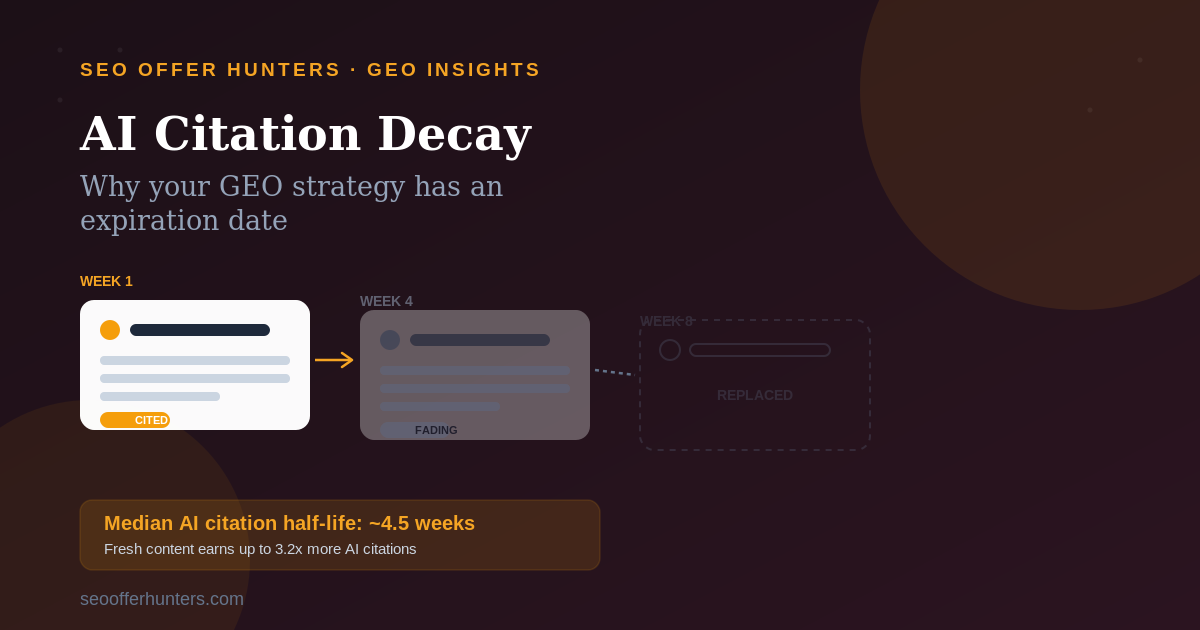
Citation half-life measures how long it takes AI tools to swap out roughly half of a topic’s cited sources for newer ones. This number varies by platform. ChatGPT churns through citations fastest, with a half-life of around 3.4 weeks. Google’s AI surfaces, including AI Overviews and AI Mode, move a bit slower at 4.3 to 4.8 weeks. Perplexity holds onto sources the longest, at roughly 5.7 to 5.8 weeks. Across every platform, the median citation half-life lands at about 4.5 weeks (Authority Tech, 2026).
Read that again. Four and a half weeks. On average, AI tools have already replaced half of the sources they cited for a given topic a month ago.
The freshness gap tells a similar story. In 2026, roughly half of all AI-cited content is less than 13 weeks old. Pages published or meaningfully updated within the last 30 days earn an estimated 3.2 times more AI citations than older pages covering the same topic (apiserpent.com, addlly.ai). Meanwhile, pages left untouched for over a year can lose more than half their AI citation frequency (Quattr, 2026).
So the pattern is clear. Fresh content earns citations fast, and AI tools drop old content just as fast.
Why This Happens: Model Updates
It helps to understand the mechanics behind this behavior, because once you see them, decay stops feeling random and starts feeling predictable.
AI models get retrained on their own schedule, and every shift changes what counts as current and trustworthy. A source that felt authoritative to an older model version can lose priority once a newer, more specific piece of content appears on the same topic. You didn’t do anything wrong here. The model’s baseline simply moved.
Why This Happens: Competitor Refreshes
You’re not the only business writing about your industry. While your page sits untouched, a competitor publishes an updated version of the same topic with newer statistics, a more recent example, or a sharper answer to the exact question people are asking. AI tools tend to favor whichever source looks most current and most precise. A fresher competitor page can simply out-position yours without you doing anything wrong at all.
Why This Happens: Stale Facts and Numbers
Facts and figures age faster than most people realize. Say your article cites a statistic from two years ago, and a more recent version of that same statistic exists somewhere else online. AI tools will often prefer the newer number instead. This matters most for pricing, industry data, regulations, and anything phrased as “as of” a particular date.
Why This Happens: Fading Technical Signals
Small structural signals matter too. Your page’s “last updated” date, its schema markup, and how recently crawlers have visited your site all play a role. A page sitting untouched for a year sends a quiet message that nothing new is happening there, even when the core information still holds up. Freshness is only one piece of the puzzle, though — a lot of what drives AI visibility happens off your site entirely. (See: The AI Visibility Factors That Have Nothing to Do With Your Website.)”
None of this means your content was wrong or badly written. It means AI visibility isn’t a one-time achievement. Think of it as a subscription that needs renewing, not a trophy you earn once and keep forever.
Traditional SEO Decay vs. AI Citation Decay
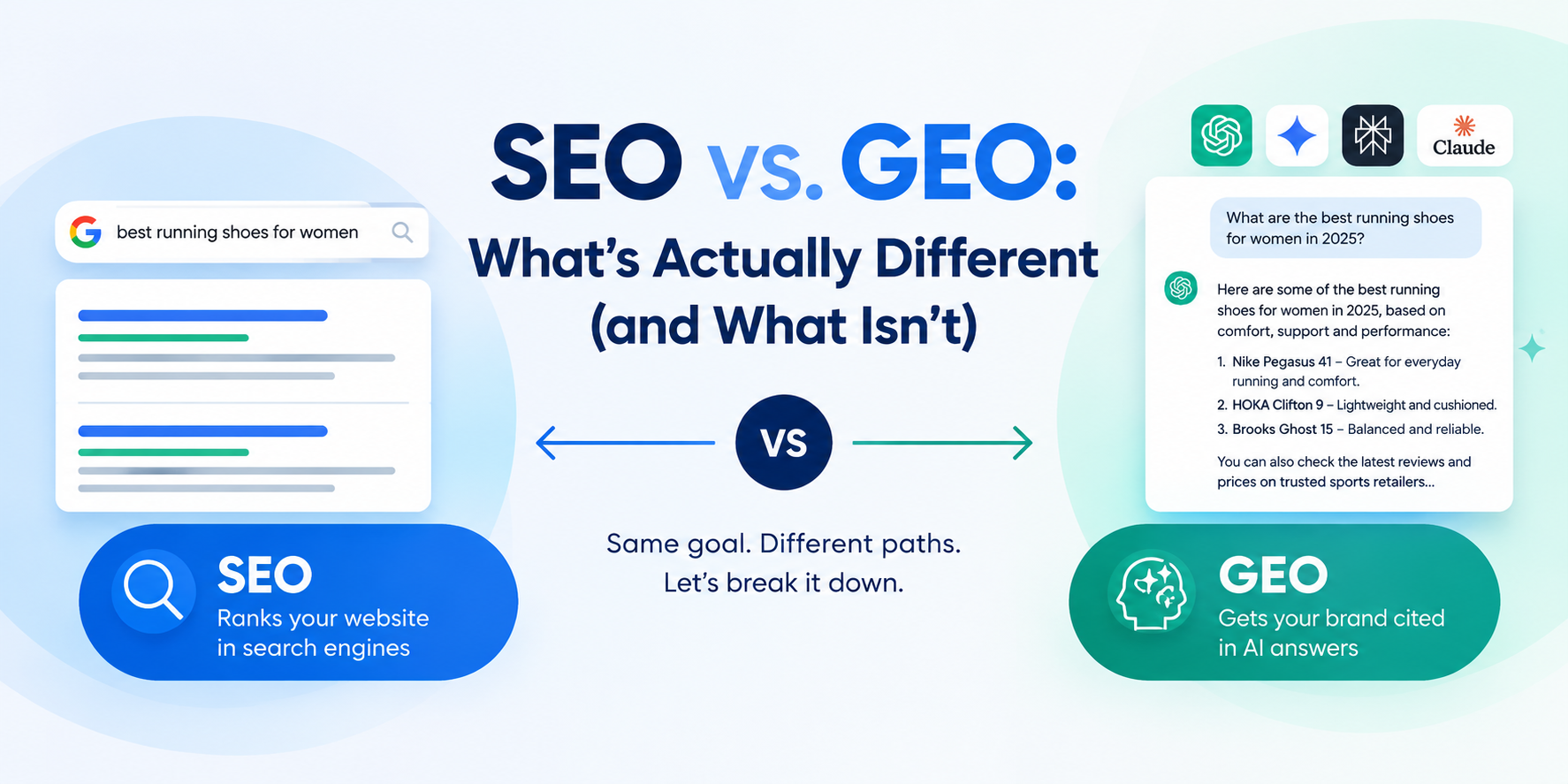
Anyone who has worked in SEO for a while already understands content decay. A blog post ranks well, then slides down the results over 12 to 18 months as competitors publish newer content and search intent shifts. That’s a slow fade, and it gives you time to notice and react. (If you’re still unclear on how SEO and GEO relate, we’ve broken that down here: SEO vs. GEO: What’s Actually Different.)
AI citation decay moves at a different speed entirely. You’re looking at a meaningful drop within weeks, not a slow fade over a year. This changes how often you need to check in on your content. A quarterly content review used to count as proactive for SEO. For GEO, that pace runs far too slow. By the time a quarterly cycle rolls around, your page may have already cycled out of AI answers two or three times over.
This is the mindset shift that trips up most businesses. They treat GEO the way they treated SEO: publish it, optimize it once, then move on. GEO doesn’t reward that approach. It rewards businesses that treat content as something living, not something finished.
What a Realistic Refresh Cadence Looks Like
Different AI platforms decay citations at different speeds, so your refresh schedule should reflect that. Current research points to a reasonable starting point.
For content you want ChatGPT to keep citing, aim for updates roughly every two weeks on your highest-priority pages. That pace sounds aggressive, and applying it to every page on your site would be unrealistic. But for the handful of pages that matter most, a biweekly touch-up, even a small one, keeps the freshness signal alive.
For content aimed at Google’s AI surfaces, a monthly update cadence tends to work well, since Google’s AI systems appear to weigh freshness a bit more conservatively than ChatGPT does. Perplexity gives you the longest runway of the three, since a six-week cycle is generally enough to hold your position there (Foglift, Authority Tech, 2026).
To be clear, “update” doesn’t require rewriting the whole page every time. Adding a new example counts. Updating a statistic counts. Answering a fresh related question counts. Small, honest updates done consistently beat one big rewrite done once a year.
A Practical Refresh Checklist
When we sit down to refresh a client’s high-priority page, we work through the same short checklist every time.
First, we check every statistic and number on the page and update anything with a newer source available.
Next, we add at least one new example, case, or scenario that wasn’t there before, since this signals real, current activity rather than a copy-paste refresh.
We also review the page’s FAQ section and add any question we’re hearing come up in client calls or seeing inside AI answers ourselves.
From there, we update the “last reviewed” date visibly on the page and make sure the schema markup reflects it too.
We re-submit the URL through IndexNow or the relevant search console, so crawlers don’t have to wait for their normal cycle to notice the change.
Finally, we ask whether the page still reflects how we’d answer the question today, not just whether it’s technically still accurate.
None of these steps take long on their own. Done together on a consistent cycle, they keep a page inside the rotation instead of letting it fall out.
What This Looks Like in Practice
Here’s a simple, illustrative example of how this plays out. A mid-sized service business publishes a strong, well-researched guide on their topic. For the first month, AI tools pick it up regularly, and customers start mentioning that ChatGPT recommended them by name.
Three months pass. Nothing on the page changes. A competitor publishes an updated version of a similar guide, complete with a newer example and a more recent statistic. Slowly, the original business notices something odd: customers stop mentioning that they found them through AI. Nothing on their website broke, and nothing got removed. The content simply aged out of rotation while a fresher alternative took its place.
Results vary by industry, competition, and how AI tools evolve over time, so this outcome isn’t guaranteed for every business. Even so, the pattern above shows up often enough that it’s worth planning for before it happens to you, rather than diagnosing it after your visibility has already quietly dropped.
What GEO Decay Doesn’t Mean
It’s worth being clear about what we’re not saying here. AI tools aren’t biased against older content out of spite, and you don’t need to publish something new every single day to stay visible. We’re also not claiming a refresh guarantees a citation, because no legitimate strategy can promise that. AI recommendation behavior shifts constantly, and no agency, including ours, can guarantee a specific ranking or a specific mention inside ChatGPT, Gemini, or any other tool.
What we’re saying is narrower and more useful than that. Content that stays current tends to earn more citations than content that doesn’t. That’s a pattern worth building a process around, not a guarantee worth promising a client.
Building Citation Decay Into Your GEO Strategy
If you take one thing from this article, let it be this: GEO isn’t a project with an end date. It works more like an ongoing maintenance habit, closer to keeping your storefront clean than to renovating it once and walking away.
Your GEO strategy needs a built-in refresh cycle from day one, not as an afterthought once visibility starts slipping. Pick a small set of priority pages, the ones most likely to influence a buying decision, and commit to checking in on them every few weeks rather than every few months. Track whether you’re actually earning citations too, instead of assuming you are just because you optimized the page once.
Businesses that treat AI visibility as a one-time setup keep getting surprised when it disappears. Businesses that treat it as an ongoing habit stay visible in AI answers six months from now, while their competitors wonder what happened.
Frequently Asked Questions
How often should I update my content to stay visible in AI search?
It depends on the page’s priority. For your most important pages, aim for a light update every two to six weeks depending on which AI platform matters most to your business. Lower-priority pages can run on a quarterly review as a reasonable minimum.
Does AI citation decay affect Google rankings too?
Not directly in the same way. Traditional Google rankings tend to decay more slowly, often over many months. AI citation decay refers specifically to how quickly a page loses its spot inside AI-generated answers, which moves on a much faster timeline.
Can I stop citation decay completely?
No, and it’s worth being honest about that. Decay is a natural part of how AI tools evaluate freshness and relevance. You can’t stop it, but a consistent refresh habit can slow it down significantly.
Is a full page rewrite necessary every time?
No. Most effective refreshes stay small: an updated statistic, a new example, a corrected date, or an added FAQ. Consistency matters more than the size of each individual update.
How do I know if I’m actually losing AI citations?
The most reliable way involves regularly testing your own key questions inside tools like ChatGPT, Gemini, and Perplexity, then tracking whether your business gets mentioned. Dedicated AI citation tracking tools can also help you monitor this over time.
Does this apply to small businesses too, or only large brands?
It applies to any business that wants to show up in AI-generated answers, regardless of size. Smaller businesses often have fewer competing pages to outrank, which can make a consistent refresh habit an even bigger relative advantage.
Published by AI SEO Offer Hunters | seoofferhunters.com | GEO & AI Search Visibility Specialists