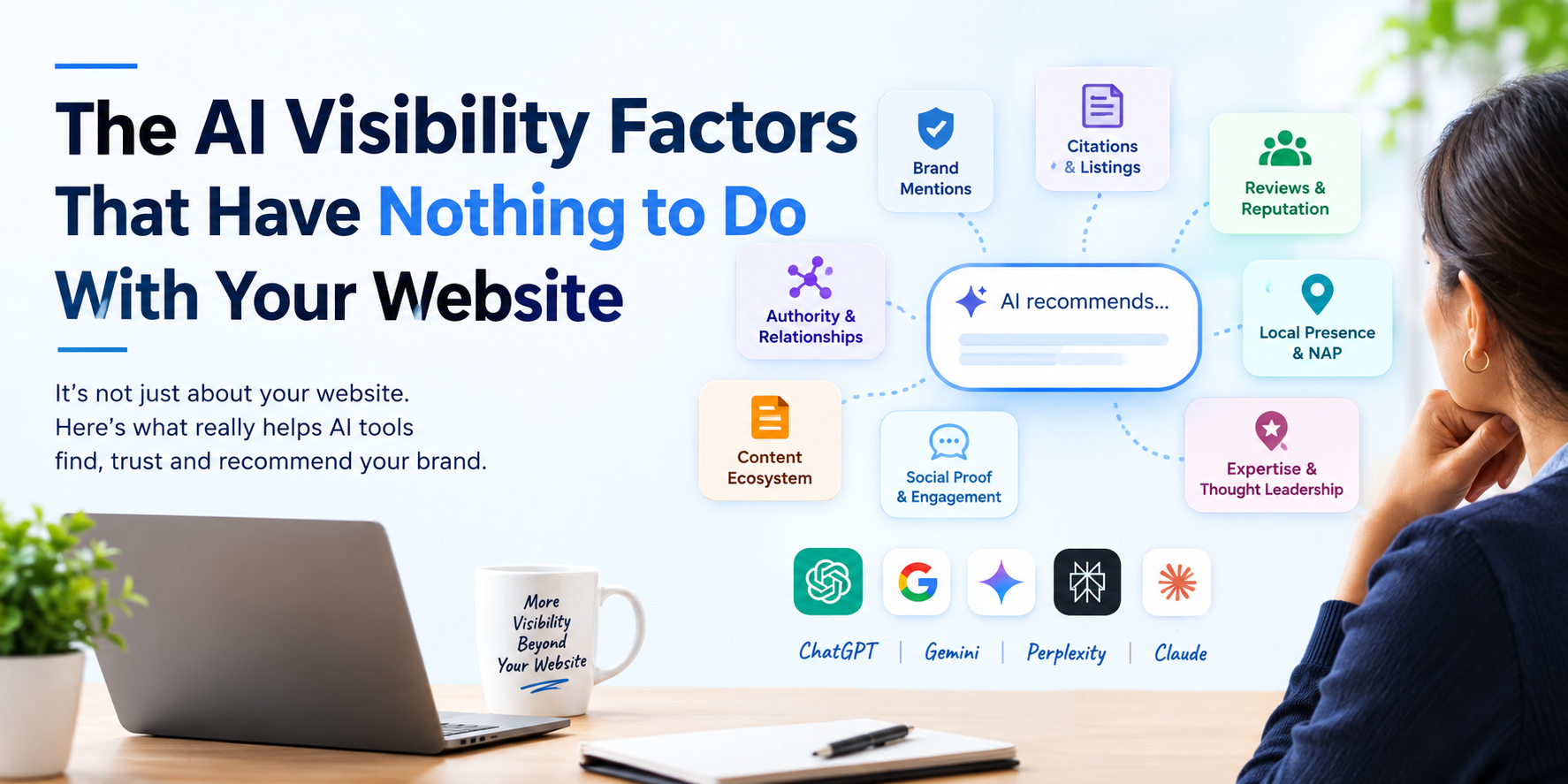
Most businesses that ask us why ChatGPT or AI Overviews won’t recommend them have already done the obvious things. Their website loads fast. Their pages have clear headings. They’ve even added some schema markup. And they’re still invisible. Here’s the part that surprises people: a large share of what decides whether AI recommends you… Continue reading The AI Visibility Factors That Have Nothing to Do With Your Website
Read More
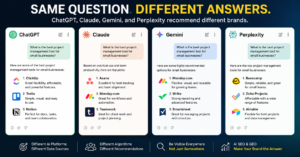
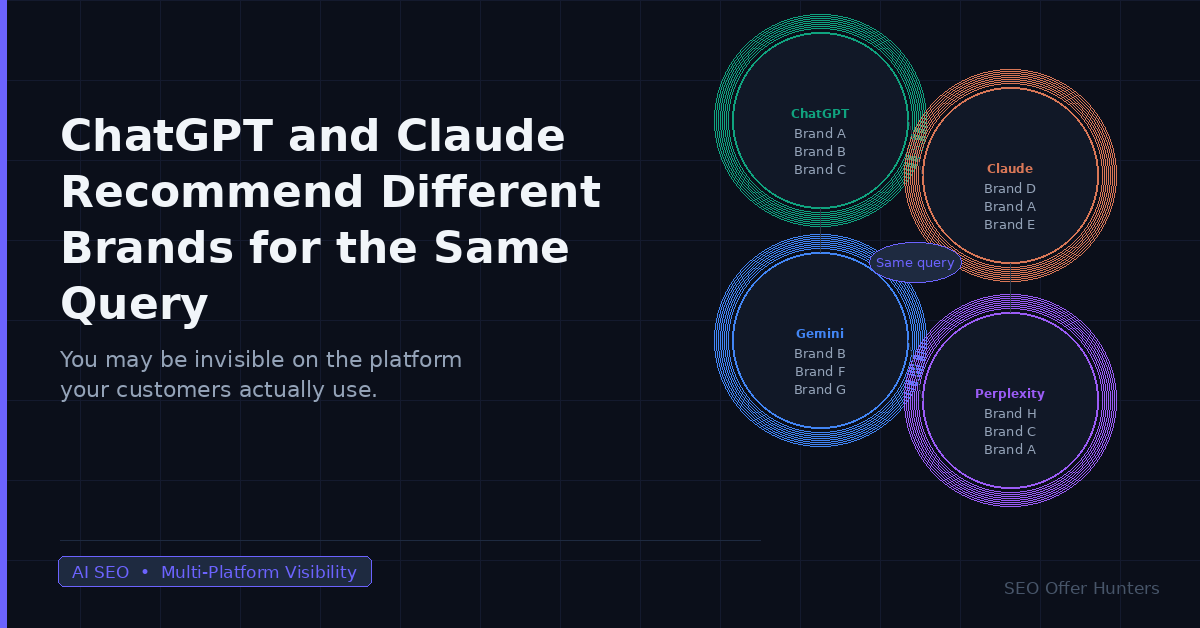
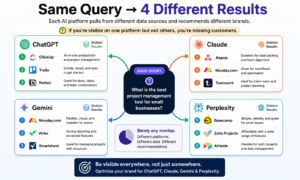
Quick Answer: ChatGPT, Claude, Gemini, and Perplexity each use different training data. As a result, they often recommend different brands for the exact same query. A business visible on ChatGPT may be completely missing from Claude. Without a multi-platform strategy, you are invisible to a large portion of AI-assisted customers — no matter how well you rank on one platform.
Try this simple test. Open ChatGPT, Claude, Gemini, and Perplexity. Type the same question into each: “What are the best [your service] companies for [your customer]?”
The results will not be the same. Some brands appear on all four platforms. Others show up on only one or two. In addition to this, some brands that rank well on Google may not appear on any AI platform at all.
This difference is one of the most important — and most overlooked — issues in AI marketing today. If you only focus on one platform, you miss the customers using the other three.
Why Do Different AI Platforms Recommend Different Brands?
Each AI platform learns from a different set of data. As a result, each one builds a different picture of which brands are trustworthy, relevant, and worth recommending.
Here are the four main reasons this happens.
Reason 1: Different training data
Every AI model learns from a different collection of text. OpenAI trains ChatGPT on one set of sources. Anthropic trains Claude on another. Google trains Gemini on its own data.
A brand that appears often in ChatGPT’s training sources may be barely present in Claude’s data. This is not about the brand’s quality. It is simply about which sources each model learned from.
“Training data” means the text an AI reads to learn about the world. Think of it like this: if you only read one newspaper, you only know the brands that newspaper mentions.
Reason 2: Different knowledge cutoffs
A “training cutoff” is the date when an AI model stopped learning new information. After that date, the model does not know about anything new.
For example, a brand that published strong content in 2022 may appear in older models. However, a brand that grew its online presence in 2024 may only appear in models with more recent cutoffs.
As a result, the timing of your content strategy matters differently for each AI platform.
Reason 3: Different design goals
Each AI platform has different priorities in how it was built. Claude focuses on safety and careful responses. Gemini integrates deeply with Google Search. These design differences affect which sources each model trusts and references.
In addition to this, even when two models have seen similar training information, they can still produce different recommendations because of these built-in priorities.
Reason 4: Live search vs. static training
Perplexity and certain ChatGPT modes use live web search. This means they can reference content published right now — even after their training cutoff.
However, other models rely entirely on their original training data. A brand with a strong current web presence may appear in live-search AI results but remain invisible in static-training models.
The AI Platform Landscape: How Each One Works
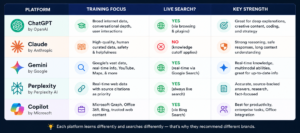
Here is a quick comparison of the five major AI platforms your customers may use:
ChatGPT: Broad web data + curated sources. Has optional live browsing mode. Reaches the largest global user base.
Claude: Safety-focused data curation. No live search (as of mid-2025). Strong among professional and enterprise users who value careful responses.
Gemini: Google Search data + the wider web. Live search built in. Reaches mobile and Google ecosystem users.
Perplexity: Live web search is its core feature. Reaches research-intent users who want cited, factual answers.
Copilot (Bing): Uses the Bing index with live search. Strong reach in Microsoft enterprise environments.
In addition to this, each platform reaches a different segment of your potential customers. Ignoring three of these five platforms means ignoring the customers who use them.
What Does Platform-Specific Invisibility Actually Mean for You?
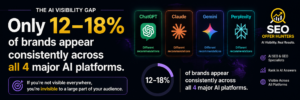
The Hidden Gap: AI SEO Offer Hunters research found that only 12–18% of brands appear consistently across all four major AI platforms for their core queries. Most businesses are visible on one or two platforms — and invisible to the rest.
Here is what this means in practice. Consider three different customers using different AI tools:
- A healthcare professional who uses Claude for research may never find your clinic — even if you appear on ChatGPT.
- A technology buyer who uses Perplexity to research vendors may find only your competitors — even if you rank well on Google.
- A younger professional using Gemini on their phone may see a completely different set of brands than an enterprise buyer using Copilot.
Your customers are spread across all these platforms. Their AI habits vary by age, profession, device, and what they are trying to do. As a result, visibility on one platform is not full market visibility — it is partial coverage at best.
Why Focusing on One AI Platform Is a Strategic Risk
Many businesses focus on ChatGPT first. This makes sense — it has the largest user base. However, this approach carries three serious risks.
Risk 1: Platform shift
AI platform market share changes fast. ChatGPT dominated in 2023. However, Gemini, Perplexity, and Claude have grown significantly by 2025.
If you build your entire AI strategy around one platform, you are vulnerable. A shift in how your customers use AI tools can undo months of work overnight.
Risk 2: Update vulnerability
Each AI model updates its training periodically. A brand that builds strong visibility on ChatGPT today may lose that visibility after an update changes how the model weights certain sources.
However, brands with visibility across multiple platforms are more resilient. As a result, losing ground on one platform does not hurt as much when others still recommend you.
Risk 3: Missing high-value customers
Certain high-value customers prefer specific AI platforms. For example, enterprise decision-makers often lean toward Copilot due to Microsoft integration. Researchers and academics frequently use Perplexity because it cites its sources.
If your most valuable customer segment uses a platform you have not optimised for, you are invisible to the exact people worth most to your business. In addition to this, these are often the customers who convert at the highest rates.
How to Build Multi-Platform AI Visibility
Building visibility across all major AI platforms requires a structured approach. However, the good news is that the core work benefits all platforms at once.
The foundation — consistent brand information, authoritative content, third-party citations, and strong review signals — works across every AI platform simultaneously.
On top of this foundation, the platform-specific layer involves four key activities:
- Identify which sources each platform weights most — then make sure your brand appears there.
- Create content formats that match each platform’s preferences. For example, use structured FAQs for live-search platforms and authoritative long-form content for training-data-heavy models.
- Monitor each platform separately. Track how often each AI mentions your brand, how accurately it describes you, and where gaps appear.
- Fill platform-specific gaps with targeted content and citation-building strategies.
This is the multi-platform AI visibility work that AI SEO Offer Hunters delivers. We do not optimise for one platform and hope for the best. We build cross-platform authority so your brand appears wherever your customers are searching.
Find out where you’re visible — and where you’re not. AI SEO Offer Hunters’ Free AI Visibility Check tests your brand across ChatGPT, Claude, Gemini, and Perplexity. Visit seoofferhunters.com to claim your free check today.
Frequently Asked Questions
Why does ChatGPT recommend different brands than Claude?
ChatGPT and Claude come from different companies — OpenAI and Anthropic respectively. Each trained their model on different data, with different methods and goals.
For example, what ChatGPT learned to associate with “trusted brand in marketing” may differ entirely from what Claude learned. This is not a bug. It is a natural result of two different models processing two different sets of information.
As a result, businesses need a multi-platform strategy — not a single-platform one.
Which AI platform do most customers use?
ChatGPT has the largest global user base as of 2025. However, usage varies significantly by customer type.
Gemini reaches a huge audience through Google and Android. Perplexity has grown quickly among research-intent users and professionals. Claude has strong adoption among enterprise users who value careful, nuanced answers. Copilot reaches the Microsoft ecosystem.
In addition to this, there is no single dominant platform for all customer types. That is exactly why multi-platform visibility is essential.
Does ranking on Google help my AI visibility?
Partially — but not as directly as most people assume. AI models trained on web content do include some Google-indexed material. However, ranking well on Google does not guarantee AI visibility.
Here is why: AI models do not use Google’s ranking algorithm. They assess content based on their own training criteria. In addition to this, live-search AI platforms may prioritise different sources than Google’s index.
Strong Google presence helps, but it is not enough on its own.
How often do AI platforms update their recommendations?
It depends on the platform type. Static-training models — like standard ChatGPT without the browsing feature — only update when they release a new model version. This may happen months apart.
However, live-search models like Perplexity and Gemini update continuously. They pull current web content in real time. As a result, your strategy should address both: long-term authority for training-data models, and strong current web signals for live-search models.
AI SEO Offer Hunters monitors both types as part of our ongoing client programmes.
What is the best first step to improve my AI visibility?
“Entity consistency” is the highest-leverage starting point. This means your brand is described the same way everywhere it appears online.
AI models identify brands as entities — named things with specific attributes. They cross-reference information about your brand across multiple sources. For example, if your company description differs between your website, LinkedIn, and Google Business Profile, AI models see inconsistency. As a result, they treat your brand as low-confidence — and low-confidence brands do not get recommended.
AI SEO Offer Hunters’ AI Visibility Check includes a full entity consistency audit as its first step.
Can AI SEO Offer Hunters guarantee I will appear on all AI platforms?
No reputable agency can guarantee specific AI outputs — AI recommendations are probabilistic, not fixed. However, we do guarantee something better.
We build the strongest possible set of AI visibility signals: entity consistency, content architecture, citation building, review strategy, and schema implementation (the structured data markup that helps AI models understand what your business does).
In addition to this, we measure real progress. We track your recommendation frequency across all major platforms over time and show you that data transparently throughout our engagement.
— Published by AI SEO Offer Hunters | seoofferhunters.com