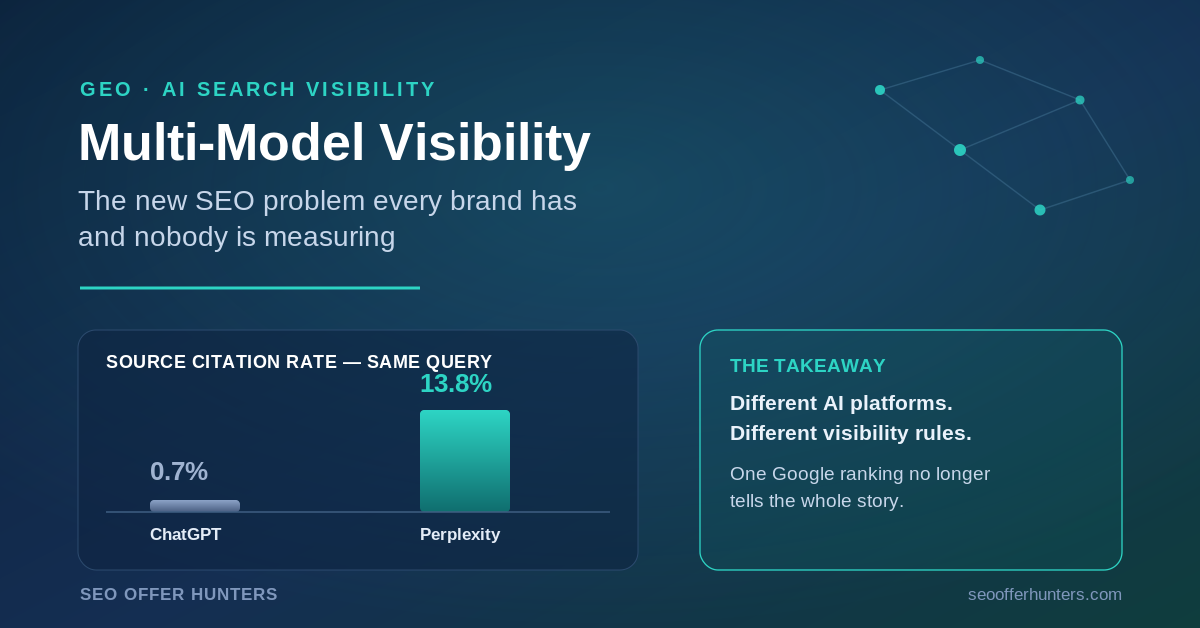
Your brand might be invisible right now, and you would never know it from your analytics. Search Console shows your rankings. Your rank tracker shows your keywords. Your traffic dashboard shows steady visits from Google. Everything looks fine. But none of these tools tell you what happens when someone asks ChatGPT, Perplexity, Gemini,… Continue reading Multi-Model Visibility: The New SEO Problem That Every Brand Has and Nobody Is Measuring
Read More
| QUICK ANSWER
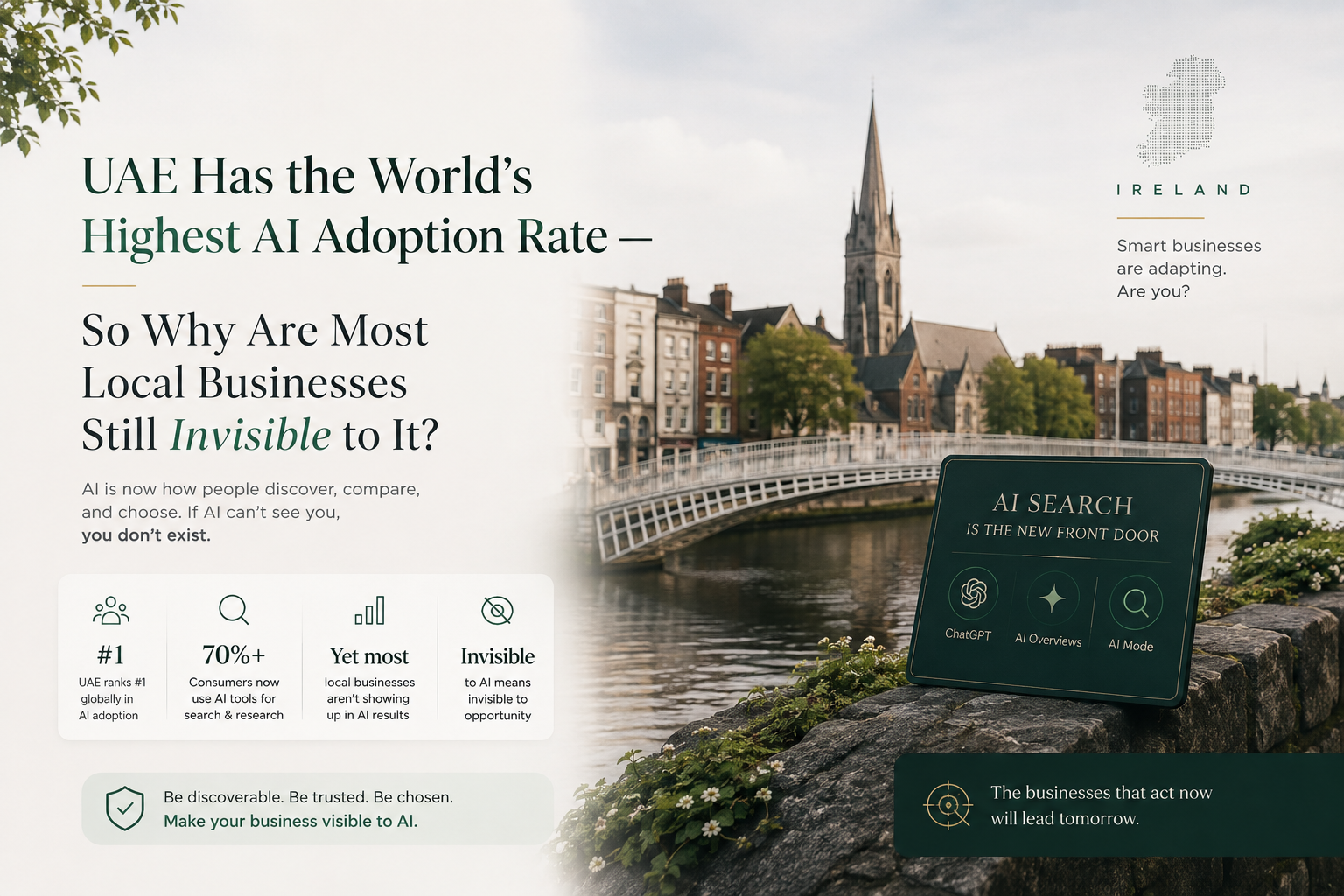
The UAE has the highest AI adoption rate in the world. 70.1% of the working-age population uses AI tools, and over 80% of employees use AI regularly at work. Yet 88% of businesses remain invisible inside ChatGPT, and even the best-performing industries, like architecture firms at 31.4% visibility, still leave roughly two in three businesses unmentioned. The gap exists because personal AI use and business AI visibility are two separate things. Closing it takes structured data, genuine third-party citations, multilingual Google Business Profile content, and deep topical authority, not just using ChatGPT yourself. |
A Nation of AI Users, and a Search Result With No Local Businesses In It
Picture this. A resident in Dubai Marina opens ChatGPT and asks for a good dentist nearby. The answer comes back in seconds, naming three or four clinics. Nowhere on that list is the dental practice two streets away, the one with excellent reviews and a loyal client base. That practice isn’t doing anything wrong. It simply isn’t built to be read by an AI system. Multiply that scene across thousands of businesses, and you have the real story of AI search in the UAE today.
Here is what makes this especially strange. The UAE recorded the highest AI adoption rate in the world in Q1 2026. 70.1% of the working-age population uses AI tools for at least 90 minutes a month. Separately, Microsoft’s January 2026 AI Diffusion Report put UAE workforce adoption at 64%. Either figure puts the UAE well ahead of almost every other country on earth. More than 80% of employees say they use AI regularly at work, according to the Stanford AI Index 2026.
So the UAE is not a market that needs convincing to use AI. Its people already have. But there is a sharp difference between a country full of individual AI users and a country full of AI-visible businesses. Those are not the same thing, and the gap between them is exactly where this guide is aimed.
This matters more in the UAE than almost anywhere else, precisely because expectations here are so high. A resident who uses ChatGPT daily for work naturally starts using it for everyday decisions too, from choosing a restaurant to picking a lawyer. When that habit meets a business that hasn’t adapted, the business simply doesn’t exist for that decision. Not because it lost to a competitor, but because it was never in the running to begin with.
The Numbers Behind the Paradox
Laid out side by side, the contrast becomes hard to miss. Personal AI adoption in the UAE is extraordinary. Business AI visibility, by comparison, is still in its early days.
| Metric | Figure | What It Tells Us |
| UAE working-age population using AI | 70.1% | Highest of any country recorded in Q1 2026 |
| UAE employees using AI regularly at work | 80%+ | AI use is now a daily habit, not a novelty |
| Middle East organisations increasing AI investment | 69% | Budgets are moving, even if strategy is still forming |
| UAE businesses invisible inside ChatGPT | 88% | Almost none show up when a customer asks for a recommendation |
| Best-performing industry AI visibility (architecture firms) | 31.4% | Even category leaders leave roughly two in three competitors unseen |
| UAE AI investment growth | 105% | Spending is surging well ahead of actual execution maturity |
Why Being an AI User Doesn’t Make Your Business AI-Visible
It helps to separate two things that get talked about as one. The first is personal AI fluency. That’s an employee using ChatGPT to draft a proposal, or a manager asking Gemini to summarise a report. The UAE leads the world at this. The second is business AI visibility. That’s whether an AI system, asked by a stranger, will name your business as an answer. These barely overlap, and the data shows exactly why.
77% of UAE executives cite inadequate data accuracy, access, and management as a major barrier to AI adoption at the organisational level. That matters here specifically, because AI search systems rely on exactly this kind of clean, structured data to decide who to cite. A business can be full of enthusiastic AI users internally and still present a messy, inconsistent, hard-to-parse footprint externally.
There’s a maturity problem too. 76% of AI-using firms are still “AI novices.” They rely on simple tools for isolated tasks, rather than integrating AI across how the business actually runs. And UAE AI investment surged 105% recently. Yet execution and data gaps are limiting how much of that spending translates into real capability. Money is moving faster than method. That combination, personal fluency plus organisational immaturity, is precisely what produces a country full of AI users and a search result with no local businesses in it.
None of this is a UAE-specific failure. It’s what happens anywhere adoption outpaces infrastructure. The difference is scale. So many UAE residents already default to asking AI first. Because of that, the cost of staying invisible compounds faster here than in a market where AI search is still a minority habit. A business that waits another year to fix this isn’t just missing today’s customers. It’s missing a growing share of every customer who now starts their search with a question to an AI system, not a browser tab.
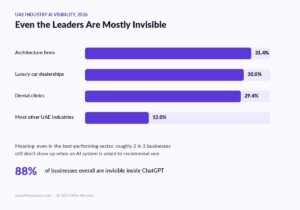
Even the strongest UAE industries for AI visibility still leave the majority of their own competitors unmentioned.
Which UAE Industries Are Already Ahead
Some sectors have made more progress than others. Architecture firms currently lead UAE AI visibility at 31.4%, followed by luxury car dealerships at 30.0%, and dental clinics at 29.4%. These are businesses whose customers tend to research heavily before buying, which naturally pushes them toward clearer, more detailed content.
But read that number again. Even in the best sector, fewer than one in three businesses shows up. That means roughly two in three architecture firms, the supposed leaders, are still invisible to an AI system asked to recommend one. Most other UAE industries sit far lower, closer to the 12% range. There is no sector in the UAE right now where AI visibility is a solved problem. There is only a gap between businesses further along and businesses that haven’t started.
That gap is exactly the opportunity. In most markets, being the tenth business to try a new marketing channel means fighting for scraps. Here, being early is still genuinely early. A business that puts the five actions below in place this quarter isn’t just catching up to a handful of leaders. It’s getting ahead of almost everyone else in its category, in every city and every sector, at once.
What Getting Cited Actually Buys You
The upside for the businesses that do get this right is substantial, and it is measurable. April 2026 research from Seer Interactive found that brands cited inside AI Overviews earn 120% more organic clicks than uncited brands appearing on the very same page. Separately, ChatGPT traffic converts roughly 31% higher than standard non-branded organic traffic. That happens largely because someone asking an AI system for a recommendation is usually much closer to a decision. They’re not casually browsing search results anymore. They’ve already narrowed things down to a short list, and being on it is what counts.
The cost of staying invisible is just as real. Even a business ranking in the top three organic positions can see click-through rates fall by 34% to 46% once an AI Overview answers the question directly above it. In other words, ranking well in traditional search no longer guarantees a click. Being the source an AI system trusts enough to cite is quickly becoming the more valuable position to hold.
Think about what this means for two competing businesses in the same neighbourhood, offering roughly the same service at a similar price. One has clean, structured data and a handful of genuine local citations. The other has neither. To a customer typing a question into ChatGPT, only one of them exists. The other could have the better product, the better price, even the better reviews on paper. None of that matters, because the AI system never surfaces it as an option in the first place.
Dubai vs Abu Dhabi: Same Country, Two Different Battlegrounds
Treating the UAE as one single market is a common mistake, and it costs businesses real visibility. Dubai’s search behaviour is shaped by tourism, luxury retail, real estate, and a hyper-competitive small business scene, all moving at speed. Abu Dhabi’s is shaped more by government-adjacent enterprise, established institutions, and a slightly more formal buying process. An AI system picks up on these differences, because the content, reviews, and citations that surround each city differ too.
That is why a single, generic “UAE strategy” tends to underperform compared with city-specific work. A page written for a Dubai tourist audience rarely speaks to an Abu Dhabi procurement team, and an AI system picks up on that mismatch just as quickly as a human reader would.
If you’re a business built around Dubai’s fast-moving, tourism-driven economy, our Dubai AI SEO & GEO services page is built around exactly that market.
If you’re operating in Abu Dhabi’s more enterprise-driven landscape, our Abu Dhabi AI SEO & GEO services page covers what actually moves the needle there.
For the full national picture across both cities, our UAE AI SEO & GEO country page is the place to start.
Five Things That Close the Visibility Gap
None of these require the UAE’s AI adoption rate to change. They require a business to close the gap between using AI personally and being visible to it publicly.
1. Clean, Structured Data
AI systems favour businesses whose name, address, services, and pricing are consistent and clearly marked up with schema. 77% of UAE executives already flag data quality as a barrier internally. Given that, this is often the very first fix worth making, and one of the cheapest. It usually starts with a simple audit. Does your website say the same thing as your Google Business Profile, word for word, down to the phone number and opening hours?
2. Multilingual Google Business Profile Content
UAE customers search in Arabic and English, often in the same week, sometimes in the same conversation. A Google Business Profile with reviews and descriptions in both languages is far more likely to surface in AI-generated local recommendations. That’s compared with one built for a single language audience. Encouraging existing customers to leave a short review in whichever language they’re comfortable with is a simple, low-cost way to build this out over time.
3. Genuine Third-Party Citations
AI systems trust what other credible sources say about a business more than what the business says about itself. A real mention on Gulf News, The National, Khaleej Times, Zawya, or a recognised chamber of commerce carries far more weight than any number of anonymous backlinks. One accurate, well-placed mention on a trusted UAE site is worth more than dozens of low-quality links from nowhere in particular.
4. Deep Topic Clusters, Not Shallow Posts
The old approach of publishing many thin, keyword-targeted pages no longer works well for AI citation. What performs better is a smaller number of deep, genuinely useful pages. Each should thoroughly answer a topic, interlinked into a clear cluster an AI system can trust as a whole. A single comprehensive guide, properly structured, tends to outperform ten shallow blog posts covering the same ground.
5. A Monthly AI Visibility Check
Ask ChatGPT, Perplexity, and Google AI Mode the exact question a customer would ask, once a month. Note what comes back. Given that even leading UAE industries sit around 30% visibility, this single habit is often the fastest way to see whether recent changes are actually working. It also catches problems early, before a competitor quietly takes the spot an AI system used to give to you.
Three UAE Businesses, Before and After
It helps to see this as something concrete rather than abstract. Here is how the same shift looks for three everyday UAE businesses, once they close the gap between using AI and being visible to it.
| Business | Before | After |
| Dubai boutique salon | Instagram-only presence, no structured website content | Bilingual Google Business Profile, FAQ page answering “best salon near JBR,” reviews in Arabic and English |
| Abu Dhabi consultancy | A generic “About Us” page with no specific service detail | A direct-answer page naming exact services, pricing ranges, and a genuine mention on a local business directory |
| Sharjah auto workshop | Word-of-mouth only, thin website with a single contact form | Schema-marked service pages, verified reviews, and a listing on a recognised UAE automotive directory |
The Bottom Line for UAE Businesses in 2026
The UAE’s AI adoption numbers are not in question. They are the highest in the world, and they are only going to climb further. The real opportunity sits in the gap this guide has walked through. 88% of businesses are still invisible inside ChatGPT, and even the strongest industries leave most of their own competitors unseen. For a market this AI-saturated, that gap will not stay open for long.
If you’d like a clear picture of where your business currently stands, our team can audit your visibility across Dubai, Abu Dhabi, and the wider UAE market. From there, we build a practical plan to close the gap before more of your competitors do.
Frequently Asked Questions
Why does the UAE have such high AI adoption but low business visibility?
Personal AI adoption measures how many individuals use tools like ChatGPT. Business AI visibility measures whether an AI system cites that business when answering a customer’s question. These require different things. One needs an app on a phone. The other needs structured data, citations, and content built for AI to extract and trust.
What does “88% of businesses are invisible in ChatGPT” actually mean?
It means that when ChatGPT is asked to recommend a business, roughly 88% of UAE businesses in the relevant category are never mentioned at all. This happens regardless of how good the underlying business actually is.
Is Dubai or Abu Dhabi easier to become visible in?
Neither is inherently easier, but they reward different approaches. Dubai’s market moves faster and is more competitive in tourism, retail, and real estate. Abu Dhabi rewards a more formal, enterprise-oriented approach. Treating them as identical markets is one of the most common mistakes UAE businesses make.
Do I need Arabic content to be visible in UAE AI search?
It significantly improves your chances, particularly for Google Business Profile content and reviews, since a large share of UAE AI search activity happens in Arabic. English-only businesses are competing for a smaller slice of the total AI search audience.
How much does it cost to become AI-visible as a UAE SME?
Several of the highest-impact fixes, like data consistency and Google Business Profile accuracy, cost nothing but time. Building genuine third-party citations and deep topic clusters takes more sustained effort, but rarely requires large upfront budgets to start.
Which UAE industries are furthest ahead in AI visibility?
Architecture firms currently lead at 31.4% visibility, followed by luxury car dealerships at 30.0% and dental clinics at 29.4%. Most other industries sit closer to 12%, meaning there is significant opportunity in almost every sector.
Does being cited in an AI Overview actually help my business, or is it just visibility for its own sake?
It has a measurable commercial effect. Brands cited inside AI Overviews earn 120% more organic clicks than uncited brands on the same page. Traffic arriving from AI tools like ChatGPT also converts roughly 31% higher than standard organic traffic.
Will ranking well on Google still matter if I’m not visible in AI search?
It still matters, but less than it used to. Even businesses ranking in the top three organic positions can see click-through rates drop by 34% to 46% when an AI Overview answers the query directly above their listing.
How long does it take to see results from AI visibility work in the UAE?
Fixing data consistency and Google Business Profile accuracy can show early changes within four to eight weeks. Building a genuine base of third-party citations and topical authority is a longer, ongoing process, typically measured in months rather than weeks.
Can a small UAE business really compete with larger, well-known brands for AI visibility?
Yes, more easily than in traditional SEO. Most competitors in most industries haven’t optimised for AI visibility yet. Because of that, even a modest, consistent effort can move a small business ahead of larger names that have ignored this shift so far.
Published by AI SEO Offer Hunters | seoofferhunters.com | GEO & AI Search Visibility Specialists