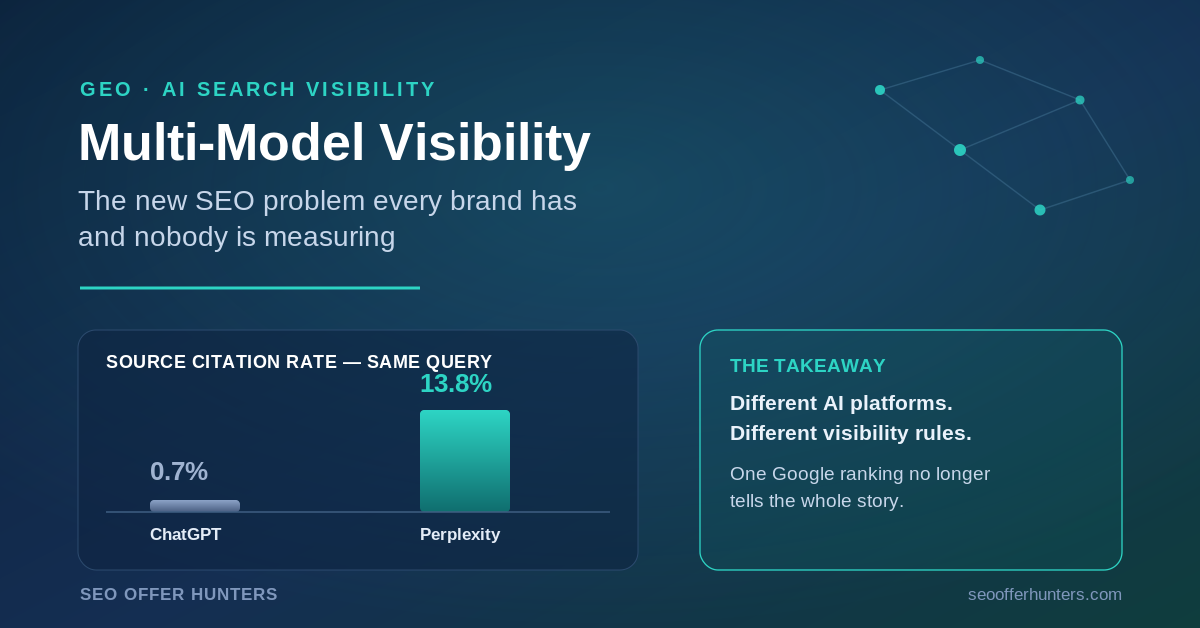
Your brand might be invisible right now, and you would never know it from your analytics. Search Console shows your rankings. Your rank tracker shows your keywords. Your traffic dashboard shows steady visits from Google. Everything looks fine. But none of these tools tell you what happens when someone asks ChatGPT, Perplexity, Gemini,… Continue reading Multi-Model Visibility: The New SEO Problem That Every Brand Has and Nobody Is Measuring
Read More
| QUICK ANSWER
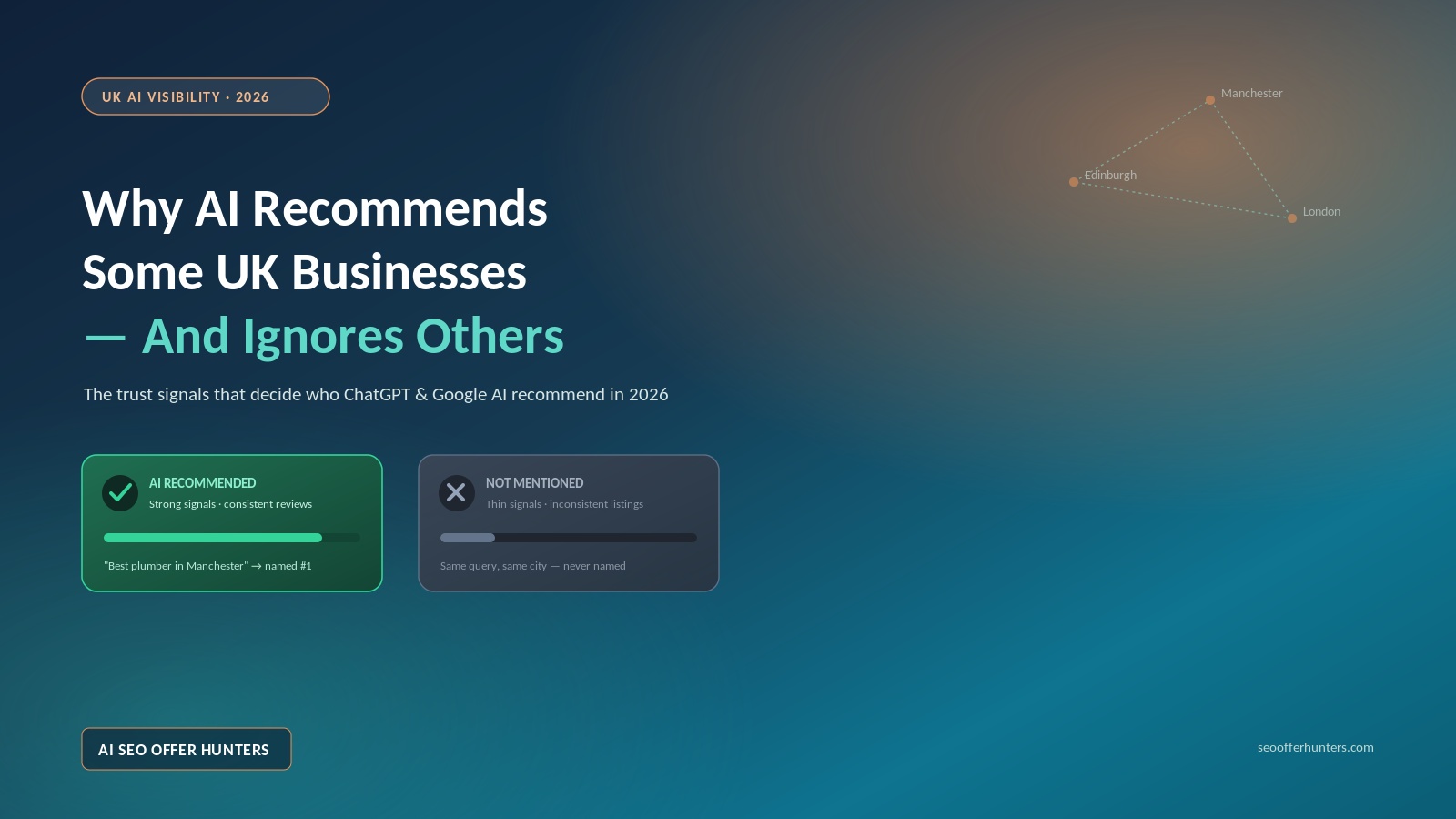
AI models recommend UK businesses based on measurable trust signals — consistent business information, third-party mentions, structured website content, and recent reviews — not on how good the business actually is. In 2026, 87% of UK companies still fail to appear in AI-generated recommendations for their core search terms, while a small number of competitors are recommended consistently across London, Manchester, Edinburgh, and every other UK market. The businesses AI ignores usually have thin, inconsistent, or undocumented online signals — not weaker products or services |
Open ChatGPT. Ask it: “best accountant near Manchester” or “best marketing agency in London.” You will get an answer — usually two or three named businesses, described with real confidence, as if the model has personally vetted them.
Now ask about a business you know is excellent — maybe your own. There is a real chance it does not appear at all. Not because it is worse than the businesses AI did name. Because AI never learned it exists in a way the model trusts enough to repeat.
This is happening across every UK city and every service category right now. Some businesses are being recommended by AI dozens of times a day, for free, without ever paying for the privilege. Others — often equally good, sometimes better — are invisible to the exact same systems. The difference is not luck. It is a specific, learnable set of signals, and this article breaks down exactly what they are.
Why AI Recommends Some Businesses and Ignores Others
Trust Signals, Not Marketing Claims
AI models do not read a homepage and decide a business is good. They cross-reference what a business says about itself against what independent sources say about it — reviews, directory listings, press mentions, and structured data. A polished website with no external corroboration reads as unverifiable to a model trained to avoid confidently repeating claims it cannot cross-check. In practice, this means a business with a modest website but strong, consistent third-party evidence will often be recommended over a business with a beautiful site and no outside verification at all.
Confidence Thresholds
AI models generate recommendations based on the strength of their trained associations for a given query. Some businesses have very strong associations — they are mentioned frequently, in authoritative contexts, in specific relation to that exact query type. Others have weak or no meaningful association at all. Businesses below a certain confidence threshold simply do not get mentioned, not because the model is being unfair, but because their signal strength never clears the bar for a confident recommendation. Being reasonably well known locally is not enough — you need to be one of the handful of businesses with the strongest signal for your specific query in your specific market.
The Cost of Inconsistent Information
For UK businesses specifically, this often comes down to basic consistency: does your business name, address, and phone number match exactly across your website, Google Business Profile, Companies House listing, and directories like Yell or Trustpilot? Mismatched details — a different phone number here, an outdated address there — do not just confuse customers. They erode the confidence a model needs before it will state your business name as a recommendation. Uncertainty-avoidance is a deliberate design choice in these systems: models are calibrated to omit a business rather than risk confidently recommending one they cannot verify.
The UK AI Search Shift Happening Right Now
This is not a marginal trend. AI-powered search has become a mainstream starting point for UK consumers researching local businesses, and the data shows how fast the shift has moved in the past year alone.
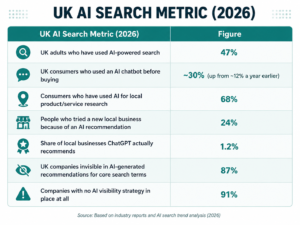
⚠ Warning: These are not niche statistics from an early-adopter minority. Nearly half of UK adults have already used AI-powered search, and Google has rolled out AI Mode — powered by Gemini 2.5 — across the UK, returning local pack-style results for location-specific queries. The businesses building AI visibility now are establishing positions that get harder to displace the longer they hold them.
The 1.2% figure is the one worth sitting with. Out of every 100 local businesses a customer might reasonably ask about, ChatGPT confidently recommends just over one of them. That is not a ranking position — it is closer to a locked door with a very small number of keys in circulation.
What an AI Recommendation Is Actually Worth to a UK Business
To understand why this matters commercially, it helps to put a number on what consistent AI recommendation actually delivers as a customer acquisition channel.
Consider a mid-sized UK service business with an average customer value of £4,000 per year. If 120 potential customers per month ask AI assistants about that service category in their area, and roughly 15% convert at a high-trust rate because they arrived already primed by an AI recommendation, the potential revenue impact becomes significant. This is where GEO services for UK businesses can help improve a business’s visibility across AI-powered search and recommendation platforms.
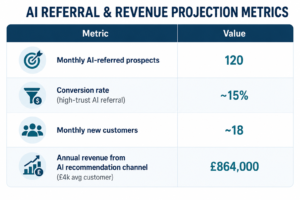
This illustration uses conservative, rounded numbers, and actual results vary enormously by industry and location. But the underlying point holds regardless of the exact figures: that revenue is going to a small number of businesses per category, and everyone else is getting zero from this specific channel — no matter how strong their traditional search rankings are.
How to Check Where Your Business Stands
Run this test yourself before assuming your business is either fine or invisible. Ask the questions a real customer would, across ChatGPT, Google AI Mode, Gemini, and Perplexity, and record the honest answers:
- Are you mentioned at all for your core service queries in your local area?
- What position do you occupy when you are mentioned — first named, an afterthought, or missing entirely?
- How accurately and specifically is your business described, if it is described at all?
- Which competitors consistently appear in your place, and what do they have in terms of reviews, press, and directory presence that you do not?
- Is your presence consistent across multiple related queries, or does it disappear the moment the phrasing changes?
This test takes about ten minutes and tells you more about your real competitive position in AI-driven search than any traditional keyword ranking report — because it shows you exactly what a prospective customer sees the moment before they decide who to call.
How AI SEO Offer Hunters Builds AI Visibility for UK Businesses
At AI SEO Offer Hunters, we treat AI recommendation visibility as a structured, measurable programme — not a vague promise to “improve your online presence.” Our process starts by mapping the specific queries your customers actually type into ChatGPT, Gemini, and Google AI Mode, identifying which businesses currently hold those recommendation positions in your market, and analysing the gap between their signal strength and yours.
From there, we build a targeted programme that combines structured content, third-party citations, review and directory consistency work, and entity signal alignment. As a result, closing that gap becomes measurable and trackable, rather than a guessing game.
Because AI recommendation patterns differ meaningfully by city and market, this work is also location-specific. For example, we run dedicated AI SEO and GEO programmes for businesses in London, Manchester, and Edinburgh, as well as for businesses operating across the wider UK market. In other words, the signal strategy reflects how AI models actually treat recommendations in your specific city, rather than a generic national approach.
In addition, we track your AI recommendation frequency as a hard KPI, measured monthly across ChatGPT, Gemini, Copilot, and Perplexity. So, instead of relying on a one-off audit that goes stale within weeks, you can see exactly how your position changes over time.
✦ Key Insight: Find out which AI recommendation slots you already hold — and which local competitors are taking the ones you should own. AI SEO Offer Hunters provides a Free AI Visibility Check that maps your recommendation position across ChatGPT, Claude, Gemini, and Perplexity. Visit seoofferhunters.com to claim yours.
Frequently Asked Questions
Why does AI recommend some UK businesses and not others?
AI models recommend businesses based on measurable trust signals — consistent business information, third-party mentions, structured content, and recent reviews — rather than subjective quality. AI systems typically omit businesses with thin, inconsistent, or undocumented online signals, even when those businesses offer excellent products or services.
What signals do AI models actually look for before recommending a business?
The highest-impact signals include consistent name, address, and phone details across your website and directories; volume and quality of third-party mentions from authoritative sources; review density and sentiment on platforms like Google and Trustpilot; and structured, specific website content that directly answers the queries customers ask.
Is Google AI Overviews the same as a ChatGPT recommendation?
No. Google AI Overviews and AI Mode draw on Google’s own index and Gemini model, including live local pack-style results for location queries, while ChatGPT relies on a mix of training data and, in some contexts, live browsing. A business can appear strongly in one and be absent from the other, which is why testing across all major platforms matters.
How many UK businesses actually appear in AI search recommendations?
Current studies indicate 87% of UK companies fail to appear in AI-generated recommendations for their primary commercial search terms, and 91% have no AI visibility strategy in place at all. Only a small minority currently show up consistently across multiple AI platforms.
Does AI recommend my business only if I rank number one on Google?
Not necessarily. AI recommendation signals overlap with traditional SEO but are not identical — third-party citations, review consistency, and structured, extractable content can matter more than raw keyword ranking position for whether an AI model chooses to name your business.
Can a small UK business compete with larger, better-known brands for AI recommendations?
Yes, particularly in local and niche categories where large national brands often have weaker location-specific signals. A smaller business with strong, consistent local citations and recent reviews can outperform a bigger competitor for hyper-local queries.
How does AI visibility differ across cities like London, Manchester, and Edinburgh?
Local signals shape AI recommendation patterns in each market, including the density and quality of local citations, reviews, and press mentions specific to that city. A business in Edinburgh competing for “best” queries needs signals rooted in Edinburgh-specific sources, not just a national presence, and the same logic applies in London and Manchester.
How long does it take for a business to start appearing in AI recommendations?
Timelines vary by category and how large the current signal gap is, but businesses generally start seeing measurable movement within a few months of a structured citation and content programme, with stronger, more consistent positioning building over six to twelve months as signals accumulate.
What is the difference between traditional SEO and AI/GEO optimisation?
Traditional SEO focuses primarily on ranking web pages in search engine results. AI/GEO (Generative Engine Optimisation) focuses on the signals that determine whether an AI model will confidently name your business in a generated answer — a related but distinct set of priorities, including third-party trust signals and structured content that a model can extract and repeat accurately.
How can I test my UK business’s AI visibility?
Ask the same questions your customers would ask across ChatGPT, Google AI Mode, Gemini, and Perplexity. Track whether your business appears, how AI describes it, which competitors appear, and which sources AI uses to support its answers. AI SEO Offer Hunters offers a free AI Visibility Check that runs this test for you across all major platforms.
— Published by AI SEO Offer Hunters | seoofferhunters.com