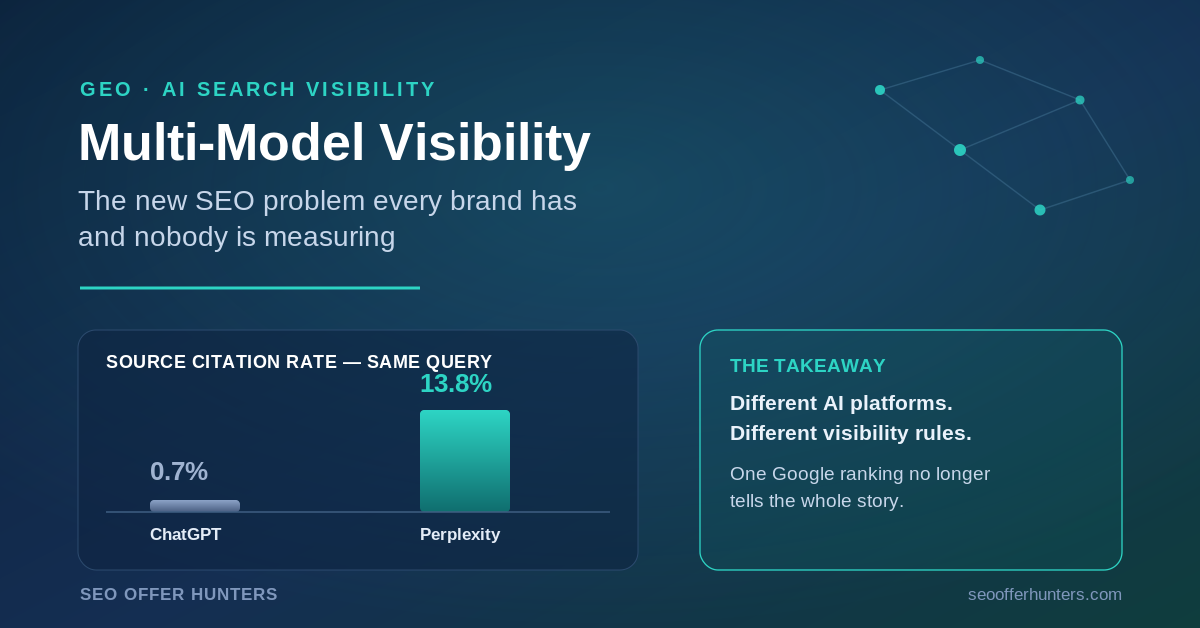
Your brand might be invisible right now, and you would never know it from your analytics. Search Console shows your rankings. Your rank tracker shows your keywords. Your traffic dashboard shows steady visits from Google. Everything looks fine. But none of these tools tell you what happens when someone asks ChatGPT, Perplexity, Gemini,… Continue reading Multi-Model Visibility: The New SEO Problem That Every Brand Has and Nobody Is Measuring
Read More
“A customer opens ChatGPT and types: ‘What is the best plumbing company in Houston, Texas?’ Your competitor’s name appears instantly. Your business doesn’t. Why?”
This scenario plays out thousands of times every day across the United States. Business owners spend years building a Google presence. However, when customers turn to AI tools for recommendations, those businesses simply don’t exist.
The reason is not that your business is bad. It is that AI search works completely differently from Google Search. Therefore, what works for Google rankings often does nothing for AI visibility.
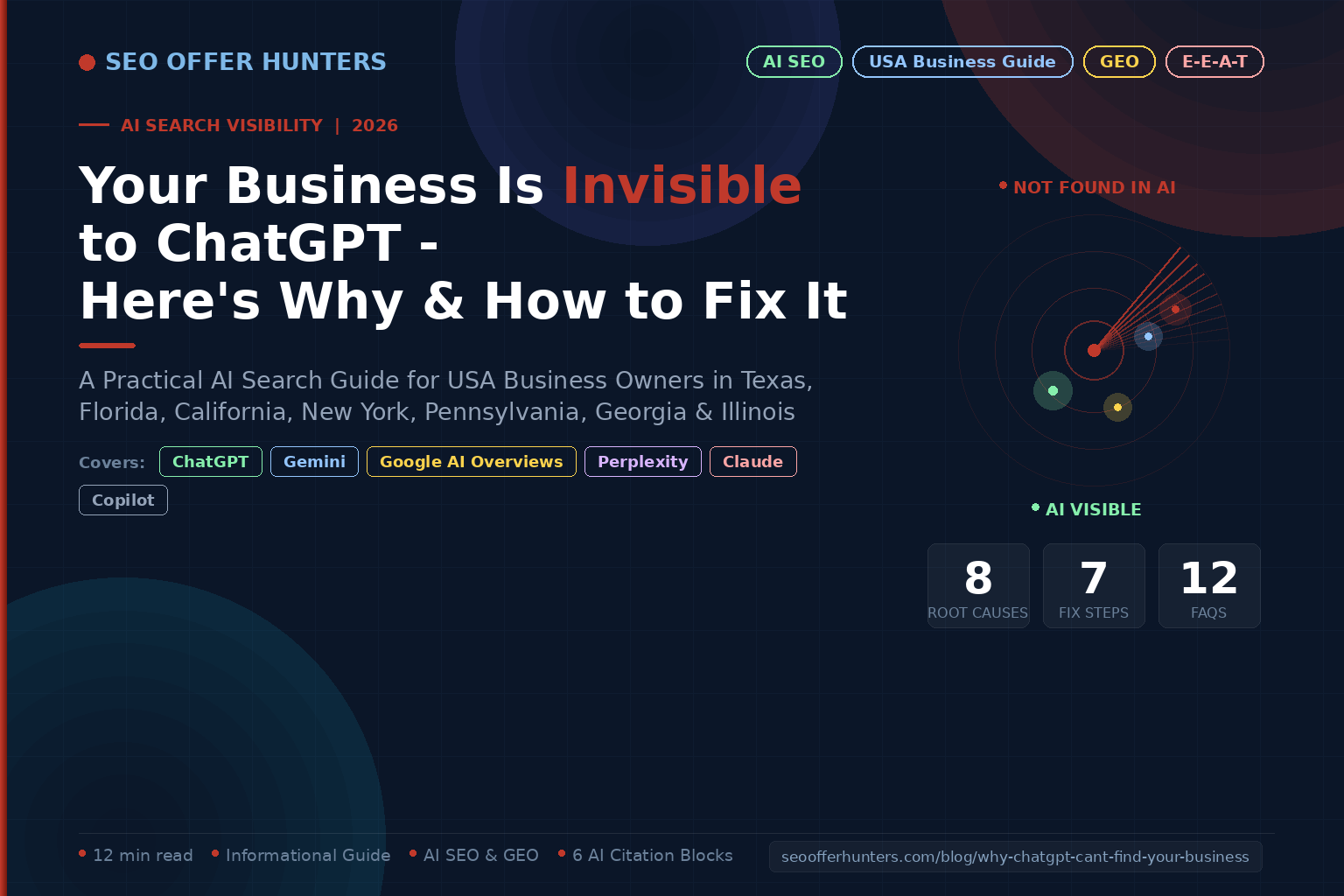
This guide explains why your business doesn’t appear in ChatGPT, Gemini, and Google AI Overviews. More importantly, it gives you the practical steps to fix it.
Traditional SEO and AI Search: Why They Are Not the Same
What Traditional SEO Does
Traditional SEO helps your website rank on Google’s results page. It focuses on backlinks, keywords, technical signals, and page speed. For years, this was the primary way customers found businesses online.
However, the search landscape has fundamentally changed. A growing share of customers now bypass traditional search results entirely. Instead, they go straight to AI tools for recommendations.
Why Google Rankings Don’t Guarantee AI Visibility
AI systems like ChatGPT don’t crawl the web the way Google does. Instead, they synthesize information from content they have already processed and learned from. As a result, your Google position has almost no direct impact on whether AI tools recommend you.
For example, a law firm in Philadelphia, Pennsylvania might rank on page one for “estate planning attorney Philadelphia.” Yet ChatGPT recommends a competitor with weaker Google rankings but stronger entity signals and topical authority. This happens because AI systems evaluate credibility differently from search engines.
Furthermore, AI recommendations carry enormous weight. When ChatGPT names a specific business, users often act on that recommendation without clicking anything else. Therefore, AI visibility is arguably more valuable than a standard search ranking for many business types.
| Q: How does AI search differ from Google Search?
Google Search ranks web pages using backlinks, keywords, and technical signals. AI search, however, generates direct answers by synthesizing information from trusted, credible sources. AI tools like ChatGPT and Gemini do not list pages — they recommend businesses directly. As a result, traditional SEO alone no longer guarantees visibility in AI-powered search. Businesses need a separate AI optimization strategy. |
What Is AI Search? The Platforms You Need to Know
AI search refers to platforms that use large language models (LLMs) to generate direct answers rather than lists of links. Each major platform works slightly differently. Here is what each one does and why it matters for your business.
ChatGPT (OpenAI)
ChatGPT is one of the world’s most widely used AI assistants. Millions of people ask it to recommend businesses, compare services, and answer purchase-related questions every day. It generates answers from its training data and, in some modes, live web browsing.
For business owners in California and New York, ChatGPT recommendations are especially significant. The user base in these states skews heavily toward tech-literate professionals who use ChatGPT as their primary research tool.
Google AI Overviews
Google AI Overviews appear above traditional results for many commercial queries. They synthesize answers from multiple web sources. Businesses featured in AI Overviews gain instant visibility — without users needing to click any individual link.
In addition, Google AI Overviews are rolling out to more query types every month. Therefore, businesses that optimize for AI Overviews gain an advantage that grows over time.
Gemini (Google)
Gemini is Google’s own AI model. It integrates with Google Search, Google Workspace, and Android devices. Many users in Georgia and Florida — particularly those using Android — receive Gemini-generated responses instead of traditional search results.
Perplexity
Perplexity functions as an AI-powered research tool that cites its sources directly. Business professionals use it to compare vendors, evaluate service providers, and research industry information. It is particularly popular with B2B buyers and procurement teams.
Claude (Anthropic)
Claude has a growing user base among professionals and knowledge workers. It handles complex research queries well and earns increasing use in business decision-making contexts. Many enterprise buyers in Illinois and Pennsylvania use Claude for vendor research.
Microsoft Copilot
Copilot integrates AI search into Microsoft’s ecosystem — including Bing, Office, and Windows. Its usage is especially high in enterprise and B2B contexts. For businesses targeting corporate clients in New York and Texas, Copilot visibility matters significantly.
Why Your Business Doesn’t Show Up in ChatGPT
This is the question most business owners want answered. Here are the most common reasons — and none of them are permanent.
1. Weak Entity Signals
AI systems understand the world through entities — named businesses, people, places, products, and concepts. If your business is not clearly identified as an entity in content AI systems have processed, they simply cannot recommend you.
Entity signals include your business name, address, phone number, core services, locations served, and consistent mentions across credible sources. For example, a law firm in Atlanta, Georgia that clearly identifies its practice areas, attorneys, and office location on every page sends strong entity signals. A firm with a vague homepage, however, does not.
2. Poor Topical Authority
Topical authority means your website demonstrates genuine depth of knowledge in your field. AI systems prefer to cite sources that cover a topic thoroughly rather than broadly.
Therefore, a single homepage with a brief service description doesn’t establish authority. However, a website with detailed service pages, FAQ content, and educational articles does. For instance, a healthcare clinic in Miami, Florida that publishes detailed guides about its specialty areas is far more likely to appear in AI health recommendations than a competitor with only a contact page.
3. Thin or Unstructured Content
AI systems extract structured, factual information from content. Generic filler text, stock phrases, and vague descriptions give AI tools nothing specific to extract and cite.
Strong AI-ready content is factual, definition-rich, and organized with clear headings. Each page should answer specific questions your customers ask. As a result, AI tools can quote your content with confidence — rather than skip it entirely.
4. Missing Structured Data
Structured data markup — specifically JSON-LD schema — tells AI systems and search engines exactly what your business is, what it does, and where it operates. Without structured data, AI tools must guess your business type from unformatted text. This leads to misclassification or no citation at all.
LocalBusiness schema, FAQPage schema, and Organization schema are particularly important for local businesses across states like Pennsylvania, Illinois, and California. They act as a formal introduction between your business and AI systems.
5. Inconsistent Business Information
AI systems cross-reference information from multiple sources to verify a business’s identity. If your business name, address, or phone number differs across your website, Google Business Profile, social media, and directories, AI tools lose confidence in your business as a reliable entity.
This problem is common for businesses that have moved, rebranded, or expanded. For example, a service company operating in both New York and New Jersey may have inconsistent location information across different profiles — which directly reduces AI citation rates.
6. Limited Brand Mentions
AI tools learn about businesses from content across the entire web. If your business rarely appears in third-party sources — news articles, industry directories, review platforms, or professional blogs — AI systems have limited material to reference.
In contrast, a business mentioned consistently across credible external sources earns strong AI citations. For manufacturers in Texas or distributors in Illinois, earning coverage in industry trade publications can significantly boost AI visibility.
7. Lack of E-E-A-T Signals
E-E-A-T stands for Experience, Expertise, Authoritativeness, and Trustworthiness. AI systems use these signals to decide which businesses to recommend and which to avoid.
Specifically, this includes clearly identified authors with credentials, transparent business history, verified client reviews, professional certifications, and consistent evidence of expertise. Without these signals, AI tools avoid recommending your business — regardless of how good your services actually are.
8. Poor Internal Linking
Internal links help AI systems understand how your pages relate to each other. Good internal linking shows AI tools that your website covers a topic completely — not just one aspect of it.
For example, a manufacturing company in Chicago, Illinois that links its product pages to its certifications page, case studies, and FAQ section creates a coherent content network. AI systems can navigate this network, understand the business fully, and cite it with confidence.
| Q: Why doesn’t ChatGPT recommend every business?
ChatGPT recommends businesses with strong entity signals, topical authority, and credible third-party mentions. Businesses with thin content, missing structured data, or inconsistent information across the web are rarely cited. Therefore, AI systems prioritize businesses that clearly identify what they do, where they operate, and why they are trustworthy — across multiple reliable sources, not just their own website. |
What Is AI SEO?
AI SEO is the practice of optimizing a business’s digital presence so that AI-powered platforms — including ChatGPT, Gemini, Google AI Overviews, Claude, and Perplexity — can accurately understand and recommend that business to users.
Traditional SEO focuses on ranking higher in Google’s results. AI SEO focuses on becoming a credible, citable source within AI systems. However, the two approaches reinforce each other. Good AI SEO naturally strengthens traditional SEO at the same time.
| Q: What is AI SEO?
AI SEO (Artificial Intelligence Search Engine Optimization) is the practice of optimizing a business’s digital presence so that AI-powered platforms — including ChatGPT, Google AI Overviews, Gemini, Claude, and Perplexity — can accurately understand, cite, and recommend that business to users. It combines traditional SEO practices with structured content, entity clarity, and E-E-A-T signals designed specifically for large language models. |
What Is Generative Engine Optimization (GEO)?
Generative Engine Optimization — or GEO — is a specific branch of AI SEO. It focuses on making your content easy for large language models to extract, cite, and present as a direct answer.
GEO content is factual, definition-rich, and self-contained. Each section answers a specific question directly. For example, instead of writing “We offer a range of legal services,” a law firm in Dallas, Texas would write: “Our Dallas litigation team handles commercial disputes, breach of contract cases, and employment law matters for Texas-based businesses.”
This level of specificity gives AI tools something concrete to quote. In contrast, vague language gives them nothing useful to work with — so they cite a competitor instead.
| Q: What is Generative Engine Optimization?
Generative Engine Optimization (GEO) is the practice of structuring website content so that large language models — the AI systems that power ChatGPT, Gemini, and Perplexity — can easily extract, cite, and present that content as a direct answer to user questions. GEO content is factual, definition-rich, organized with clear headings, and written to answer specific questions that potential customers ask AI tools. |
How to Improve Your AI Visibility: Practical Steps for USA Businesses
Good news: every reason your business is invisible in AI search is fixable. Here are the practical steps to take — starting today.
Step 1: Build Clear Entity Signals
Start by making your business identity crystal clear everywhere online. Your business name, address, phone number, and core services should appear consistently across your website, Google Business Profile, Yelp, LinkedIn, and industry directories.
This is particularly important for service businesses in high-competition states like California and Florida. In these markets, AI tools receive thousands of similar queries daily and must distinguish one business from another quickly. Inconsistency creates doubt. Clarity earns citations.
Step 2: Build Topical Authority
Create in-depth content that covers every aspect of your service area. A healthcare clinic should not just list its services. Instead, it should publish articles, FAQs, and guides covering every condition it treats and every question patients commonly ask.
Similarly, a law firm in New York City should maintain separate, detailed pages for every practice area. Each page should answer the questions a real client would ask — not just describe the service in general terms. This depth of coverage is what topical authority means in practice.
Step 3: Add Structured Data Markup
Add JSON-LD schema markup to every important page on your website. Start with Organization schema, LocalBusiness schema, FAQPage schema, and Service schema. These markups help AI systems understand your business type, location, and offerings — even when your written content is imperfect.
A SaaS company in San Francisco, California might also benefit from SoftwareApplication schema and Product schema. For a manufacturer in Georgia, adding ItemList and Product schema to product catalog pages helps AI tools understand the full range of what the business offers.
Step 4: Strengthen Your E-E-A-T Signals
To strengthen E-E-A-T, take these specific actions:
- Add author bios with professional credentials to every blog post and article.
- List team members, qualifications, and certifications on your About page.
- Publish verified client testimonials and case studies with specific outcomes.
- Earn mentions in reputable industry publications, local news, and professional directories.
- Maintain an active Google Business Profile with consistent, recent reviews.
For example, a manufacturing company in Pennsylvania that publishes ISO certification details, client success stories, and team bios earns far stronger E-E-A-T signals than one with a bare-bones website.
Step 5: Write AI-Friendly FAQs
AI tools frequently pull content from FAQ sections because FAQs are structured, direct, and self-contained. Therefore, every service page on your website should include a dedicated FAQ section.
Write FAQs using natural conversational language — the same way a customer would phrase a question to ChatGPT. For example: “What does an AI SEO consultant do?” or “How much does digital marketing cost for a small business in Georgia?” This phrasing directly matches the queries AI tools receive.
Step 6: Improve Internal Linking
Internal links help AI systems map the relationships between your pages. Link your service pages to related blog posts, FAQs, testimonials, and location pages. In particular, businesses serving multiple states — such as Texas and Illinois — should link city and state pages to main service pages clearly.
Good internal linking creates a content network. AI systems navigate this network, understand your full offering, and cite your business with confidence rather than uncertainty.
Step 7: Build Third-Party Brand Mentions
AI systems learn about businesses from content across the entire internet — not just from your website. Getting your business mentioned in industry publications, local news outlets, review platforms, and partner directories significantly strengthens your AI visibility.
For example, a marketing agency in Chicago, Illinois that earns a feature in a marketing industry publication receives a credibility signal that website optimization alone cannot replicate. Similarly, a healthcare provider in Houston, Texas that appears in local health news builds AI trust that persists over time.
| Q: What helps AI models trust a business?
AI models trust businesses with strong E-E-A-T signals — Experience, Expertise, Authoritativeness, and Trustworthiness. Specifically, this includes clearly identified authors and credentials, consistent business information across the web, verified client reviews, third-party brand mentions, structured data markup, and content that demonstrates genuine subject matter expertise. Businesses that combine all these elements are cited most frequently by ChatGPT, Gemini, and Google AI Overviews. |
AI SEO Checklist for USA Business Owners
Use this checklist to assess your current AI visibility and identify the gaps to fix first.
Entity & Business Information
- Business name, address, and phone are consistent everywhere online
- Google Business Profile is claimed, verified, and fully complete
- Business appears in relevant directories (Yelp, BBB, and industry-specific)
- Social media profiles match website business information exactly
Website Content
- Each service has its own dedicated page with a detailed description
- About page includes team bios, credentials, and company history
- FAQ sections appear on all key service pages
- Location pages exist for every city or state you serve
- Blog or resources section demonstrates genuine topical depth
Structured Data
- Organization or LocalBusiness schema added to homepage
- FAQPage schema added to all FAQ sections
- Service schema added to all service pages
- Schema markup validated using Google’s Rich Results Test
E-E-A-T & Trust Signals
- Author credentials are visible on all content pages
- Client reviews are published and linked from relevant pages
- Certifications, awards, and accreditations are listed on the website
- Media mentions or press coverage are highlighted
Internal Linking
- Service pages link to related blog content and FAQs
- Location pages link to relevant service pages
- Blog posts link back to core service pages contextually
Common Mistakes That Keep Businesses Invisible in AI Search
Many business owners make the same avoidable errors. Here are the most important ones to fix.
Relying on Google Rankings Alone
A high Google ranking does not mean AI tools will recommend you. AI search and Google search use different signals. Therefore, businesses that invest only in traditional SEO often find themselves completely invisible in AI-generated answers.
Publishing Thin Content
Brief service descriptions and generic “about us” paragraphs give AI tools nothing to extract. AI systems cite businesses with detailed, specific, factual content. In addition, thin content signals low expertise — which reduces E-E-A-T scores across every AI platform.
Ignoring Structured Data
Many websites skip schema markup entirely. However, structured data is one of the clearest signals you can give AI systems about what your business does. Without it, AI tools must guess your business type from unformatted text — and often guess wrong or skip you entirely.
Inconsistent Business Information
If your phone number on Yelp differs from your website, AI systems flag this inconsistency. As a result, confidence in your business as a reliable entity drops. This is especially common for businesses in Florida and Georgia that have changed locations or updated branding without updating all online profiles.
Writing for Search Engines Instead of People
Keyword-stuffed content reads unnaturally and provides low-quality answers. AI systems are trained on human language. Therefore, they prefer content that sounds genuine, helpful, and authoritative — not content written to manipulate rankings.
No Third-Party Visibility
A business that only exists on its own website has a very limited AI footprint. Earning mentions in credible external sources matters enormously for AI citation. This is particularly important for B2B businesses and manufacturers targeting enterprise clients.
When Should You Hire an AI SEO Expert?
AI SEO can be done independently using the checklist and steps in this guide. However, some situations genuinely benefit from professional support.
Consider Professional Help If:
- You’ve followed basic SEO best practices but still don’t appear in AI recommendations.
- You operate in a competitive market — law, healthcare, or financial services in New York, California, or Texas.
- Your business serves multiple states and needs consistent AI visibility across locations — for example, Pennsylvania and Illinois.
- Your website has significant technical issues that affect content structure and crawlability.
- You want AI visibility as a structured, long-term strategy rather than a one-time fix.
What Professional AI SEO Includes
Professional AI SEO goes beyond traditional optimization. It typically includes:
- AI content audits
- Structured data implementation
- Entity optimization
- Topical authority planning
- Internal linking improvements
- Ongoing performance monitoring
These activities require continuous analysis and refinement. For businesses in competitive markets like California, Georgia, and Florida, expert support can help accelerate results.
Ready to Improve Your AI Visibility?
If you’d like to explore professional help, learn more about our AI SEO services in the USA or explore our GEO solutions for businesses that want to be cited by AI platforms. You can also contact us to speak directly with a specialist.
| Q: How long does AI SEO take?
AI SEO typically produces initial results within 8 to 16 weeks for businesses that implement changes consistently. The timeline depends on your website’s current state, your industry’s competitiveness, and how much content restructuring is required. Unlike paid advertising, however, AI visibility compounds over time. Businesses that build strong topical authority early create a lasting advantage that competitors find very difficult to close. |
Looking for AI SEO Services in Your State?
Whether you’re a local business, startup, or established company, we help businesses improve their visibility in ChatGPT, Gemini, Google AI Overviews, and other AI search platforms across the United States.
Choose your state to learn more:
• Texas ,Florida ,California ,New York
• Illinois, Pennsylvania ,Georgia
clusion: Getting Found in AI Search Is a Choice
Businesses that appear in ChatGPT, Gemini, and Google AI Overviews share common characteristics. They have clear entity signals, detailed content, consistent business information, and strong trust credentials.
However, most of these are not technical achievements. They are content and credibility achievements. If your business is invisible in AI search today, it is because AI systems do not yet have enough structured, credible information to recommend you with confidence.
The good news is that this is entirely fixable. Start with the checklist above. Improve your content structure. Add structured data. Strengthen your E-E-A-T signals. Over time, AI tools will learn to find you, understand you, and recommend you.
Businesses across Texas, Florida, California, New York, Pennsylvania, Georgia, and Illinois are already building AI visibility now. The window for early-mover advantage is still open — but it is closing.
If you want professional guidance on where to start, contact us to speak with an AI SEO specialist. Alternatively, explore our AI SEO strategy page to understand how we help USA businesses build lasting AI visibility across every major platform.
Traditional SEO vs AI SEO: Side-by-Side Comparison
| Signal / Factor | Traditional SEO | AI SEO / GEO |
| Primary goal | Rank on Google page 1 | Get cited by ChatGPT, Gemini, AI Overviews |
| Content focus | Keywords and backlinks | Entity clarity, topical authority, factual answers |
| Structured data | Helpful but optional | Critical for AI entity recognition |
| Key trust signal | Domain authority and links | E-E-A-T signals and brand mentions |
| Content format | Keyword-optimized pages | Definition-rich, FAQ-structured, self-contained |
| Local signals | NAP citations and reviews | NAP consistency + entity signals across the web |
| Speed of results | 3–6 months for rankings | 8–16 weeks for AI citation improvements |
| Voice / conversational | Limited optimization | Core requirement for AI discovery |
| Works across platforms | Google only | Google, ChatGPT, Gemini, Perplexity, Claude |
FREQUENTLY ASKED QUESTIONS
Q1. Why doesn’t ChatGPT recommend my business?
A: ChatGPT recommends businesses with clear entity signals, topical authority, and strong third-party mentions. If your website has thin content, inconsistent business information, or missing structured data, AI systems cannot confidently identify or recommend you. In addition, if credible sources outside your website rarely mention your business, AI tools have limited information to draw from. Fixing these gaps is exactly what AI SEO addresses.
Q2. Does my Google ranking affect my ChatGPT visibility?
A: Not directly. ChatGPT and other AI tools do not use Google’s ranking signals to generate recommendations. Instead, they rely on entity clarity, content quality, structured data, and third-party mentions. However, good SEO practices — particularly quality content and consistent business information — support AI visibility indirectly. The two strategies work best when combined, not treated separately.
Q3. What is the difference between AI SEO and traditional SEO?
A: Traditional SEO helps your website rank on Google’s search results page through backlinks, keywords, and technical optimization. AI SEO, however, helps your business get cited by AI platforms — ChatGPT, Gemini, Perplexity, Google AI Overviews, and others. These platforms generate direct answers rather than lists of links. Therefore, AI SEO requires a different approach: structured content, entity clarity, E-E-A-T signals, and topical authority.
Q4. What is Google AI Overviews and why does it matter for my business?
A: Google AI Overviews are AI-generated summaries that appear above traditional search results for many commercial and informational queries. They synthesize answers from multiple credible sources. A business featured in a Google AI Overview gains instant, prominent visibility — without users needing to click any link. As more queries trigger AI Overviews, businesses not included in these summaries effectively become invisible at the top of Google search.
Q5. What is GEO and how is it different from SEO?
A: GEO (Generative Engine Optimization) is a branch of AI SEO focused specifically on making your content easy for large language models to extract, quote, and present as direct answers. Traditional SEO optimizes for ranking algorithms. GEO, on the other hand, optimizes for AI comprehension and citation. GEO content is factual, self-contained, definition-rich, and organized with clear question-and-answer structures that AI tools can parse easily.
Q6. What is entity SEO and why does it matter for AI visibility?
A: Entity SEO involves making your business clearly identifiable as a distinct, trustworthy entity in AI systems and search engines. This means consistently presenting your business name, location, services, and credentials across your website, directories, and online profiles. AI systems understand the world through entities and the relationships between them. Therefore, a business with strong entity signals gets cited accurately — while one with weak signals gets ignored or misrepresented.
Q7. How does structured data help AI systems find my business?
A: Structured data markup — specifically JSON-LD schema — provides AI systems with a formal, machine-readable description of your business. It tells AI tools your business type, the services you offer, where you operate, and what makes you credible. Without structured data, AI systems must infer this information from unformatted text. This leads to errors or missed citations. LocalBusiness, FAQPage, Organization, and Service schema are the most important types for most businesses.
Q8. Can a small business compete with large brands in AI search?
A: Yes — and this is one of the biggest opportunities AI SEO creates. Large brands have built-in AI visibility because of their extensive web presence. However, a small business with well-structured, expert content covering a specific niche or location can appear alongside much larger competitors in AI-generated answers. AI systems evaluate content quality and entity clarity — not company size or marketing budget. This levels the playing field significantly for small businesses in any state.
Q9. How long does it take to appear in ChatGPT results?
A: Initial improvements typically appear within 8 to 16 weeks for businesses that implement structured content changes consistently. However, the exact timeline varies. Businesses with significant content gaps or technical issues may take longer. On the other hand, businesses with a solid content foundation that only need structured data and entity improvements can see faster results. AI visibility compounds over time — early investment delivers the greatest long-term return.
Q10. What is topical authority and why does AI SEO require it?
A: Topical authority means your website demonstrates comprehensive knowledge about a specific subject area. AI systems prefer to cite sources that cover a topic deeply — not just superficially. For example, a healthcare clinic in Texas that publishes detailed articles about every condition it treats, every procedure it offers, and every question patients ask earns high topical authority in that area. A clinic with only a services list page does not. AI tools cite the first type, not the second.
Q11. How do I know if my business currently has AI visibility?
A: Test it directly. Open ChatGPT, Gemini, and Perplexity. Type questions your target customers would ask — for example, “What are the best [service type] businesses in [your city]?” or “Which [product category] companies in [your state] do you recommend?” If your business does not appear in any of these answers, your AI visibility is low or zero. A professional AI SEO audit can identify the specific content and technical gaps preventing AI citation.
Q12. Do I need to hire an AI SEO expert or can I do this myself?
A: Many businesses can improve their AI visibility significantly through the self-directed steps in this guide — particularly by fixing structured data, improving content specificity, and building consistent entity signals. However, businesses in competitive markets — such as law, healthcare, or financial services in California, New York, or Texas — often benefit from professional AI SEO support. Professionals can accelerate results by mapping topical authority, auditing entity signals, and implementing technical improvements systematically.
Published by AI SEO Offer Hunters | seoofferhunters.com | GEO & AI Search Visibility Specialists