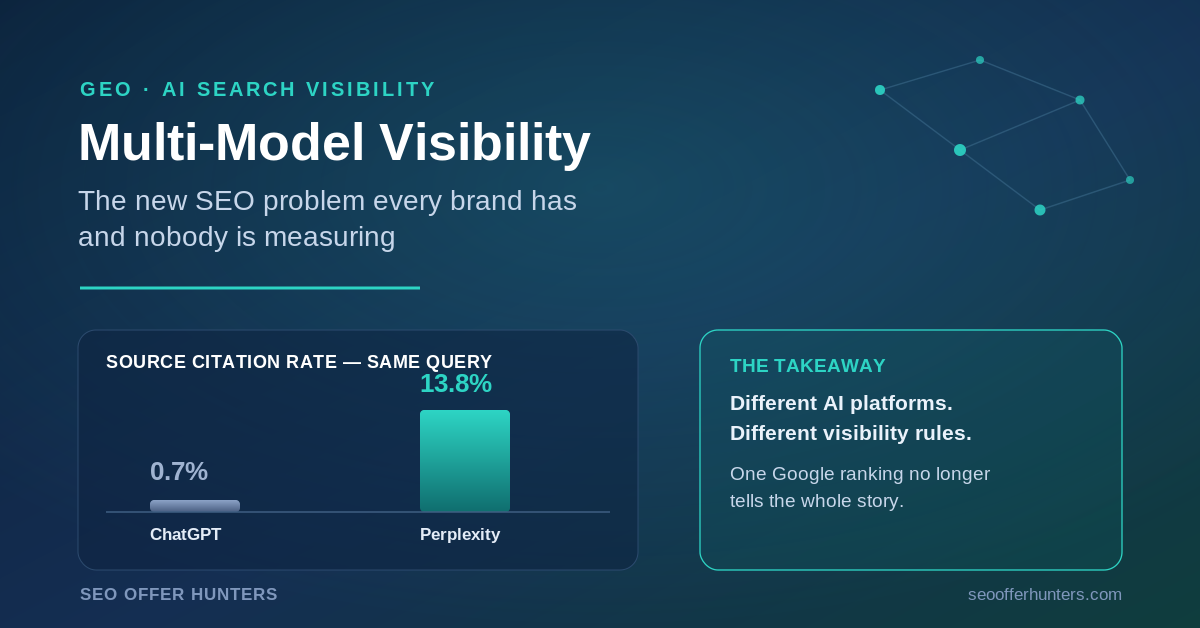
Your brand might be invisible right now, and you would never know it from your analytics. Search Console shows your rankings. Your rank tracker shows your keywords. Your traffic dashboard shows steady visits from Google. Everything looks fine. But none of these tools tell you what happens when someone asks ChatGPT, Perplexity, Gemini,… Continue reading Multi-Model Visibility: The New SEO Problem That Every Brand Has and Nobody Is Measuring
Read More
|
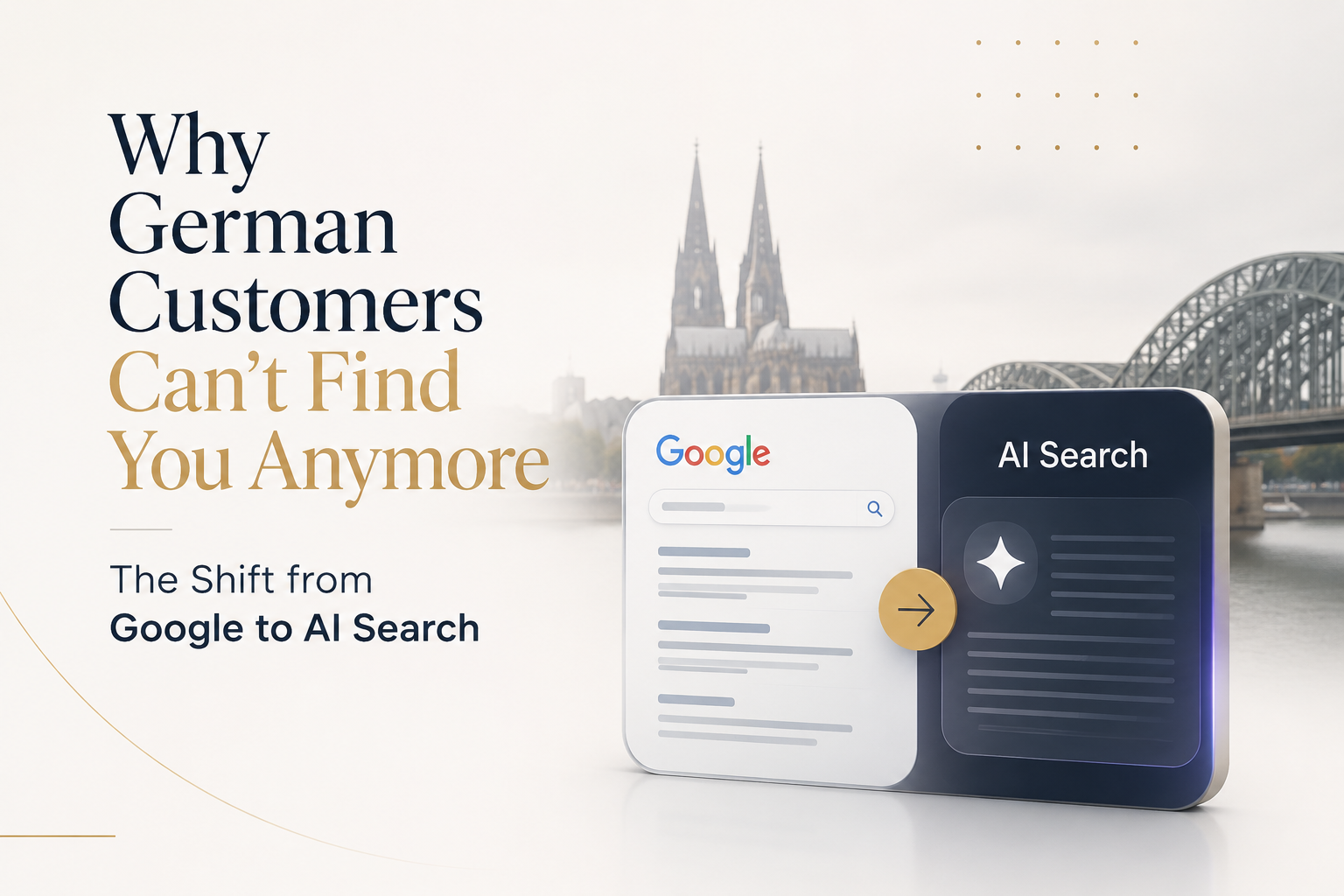
QUICK ANSWER German customers increasingly get their answers from Google AI Overviews and ChatGPT. Because of this, fewer of them ever click through to a website. Since AI Overviews launched across the DACH region in March 2025, click-through to the top organic result has dropped from roughly 27% to about 11%. Most businesses have not adjusted for this. As a result, a small number of competitors are being named directly by AI, for free, while everyone else gets nothing from that answer at all. |
Two Versions of the Same Search
Picture a customer in 2019. When she needs a local service, she starts with a Google search. She reviews the results, visits a few businesses, compares her options, and then decides which one to contact. Your website had a real chance to be seen in that process, simply by existing and ranking reasonably well.
Now picture the same customer in 2026. She opens Google, or she opens ChatGPT directly. She asks one question. Instead of ten links, she gets one written answer. That answer often names two or three specific businesses by name. She reads it, picks one, and never scrolls further. If your business was not one of the names, you were never in the running at all, even if your website is well built and technically sound.
This is not a small shift in behavior. It is a complete change in how a “search” even works. Under the old model, being present was often enough. Under the new model, being present means nothing unless an AI system also trusts you enough to say your name out loud. This article walks through why that shift happened, how to check where your own business stands today, and what actually closes the gap.
The Moment Everything Changed in Germany
This shift has a clear starting point, not a vague trend line. Google AI Overviews went live across Germany, Austria, and Switzerland in March 2025. Google AI Mode followed in Germany that October. Both replaced the traditional results page with a single generated answer for a large share of searches.
The impact shows up clearly in the data. Sistrix tracked what happened to the top organic result once an AI Overview appeared above it. Click-through fell from around 27% to approximately 11%. In other words, a page that once earned real traffic now earns less than half of it, for the exact same ranking position.
Gartner’s broader forecast lines up with this. By the end of 2026, traditional search engines are expected to lose 25% of their traffic. That share moves to conversational AI instead. This is already happening, not something still on the horizon. Every month that passes without adjusting is a month spent competing for a shrinking slice of attention, while a growing slice goes somewhere your business currently has no presence at all.
Score Yourself: Visible or Invisible?
Before reading any further, answer these five questions honestly. They take less than two minutes, and they matter more than any traditional SEO checklist right now.
- Have you personally asked ChatGPT, Gemini, or Perplexity about your own service category, in your own city, this month?
- If you did, was your business named in the answer, by name, without you prompting it?
- Does your website answer real customer questions directly, in plain language, near the top of the page?
- Is your business name, address, and phone number identical across your website, Google Business Profile, and major directories?
- Do you have any FAQ-style content that a system could lift as a clean, self-contained answer?
Each question addresses a specific visibility gap. The first two reveal whether AI systems can find and recognise your business in the first place. The third examines whether your content provides information worth citing. The fourth checks whether AI can verify your business and establish where it operates. The final question looks at how easily an AI system can extract a clear, useful answer from your page.
⚠ Warning: If you answered “no” to three or more of these, your business is very likely sitting at what this article calls “indexed but skipped.” Your website exists, but nothing about it is giving an AI system a confident reason to name you over a competitor.
How AI Actually Decides Which Business to Name
It helps to understand what is happening behind the scenes when an AI system answers a query. It is not simply repeating whichever page ranks first on Google. Instead, it weighs several signals before deciding what to say, and before deciding whether to say anything specific at all.
- Clarity: Does the page state a direct answer, or does a reader have to dig for it?
- Consistency: Do your name, address, and details match everywhere the system can check?
- Corroboration: Do other sources, such as reviews or directories, confirm what your own website claims?
- Freshness: Does the content look current, or does it read like it has not been touched in years?
When a page is weak on even one or two of these signals, many AI systems default to caution. Rather than risk naming a business it cannot confidently verify, the system simply leaves it out of the answer entirely. This is why a business can be fully indexed, technically “in Google’s system,” and still never get mentioned. The system is not being unfair. It is being cautious, and caution favors whichever competitor gave it the clearest, best-supported answer.
Three Myths Keeping German Businesses Invisible
Most business owners are not ignoring this problem on purpose. Instead, a few common assumptions are quietly keeping them stuck. Here are the three we hear most often, and what is actually true.
Myth 1: My Google ranking already protects me
This used to be true. It no longer is. A page can hold the number one organic position and still lose most of its traffic. That happens the moment an AI Overview appears above it. Ranking well is necessary, but it is no longer sufficient on its own. In fact, some of the businesses losing the most traffic right now are the ones that were previously ranking best, since they had the most to lose once the click-through rate collapsed.
Myth 2: AI search is only for younger, English-speaking users
The age gap is real. Around 87.5% of Germans aged 16 to 19 use ChatGPT, compared to about 26.6% of those over 60. However, this gap closes every year, not the other way around. There is a second, more specific issue too. German small and mid-sized businesses, often called the Mittelstand, tend to publish almost entirely in German. Meanwhile, AI training data skews heavily toward English sources. As a result, even excellent German-language content can be harder for some AI systems to surface with confidence. Waiting for the audience to “catch up” simply hands early advantage to whichever competitor addresses this gap first.
Myth 3: This is a technical problem for our developers
It rarely is. Most AI invisibility comes down to content, not code. Vague pages, inconsistent business listings, and missing FAQ sections are the real culprits. None of these require a website rebuild. They require clearer writing and better structure. A developer can rebuild your entire site and your AI visibility will not move an inch if the underlying content still fails to answer real customer questions directly.
What This Actually Costs: Two Businesses, Same City
Consider two similar service businesses operating in the same German city. Both have decent websites. Both rank reasonably well on Google. Only one of them shows up when a customer asks an AI assistant the same question.
Business A gets named directly in the AI-generated answer. The customer reads a short, accurate description, and calls that same day. Business B never appears at all. Its owner assumes their marketing “isn’t working,” without realizing the AI system simply never considered them a confident enough source.
To make this concrete, assume both businesses have an average customer value of €3,500 per year. If 100 potential customers per month ask an AI assistant about that service category nearby, and Business A converts around 15% of them because those customers arrive already primed by a trusted recommendation, the difference looks like this:
| Metric | Business A (AI-Visible) | Business B (AI-Invisible) |
| Monthly AI-referred prospects who see their name | 100 | 0 |
| Conversion rate from this channel | ~15% | N/A — never appears |
| Monthly new customers from AI search | ~15 | 0 |
| Annual revenue from this channel (€3.5k avg customer) | €630,000 | €0 |
These figures are conservative and illustrative, not a guarantee. Actual results vary by industry, region, and competition. Still, the pattern holds regardless of the exact numbers. One business captures the entire channel. The other gets nothing from it, no matter how strong its traditional Google ranking looks.
The gap also compounds over time. Once an AI system starts naming a particular business consistently, that business accumulates more reviews, more mentions, and more corroborating signals. Those signals then make the system even more confident the next time someone asks. Meanwhile, the invisible competitor stays exactly where it started. This is why closing the gap earlier costs far less effort than closing it later, after a competitor has already built months of accumulated trust with these systems.
What AI-Ready Content Actually Requires
Closing this gap does not mean starting over. It means adjusting how content gets written and organized. These are the elements that consistently separate visible businesses from invisible ones:
- Direct answers near the top: State the answer plainly in the first few sentences, before any brand story or background, so a system does not have to guess what the page is actually about.
- Specific, checkable facts: Real numbers, named locations, and concrete details give an AI system something confident to repeat, instead of vague marketing language it cannot verify.
- Consistent business details: Your name, address, and service information should match exactly everywhere it appears online, since mismatches quietly erode the confidence a system needs to name you.
- Structured FAQ content: Clear question-and-answer sections are easy for an AI system to lift and attribute to you directly, in your own words rather than a paraphrase.
- Third-party validation: Reviews, press mentions, and outside citations build the trust that pushes you from indexed to citable, because a system trusts corroborated claims far more than self-reported ones.
A German Business Owner’s 90-Day Plan
None of this needs to happen overnight, and trying to fix everything at once usually backfires. Here is a realistic sequence for closing this gap, based on what tends to work first:
- Weeks 1–2: Run the five-question self-check above across ChatGPT, Gemini, Google AI Mode, and Perplexity. Write down exactly what each one says, word for word.
- Weeks 3–6: Rewrite your highest-priority pages so they answer real customer questions directly, with specific, checkable details near the top rather than buried further down.
- Weeks 7–8: Fix inconsistent business information across your website, Google Business Profile, and major directories, since even small mismatches slow this process down.
- Weeks 9–10: Add structured FAQ content built around the exact questions your customers already ask you in person or by phone.
- Weeks 11–13: Re-test your visibility across every major AI platform. Focus next on the categories where a competitor still consistently outranks you.
This is not a one-time fix. AI systems keep reassessing which sources they trust, so this becomes an ongoing habit rather than a single project. Businesses that revisit this quarterly tend to hold their position. Businesses that treat it as a one-time task tend to slip back within a few months, once a competitor catches up.
Where This Matters Most: Local and Service Businesses
Not every business feels this shift equally. It hits hardest where customers are actively comparing options before they decide, rather than searching for one specific, already-known brand. Local and service businesses sit right in that zone. A customer searching for a plumber, a dentist, a restaurant, or a repair shop rarely already knows who they want. They are asking a question and expecting a short list of trustworthy answers.
That is exactly the kind of query an AI system now tries to answer directly, instead of handing back ten links. When it does, it can only name businesses it already trusts enough to recommend by name. If your business operates in one of these comparison-heavy categories, closing this gap is not optional in the medium term. It is the difference between being one of the names a customer hears, and never entering the conversation at all.
How AI SEO Offer Hunters Builds AI Visibility for German Businesses
At AI SEO Offer Hunters, we treat AI visibility as a structured, measurable programme. We do not offer a vague promise to “improve your online presence.” Instead, we map the exact questions your customers are asking ChatGPT, Gemini, and Google AI Mode. We then identify which businesses are already being named for those questions, and what separates their content from yours.
Because this work is market-specific, we run a dedicated AI SEO and GEO programme for businesses across Germany. It is built around how AI systems actually treat German-language content and DACH-region queries, not a generic strategy translated from an English-language market.
We track your AI recommendation frequency as a hard KPI every month, across ChatGPT, Gemini, Copilot, and Perplexity. That way, you always know exactly where you stand, instead of relying on a one-off audit that goes stale within weeks.
✦ Key Insight: Find out whether your business is currently being named by AI, or quietly skipped in favor of a competitor. AI SEO Offer Hunters provides a Free AI Visibility Check that maps your recommendation position across ChatGPT, Claude, Gemini, and Perplexity. Visit seoofferhunters.com to claim yours.
Frequently Asked Questions
Why can’t customers find my business through Google anymore?
Google AI Overviews and AI Mode now generate a direct answer above the traditional results for many searches. Customers increasingly stop there instead of clicking through. If your business isn’t named in that answer, a well-ranked page can still see far less traffic than before, even though nothing about the page itself has changed.
When did AI Overviews and AI Mode launch in Germany?
Google AI Overviews went live across the DACH region, covering Germany, Austria, and Switzerland, in March 2025. Google AI Mode followed specifically in Germany that October, extending the same shift to an even larger share of everyday searches.
Is my Google ranking still worth anything?
Yes, but it is no longer enough on its own. A page can rank first on Google and still lose most of its clicks once an AI Overview appears above it. Ranking well is necessary, but not sufficient anymore, since visibility inside the AI answer itself now matters just as much.
How much has click-through actually dropped in Germany?
Sistrix data shows the click-through rate on the top organic result falling from around 27% to approximately 11% once an AI Overview appears above it. That is a drop of more than half for the same ranking position, which is why so many businesses feel like their SEO “stopped working” even though nothing broke.
Are German businesses more exposed to this shift than other markets?
In some respects, yes. German small and mid-sized businesses, often called the Mittelstand, tend to publish primarily in German. Meanwhile, AI training data skews toward English-language sources, which can make even strong German content harder for some systems to surface confidently.
Do older customers in Germany still rely on traditional search?
AI adoption in Germany is currently uneven by age, with about 87.5% of 16–19 year-olds using ChatGPT versus roughly 26.6% of those over 60. This gap is closing over time, so it is not a reason to delay preparing for it.
Is fixing this a technical job for developers?
Usually not. Most AI invisibility comes down to content and structure rather than code. Clearer answers, consistent business listings, and FAQ sections typically matter far more than any technical rebuild, and most of these fixes can start without touching the site’s backend at all.
How do I know if my business is currently AI-visible?
Ask your own core service question, in your own city, directly to ChatGPT, Gemini, Google AI Mode, and Perplexity. If your business is never named, it is likely indexed but skipped rather than genuinely invisible, which is a fixable, specific problem rather than a mystery.
What is the fastest first step to improve AI visibility?
Start with the five-question self-check covered in this article, then rewrite your highest-priority page so it directly answers a real customer question within the first few sentences, before any brand story or background information.
How can I get a full picture of my AI visibility in Germany?
AI SEO Offer Hunters offers a free AI Visibility Check that tests your business across ChatGPT, Claude, Gemini, and Perplexity, and shows exactly where you stand against competitors in your market, city by city.
— Published by AI SEO Offer Hunters | seoofferhunters.com